Friday, April 8, 2022

Friday Funnies

This is very good great advice for any time of year.
As many regular readers of this blog well know, we always practice that motto whenever possible on our road travels and closer to home.
The Nashua, NH, weekend weather is forecast to be wet and rainy, so any enjoyment may be at home. We will be attending an indoor classical musical performance at a local church, a calm way to spend Palm Sunday afternoon.

Enjoy Your Weekend, Everyone.
Find some calm & enjoyment however possible 

Thursday, April 7, 2022

So Now I Know (Again)

There's way too many things I've read about/learned recently, some interesting and useful, others not so much. Whenever I go online looking for something, that path veers way off

Maybe, you know exactly how that goes. Especially the past couple of years (just saying)

As most of you know by now, I like to share finds, whether new to me or not. This post contains some of those.

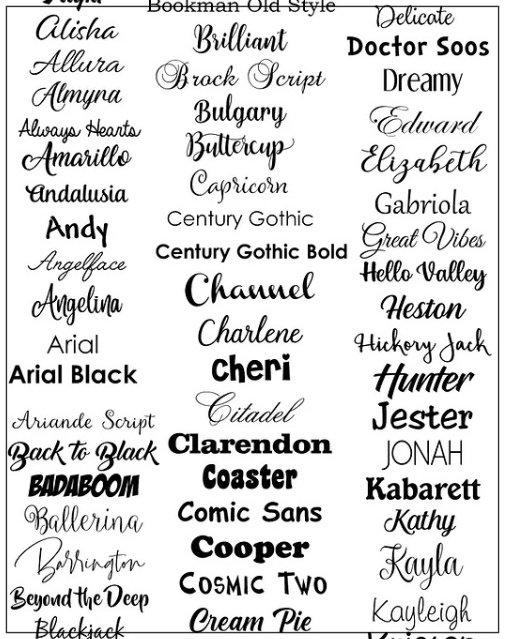
Some fonts are ink guzzlers . . .
OK, so that's nothing new and everyone who has ever printed something and is reading this post, already knows that the bigger and bolder the font, the more ink it will use and will not be the cheapest print choice. And, like with most things, size matters as well. The larger the font size, the more ink it uses and the more to be bought.

Surprisingly, one of the most popularly used fonts, which isn't the biggest or boldest in the group, is one of the biggest ink hogs — Arial. This font reportedly uses as much as 30% more ink than similar ones. That means that if it's a favorite of yours, you could be restocking ink cartridges or refills more often.

But there's workarounds and selecting another font can help, another long-time favorite—Times Roman, is reportedly more economical with ink use thanks to its thinner letters. If you're not a fan of this font, there's other choices — Calibri or Century Gothic are possible substitutes. 

Another way to select ink-saving fonts is to use ones labeled — Thin, Condensed or Narrow. It's a tip-off that since strokes are thinner, the font will use less ink; Helvetica Condensed uses less ink than standard Helvetica.

Studies by printing professionals (yes, there are such groups) have shown that the fonts named above use up to  30% less ink than Arial. Not only that, but they have been labelled as among the most ink efficient fonts. This example ↓ shows all three fonts at the identical point size. (In typography, the point is the smallest unit of measure used for measuring font size, leading, and other items on a printed page.)
Times New Roman is a serif typeface commissioned in 1931 by the British newspaper The Times and conceived by typographer Stanley Morison. It's become one of the most popular typefaces ever created. It's a default font installed on nearly all desktop computers. The Times used it for 40 years until 2004 when new production techniques and a format change from broadsheet to tabloid caused it to switch typeface several times. But, all those changes have been variants of the original New Roman typeface.

Century Gothic is a sans serif font created in 1991 for monotype imaging. Century Gothic is neat and readable. It's widely used for print material and headlines as it can be read from a distance and has delivered a 31 percent savings in printing costs over Arial. 

Calibri is a digital sans-serif typeface family in the modern style designed by Dutch type designer Lucas de Groot, and released to the public with Microsoft Office 2007.

And now, the next topic is decluttering.
But not in the usual way of thinking about getting rid of stuff, like I've been doing in recent weeks. Those boxes of stuff in the photo → were taken to a local thrift center last week. What helped with this process was following the process that once something went into the box and the box was filled, nothing came out, and the box was taped — out of sight, mind, and apt.

And, the same way that decluttering works for ridding us of physical things, like household items, it can also work for our minds. Mental decluttering is what older adults, aged 60 to 85 years of age need to do often according to recent research studies read about online. Cluttered minds are found to be common among older adults with a lot of accumulated life experiences, but don't we all? 

Why? 
Because, according to several studies, folks in this age group process and store too much information in their brains. This can lead to cluttering the memory with facts that are no longer needed, knowledge from years ago, creating distractions. The researchers found that overloaded memory can impair recall in older adults and account for age differences in memory tests.

By whatever name it's called, memory, mind or brain clutter. There are pros and cons.

What's a downside of remembering too much?
If what you want to remember is bound up with too much information this can slow down your memory processes. For example, if a place/person changes an address, older people can often recall older details. By comparison, younger folks suppress old information and replace it. Older brains can have a harder time doing so even when information is no longer useful. A lifetime of accumulated information and knowledge can lead to memory errors or reduced attention to detail. Aging also comes with reduced attention to detail as older adults can be distracted by competing thoughts when trying to remember something.

There's an upside to mind clutter.
Cluttered memory can be beneficial and knowledge retention helpful in what's called enriched memory. Decision making can also benefit from accumulated memory when older people are in positions where important decisions are needed. Accumulated memory and knowledge can help what seems like stored obsolete information is accessed to help with tasks that require creativity.

How to keep our brains healthy. 
It's as easy as staying physically active, still considered the best way to improve cognitive health as we age. Exercise is associated with brain health, including better blood flow to areas involved in cognitive tasks. 

Researchers who studied the effects of exercise on thinking ability in those over 50 including memory, alertness and ability to quickly process information found that physical activity improved all these skills — 40 to 60 minutes of moderate exercise as many days as possible. 

A 2020 study showed that a simple exercise, walking, could slow brain aging by up to 4 years. Previous studies showed it was an average of 10 years, but that required doing moderate to heavy exercise. 

Regular exercise I can manage by visits to the in-house gym here, heavier stuff not so much.

For those averse to or who can't exercise, the good news is that there's other options to keep the brain healthy and working well. It's sort of like flossing to maintain dental health, only it is brain flossing. Staying mentally active, trying new things, and being in mind-stimulating environments — as easy as taking a class, playing games, solving puzzles. That's why we're going to keep playing dominoes weekly.

That's enough this 'n that for now.  I'm going to watch some YouTube videos to learn a lot that's new to me — doesn't everyone do that?

Monday, April 4, 2022

Birthday Time!

Today, is my younger brother Anthony's birthday, my lone sibling. It doesn't matter that we are now both firmly in the age category of seniors, he will always be my little brother.

I've read that as siblings age, bonding can actually make a difference in their well being. According to researchers, their spirits are higher.

Tony as he prefers to be called now is younger than myself by 3 years, which will always make him my younger brother. He lives in NJ and while we didn't celebrate in person, as years ago, we talk today as we do quite often. As the remaining family members on our side of the family, it's important to keep in contact, even when we can't do so in person.

The research also revealed that the supportive benefits of these relationships weren't dependent on how often siblings interacted. What mattered most was just their existence and availability.
We talked about how many years ago, a birthday was the cause for extended family to gather and celebrate. Back then, they didn't live great distances apart as well. 

The top half of the above collage shows Anthony (Tony) the birthday boy in the center. Our oldest cousin is on the left and that's me on the right. The bottom part of the collage shows our maternal grandparents, aunt and uncle, and assorted cousins, our mother on the right and the photographer was our father (not shown). Sadly, all the adults in the photo are long deceased.

The relationship between siblings has been described as life's longest one and, for many, lasts longer than the bond with parents and often grows stronger when both parents are gone. Personally speaking, this has been the case with my brother and myself.

These images show another birthday celebration in our home years later. That sure was a large birthday cake being enjoyed by my family of four and most likely for several days. My brother's birthday sometimes coincided with the Easter holiday, but both events were always celebrated.

After my mother's passing, I sadly learned that she had several miscarriages before the birth of my brother. These were never mentioned. Learning this bit of undisclosed family history later in life made me even more thankful for my sibling. It's especially wonderful to wish him all the best on his Special Day and always — even if from a distance.

Hopefully, some fellow bloggers also have the same opportunity with their families; Unlike myself, Grenville was an only child.
🎊 Happy 🎂 Birthday, Tony 🎉

Friday, April 1, 2022

Friday Funnies

No Fooling today . . . here's some truth in package labelling and there's more too !
Because, why would anyone want artificial almonds in a breakfast cereal? The only fake almonds I found online were not the edible type (no fooling). It's always amazes me that things like this are not made up. Funnies are all around.

As most know, today, April Fools' Day/April Fool's Day (depending on which style guide you consult) is an annual custom at the start of April, marked by practical jokes and hoaxes, and pranksters shouting April Fools! 

Sadly, mass media (and advertisers too) can be involved in these pranks. This now infamous story has been widely repeated before, including by myself. Being of Italian descent, it's always made me laugh. Grenville told me his father had his mother believing it to be true.

One of the most famous pranks is the BBC’s “spaghetti harvest” segment in 1957 on the BBC current affairs program, Panorama. A news broadcaster told his British audience that Ticino, a Swiss region near the Italian border, had had “an exceptionally heavy spaghetti crop” that year. The camera cut to footage of people picking spaghetti from trees and bushes, then sitting down to eat some “real, home-grown spaghetti.”
Back then, pasta was not widely eaten in the UK. Some Britons were unaware spaghetti is pasta made from wheat flour and water. Viewers phoned the BBC, some to comment that the story was false, others asked how to grow a spaghetti tree. CNN has reportedly called it the biggest hoax that any reputable news establishment ever pulled.

However, April 1 goes for you, hopefully it's not on the receiving end of any pranks. In recent weeks, humor has been in short supply worldwide. Take time to laugh. It's good for you

Enjoy Your Weekend, Everyone
Mid-50s daytime on the weekend; 30s overnight; no Spring here 

Wednesday, March 30, 2022

GA Coke & Fried Chicken

Did you know that Atlanta is not only the capital city of Georgia GA and the state's most populated city, but it's also the home of Coca-Cola?
The World of Coke Museum, cousin Kathie and Us (Atlanta, GA)
The company's headquarters are on Pemberton Place which is a few blocks from its museum dedicated to the popular soft drink and called, no surprise, The World of Coca-Cola. On our February road trip we visited it when we spent time in GA to see my cousin. The museum, which showcases the history of the Coca-Cola Company, opened in May 2007 and replaced a previous exhibit space founded in 1990 in the former Underground Atlanta. We went on a very crowded Sunday and admission is charged: adults $18, seniors $16; youth to age 12 $14, toddlers free with paid adult admission; veterans Free. 

Dr. John Pemberton
The location is named in honor of  Dr. John Pemberton, recognized as the inventor of Coca-Cola. Pemberton created the original Coca-Cola formula in 1885 in a large kettle, which is featured in a museum exhibit. His creation contained cocaine—in the form of an extract of the coca leaf. This led to the “Coca” part of the beverage’s name. The “Cola” in the name comes from the kola nut, which contained caffeine, another stimulant. At the time of Pemberton's creation, cocaine was legal and a common ingredient in medicines, considered as not harmful when consumed in small doses.

Pemberton, a doctor and pharmacist, was also a Confederate army veteran who suffered a saber wound in 1865 at the Battle of Columbus (GA) in the final month of the Civil War. After experimenting with pain relief, he became addicted to painkillers, mainly morphine and began seeking a cure for his addiction. In 1866, he began experimenting with painkillers that would be morphine-free alternatives drawing on his study of herbal medicine, he often used plants substances in his formulas.

Pemberton's French Wine Cola Ad
After experimenting with coca and coca wines, he developed a recipe called Pemberton’s French Wine Coca advertised as a nerve tonic cure-all. The product was an alcoholic beverage, mixed with coca, kola nut, and a wild shrub, damiana. It included extracts from coca leaves in a limited amount, not enough to cause cocaine addiction. (The use of coca leaves was later removed from the formula.) In the nineteenth century, patent medicines were unregulated, unlike today. Health benefits could be claimed without proving effectiveness or dangers.

The remedy was sold as a cure for depression and anxiety, especially for women. Because it included alcohol, an issue arose when the city of Atlanta introduced alcohol prohibition in 1886 which also disallowed the sale of wine. 

Early Coca-Cola Ad
Pemberton had to create a non-alcoholic and new version of the popular product. He worked on creating on a formula that would appeal to a wider group of people. The wine was removed as he created a sweetening syrup from the coca leaf and kola nut and dropped any alcohol reference. Pemberton called his formula the ideal temperance drink, both on the label and in advertising.

The product's name was coined by Frank Mason Robinson, Pemberton’s bookkeeper, from the two main ingredients. Robinson, who recognized that the two curly ‘C’s would look great in advertising, hand lettered a banner in the curved flowing script that remains one of the most recognizable and famous logos in the world even now. 

In 1886, Pemberton took the syrup to Jacob's Pharmacy, a popular Atlanta soda fountain, for tasting. In summer months and in hot southern towns, the local pharmacy soda fountain was a time-honored and well-known American institution. 
Jacob's Pharmacy, Atlanta, GA, circa 1886 (now demolished)
At the pharmacy, Pemberton's syrup was added to carbonated water thought to be very good for one's health and often used in popular “cure-all” mixtures. The combination was sampled by customers who praised the drink and called it, excellent
Vintage Coca-Cola advertising
As with his previous formula, Pemberton's new product was labelled as a cure-all and was described as a valuable brain tonic to help nervous issues, headaches, hysteria, depression and as a general stimulant and health booster. The new drink was also said to stimulate students and all brain workers and advertised as Delicious and Refreshing, a theme continued in later years. It was initially sold only in pharmacies and a soda fountain glass cost five cents. 
Early Coca-Cola Soda Fountain Ad

Pemberton advertised heavily, using banners, newspaper advertisements and hand-painted oilcloth signs on store front awnings. He added the word, drink, to let people know that the new beverage was a soda fountain refreshment.  On May 29, 1886, the first Coca-Cola newspaper ad appeared in The Atlanta Journal, inviting thirsty citizens to try the new soda fountain drink. Despite initial praise, the new drink was not an immediate hit and averaged less than 10 sales a day the first year. 

This lack of sales is possibly what led Pemberton to sell a majority of his business to various business partners before his death, including fellow pharmacist Asa G. Candler who purchased the recipe for $1,750 in 1887. 

After buying the rights to Coca Cola from Pemberton, Candler launched a new marketing campaign for the beverage. Under Candler’s management, distribution expanded to soda fountains beyond the Atlanta area. In 1892, he established the Coca-Cola Company and began large scale production in 1899 as a soft drink, bottled and canned it for retail sale.

Sadly, Pemberton didn't live to see the widespread success of his formula. He died in 1888 at age 57 in from stomach cancer. A skilled pharmacist and chemist, he was active in medical reform and a respected member of the state’s medical establishment. On the day of his funeral, sales of Coca-Cola were suspended for the day as city pharmacists closed their shops in tribute to one of their own and attended the funeral services. Candler served as one of the gentleman pallbearers. Pemberton's laboratories remain in operation 125 years later as part of the Georgia Department of Agriculture.
Vintage Coca-Cola Advertisements
Three years after Pemberton’s death, Candler bought up all the interests in Coca-Cola for a total investment of $2,300. In 1919, the Candler family sold the company for $25 million to a group of investors who expanded it into a global enterprise. Candler also served as the 41st mayor of Atlanta from 1916 to 1919.

What began as a health tonic in 1886 was being sold in every U.S. state by 1900. The company now sells an estimated 1.9 billion bottles per day in over 200 countries making the Coca-Cola Company among the most widely recognized consumer products worldwide. The secret formula for Pemberton’s invention was kept in a SunTrust bank vault since 1925. In late 2011, it was moved to a vault that's now part of the Coca-Cola museum. 
Coca-Cola Ads from 1940s
The logo that remains one of the most recognizable and famous ones in the world was created using Spencerian script, a standard writing script for American business correspondence from 1850 to 1925. After that, widespread popularity of the typewriter obsoleted it as a prime method of business communication. (Other product name logos recognizable in Spencerian script are those for the Ford Motor Company and Kellog's.)
Coca-Cola Ad from 1942
Coca-Cola preceded the soft drink, Pepsi-Cola, by just a few years. While Pemberton created Coca Cola in 1886, the first Pepsi-Cola was created in 1893, also by a pharmacist, Caleb Bradham, in New Bern, NC. Bradham created a formula to duplicate the success of Coca-Cola and sold it under the name "Brad's Drink." Seeking a better name, Bradham bought the name "Pep Kola" from a local competitor changing it to Pepsi-Cola. Pepsi is taken from pepsin, a digestive enzyme used in Bradham's original formula. Introduced in 1898, its name implied its origin as a health tonic and the drink proved popular. In 1902, Bradham incorporated the Pepsi-Cola Company. And, just as Coca-Cola no longer contains cocaine, Pepsi-Cola no longer has pepsin as an ingredient.
Mary Mac's Tea Room, Atlanta, GA
If Coca-Cola is Atlanta's most iconic drink, fried chicken is one of its best-known foods, and one of the best places to eat it is at Mary Mac’s on Ponce De Leon Ave. It's been named Atlanta's Dining Room and has been recognized as an iconic Atlanta institution.

There’s nothing in Atlanta quite like it. The surroundings are comforting and the food is classic Southern cooking.

Mary Mac’s always draws a crowd of hungry diners. There's usually a waiting line on weekends. My cousin advised we get there early to avoid the surge of diners after Sunday services. She was right. There was no waiting line when we arrived before noon, but a lengthy waiting line by the time we exited.

Mary Mac's was just one of 16 tea rooms that populated Atlanta in the 1940s and has remained in the same location since opened by Mary MacKenzie in 1945. After WW II ended, women established restaurants all over Atlanta. Back then, a woman couldn’t simply up a restaurant, especially in the South, so many female proprietors used the more refined Southern name, “tea room.” Mary Mac’s Tea Room (originally Mrs. Fuller’s Tea Room) seated 75 guests in one dining room. Today, it's the only original tea room still in operation with six dining rooms and is one of the city’s five-largest restaurants.

Mary MacKenzie (L) & Margaret Lupo (R)
Mary MacKenzie ran the tea room from 1945 to 1962 when one of her employees, Margaret
Lupo, became the new owner. Lupo turned heads for making her dining room unsegregated because as she said, You were all equal folk at the table. In 1992, after 30 years, Lupo was ready to quit the business. She reportedly trained its next owner, John Ferrell, for 18 months before feeling OK with him owning it. Ferrell ran the business until March 2020 when, in the wake of COVID-19, he closed the restaurant for the safety of staff and guests.
 
Mary Mac’s remained closed for most of its 75th year in business, then Harold Martin purchased the restaurant and ensured it could re-open with stricter safety and sanitary measures. Martin kept all 100+ employees on staff and didn't change anything about the restaurant or its menu, which has mostly remained original to 1945. Kitchen technology has advanced, but Mary Mac’s Tea Room still does everything in-house – down to shucking bushels of corn and snapping fresh green beans by hand. Every morning, breads and desserts, like old fashioned banana pudding and fresh Georgia peach cobbler are baked in house and Table Wine of the South, otherwise known as sweet tea, is brewed.
Grenville & Mary Mac's Fried Chicken
Of course, we had to order the crispy fried chicken. The menu also includes over 30 fresh vegetables, including fried green tomatoes, which my cousin ordered. Many recipes were documented by former owner Margaret Lupo in the 1960s. Others have been passed down from family members over the years.

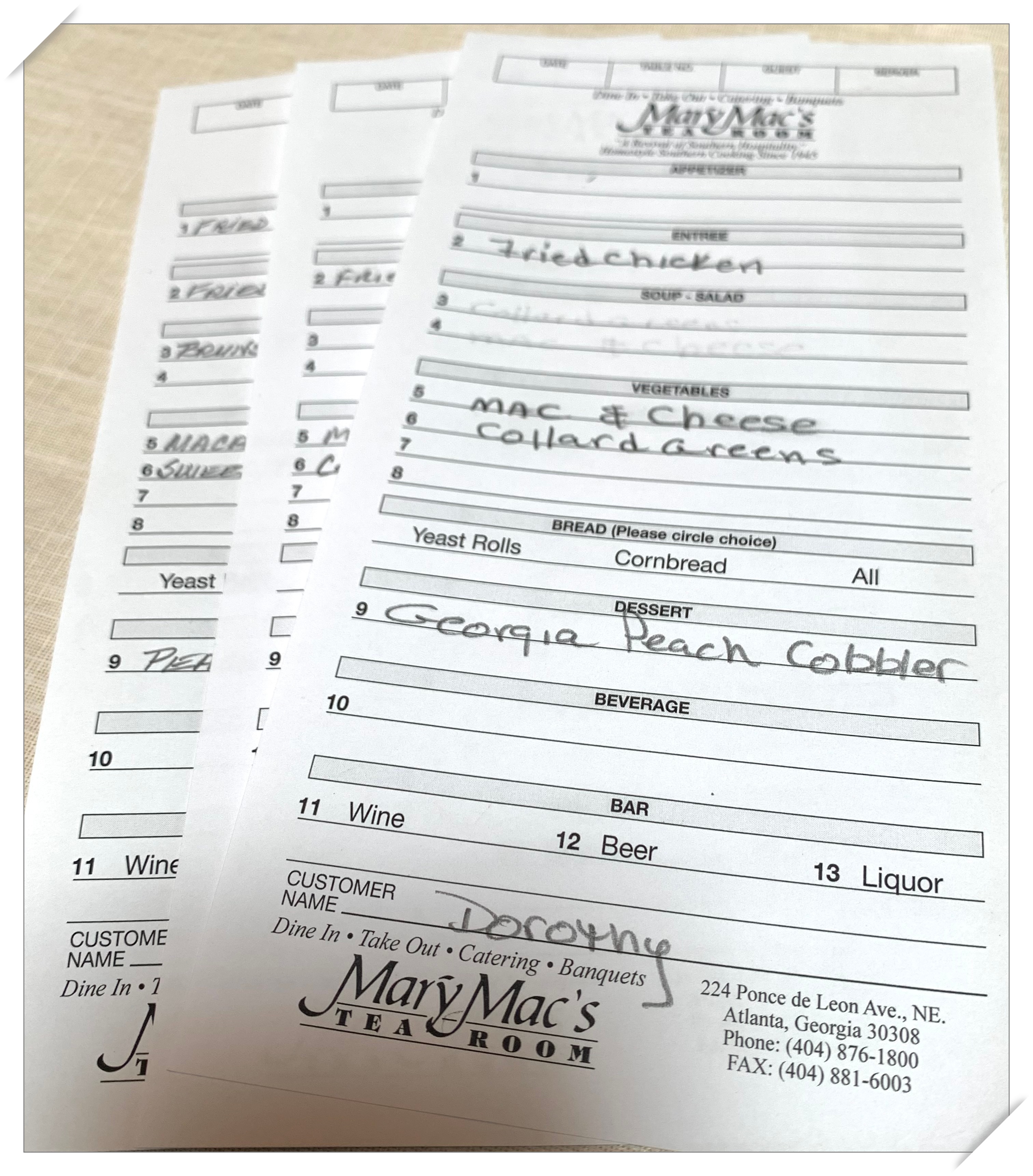
Mary Mac's table order forms
Traditions are important here. Some remain for sentimental reasons, others are kept because they continue to work. Food orders are placed with pencils and order forms at each table. A complimentary cup of pot likker and cracklin' cornbread muffin are served to first-time diners, which we enjoyed. (For non-southerners, pot likker is the salty and porky broth left after cooking collard greens. Cracklin’ cornbread is cornbread with crispy pork skins baked in.)

Much like the food, there's no secret special sauce that makes Mary Mac’s Tea Room such an iconic Atlanta institution. This establishment paints a more vivid picture of Atlanta than any museum or historical site ever could. Once again, if it ain’t broke, don’t fix it.

The walls are covered with pictures of famous visitors over the years, including Dalai Lama, Congressman John Lewis, James Brown, Beyonce, Senator Hillary Clinton, country singer Alan Jackson and President Jimmy Carter.
You don't have to be famous to dine at Mary Mac's tea Room, just come hungry, and be prepared to wait if you're not early enough. Trust us, it was worth the wait.

Full disclosure: Grenville and myself are not soda drinkers, except for an occasional Dr. Pepper (whoops, PepsiCo product). Touring the museum was a one-off, been there, done that experience. As for the best fried chicken, while many folks have favorites, our vote would go to the former Tammy & Johnny's in Melfa, VA.

This is the final post on our February road trip to FL and places in between. Next week is a return to posts about places closer to home and random posts of nonsense.

Friday, March 25, 2022

Friday Funnies

Topsy-Turvey, as with similar phrases like upside-down, refers to the top and bottom being interchanged from their usual places. Topsy is an allusion to top, but turvy isn't as easy to interpret. There's no certain definition, but it possible that the term derives from an old expression top-over-terve meaning to topple-over. 
This topsy-turvey image isn't from a disaster destroyed building. While it looks like a mansion that's upside-down in the middle of the block on International Drive, the main tourist drag in Orlando, FL.

How did this happen— Get ready for some make-believe
Professor Wonder was working in a top-secret laboratory in the mysterious Bermuda triangle trying to harness a tornado's power when the wind grew stronger than expected. The tornado's power ripped the building from its foundation carrying the lab miles away where it landed upside down and all exhibits remained intact. The former laboratory is now called WonderWorks, a combination science-focused indoor amusement park and children's museum. There are four floors of exhibits in a 35,000 square feet experience labelled edu-tainment, a combination of education and entertainment with over 100 interactive exhibits.

OK, so that's just a fanciful story spun by marketeers, here's the real behind-the-scenes story.

WonderWorks was created in 1998 by Florida attorney John Morgan, founder of mega-law firm Morgan & Morgan, known as America's Largest Personal Injury Law Firm headquartered (where else?) in Orlando. Morgan who worked in attractions during college claims that this experience provided insight to develop a successful and original theme park. 

It seems he was right as the flagship Orlando location has been going strong for 22 years. Now, WonderWorks is become a national chain with upside-down mansions in Panama City Beach, FL, Myrtle Beach, SC, Syracuse, NY, Pigeon Forge, TN and Branson, MO. 
If you ever plan to visit, know that the experience can be is costly, currently at $34.99 adults, $25.99 kids (under 3) and seniors. There's lots of time to explore, 9 am to midnight, 365 days. 

And, don't be concerned about walking through the upside down building. Everything is upside down at entry, after admission is paid, a walk through the Inversion Tunnel turns everything right side up again.

No, we didn't enter WonderWorks attraction on our February road trip, while many did, others simply took exterior photos like myself. It was a lot less costly too.

Enjoy Your Weekend, Everyone
Rainy Saturday forecast and sunshine Sunday

Tuesday, March 22, 2022

Perils of Periodontitis

Yes, the title is quite a mouthful (no pun intended). That's because periodontitis is neither a pleasant term to hear or to read about. It's even more unpleasant to experience this serious gum infection. 

I speak from first hand experience, which is the reason for this post.

Thanks for the well wishes in your comments after I posted last week about my then upcoming dental procedure. It's over with a couple of follow up visits starting this week. (No surgery details or photos are in this post.) All illustrations are from online sources.

If left untreated, periodontitis is a serious gum infection that can lead to tooth loss and serious health issues. It damages soft tissue and can destroy bone that supports the teeth which then leads to tooth loss.
Gingivitis is a gum disease that's a milder stage of periodontitis. Gingivitis often results in reddened or swollen gums and bleeding when brushing or eating. 

Both infections are the body’s response to bacteria that accumulates on teeth. In the long term, this bacteria forms plaque, which hardens to tartar (or calculus). When tartar build-ups below the gum line, teeth are harder to clean, leading to spaces around the teeth under the gum line. 

It's these spaces, known as pocketing, that have always been a problem for myself. In my case, an underlying cause may be heredity as not only did my late mother have dental issues, but so does my brother.

If your dental visits are like mine, they include periodontal charting, a process that measures the distance between the gums and where they attach to the teeth. The higher the number, the higher the chance of infection and if pockets fill with bacteria, this can lead to periodontitis

That's what happened with myself. Unfortunately, periodontal disease is mostly seen in adults.

According to the Centers for Disease Control and Prevention (CDC), almost half of U.S. adults have some degree of gum disease and it increases with age. By age 65, 1 in 4 adults have serious gum disease. Estimates from the U.S. Department of Health and Human Services are that 1 in 7 adults between 35 and 44 years old have some form of gum disease from gingivitis to severe periodontitis. 

Gum disease is has been linked to other conditions including heart disease and stroke in older adults. 
Researchers have also linked periodontal disease with an increased buildup of beta-amyloid in the brain, which is the neurological hallmark of Alzheimer’s disease. 

Factors that increase the risk for periodontal disease include smoking, diabetes, poor oral hygiene, stress, heredity, crooked teeth, and underlying immuno-deficiencies.

Bacteria in the gums can enter the blood supply and move to other parts of the body like the heart and possibly cause inflammation and damage in the cardiovascular system. That said, not everyone with heart disease has had gum disease, and not everyone with gum disease has a diagnosis of heart disease.

The severity of periodontitis disease determines its treatment with the goal being to bring the infection under control and prevent further damage. Options include:

Medications (antibiotics or antimicrobialto reduce the size of gum pockets in the form of mouthrinse, gel, pills, or particles that a dentist places directly in the infected area.

Scaling and root planning for less severe cases. This deep-cleaning method removes bacteria from around the gum line and tooth root.

Surgery when inflammation persists in sites inaccessible to brushing and flossing. Flap surgery cleans deposits under the gums. Gum or bone graft surgery grafts tissue or bone from another part of the mouth onto the damaged part of the gum.

My procedure was flap surgery done under local anesthesia to numb the gums which are then lifted up and roots of the teeth cleaned. Then, the gums were stitched back into place. I am so grateful not to have seen or felt anything during the procedure, novocaine is a great thing.

My periodontist took time to detail the procedure and the follow-up care needed afterwards. Start to finish, the process took about 1-1/2 hours and I went home afterwards. I received a pain medication prescription, but over the counter pain relievers worked as did an ice pack. Grenville also was most attentive. We did have ice cream, which was one of the soft foods recommended after surgery. Not that we needed any excuse for a treat!

Sutures come out this week. Complete healing will take 2-3 full weeks with procedures to be followed, last checkup in several weeks. Hopefully, there will not be a repeat procedure needed anytime. 

This was a very longish post on a rather different topic compared to what's going on worldwide. For myself, blog posts tend to be more personal with topics selected from personal experience and some may also have a widened scope. In doing online research for this post, it was eye-opening to read the statistics of those also affected and possible health issues if left untreated.

Your turn — Anyone else faced a similar situation in the past (or now)? 
If so, hopefully your outcome was (or will be) a good one as well.

Friday, March 18, 2022

Friday Funnies

Not all lunch fights take place in school cafeterias. On the day we visited, these pelicans were scrabbling over rights to fish scraps tossed from a fishing boat in Destin, FL.
One pelican seemed completely disinterested in the food tug-of-war, and wasn't the only one. 
Perhaps, wanting a closer view, this great blue heron watched from onboard the boat.

Your turn — did you ever have a food fight at school? At my school, we dared not even consider it. The nuns would have reprimanded sternly, knowing that was enough of a deterrent.

Enjoy Your Weekend, Everyone
There's a big library book sale here this weekend

Wednesday, March 16, 2022

Standing By This Week

Glad to read all your comments in my recent blog posts about our visit to Covington, GA, which in recent years has been called The Hollywood of the South™️ and Nashua's unpredictable weather.

The snowfall just a week ago is all gone. The snowy a.m. scenes taken last Thursday were beautiful for the very short time they lasted. Since then, the forecast has been much better.
The forecast since then has been much better. As shown above, the mid-week forecast is for rain over the next week, and with a definite warming trend.

Posting this week is taking a back seat to some other matters that involve house chores (lots of decluttering projects) and my least favorite appointment, a periodontal 🦷 procedure, involving surgery. The upside is that afterwards it was recommended nothing be done the rest of today. Of course, I will be heeding that great medical advice by taking it easy the rest of the day. Grenville is on dinner duty and has insisted that I stay out of his kitchen today — no problem there.

Hope all is good with everyone whatever you have been doing this week, and I will catch up with your recent posts. I'm planning a new Friday Funny to end the week before posting one more next week from our recent GA visit. 

See you later.

Friday, March 11, 2022

Friday Funnies

Mother Nature played the trickster this week.
Spring isn't exactly around the corner despite what the calendar shows. After a week of moderate tempss, including a nearly 65-degree day last Sunday, we had snow this week.
It wasn't a heavy snow, but a very pretty one as trees were snow-covered early Thursday morning. By late morning, the snow was history as temps climbed to near 50 degrees.
This weekend's forecast is rain mixing with ❄️ Saturday with an inch accumulation expected. 

In NH, we'll Spring forward this weekend. Daylight saving time will begin at 2:00 a.m. on Sunday, March 13, no fooling (that comes next month)!

Enjoy Your Weekend, Everyone