Wednesday, September 11, 2024
When Doves Gather
Wednesday, July 30, 2014
Feed Me!
House sparrows are more closely associated with humans than any other established North American wild bird. There are about three dozen species of sparrows in North America. The species was introduced to New York City in 1851 when NYC faced a serious problem. The snow-white linden moth was devouring fruit trees and leafy elms. City officials hoped the sparrows would devour the moth larvae and they did.
But, there's is a similarity between the fictional Audrey and sparrows — a non-stop appetite. After eating moth larvae, sparrows devoured vital crops, stole the nests of native birds, and flourished in urban habitats by killing off weaker species — in short, they were predators, especially targeting bluebirds. By the 1980's, America’s indigenous bluebird population was in steep decline. It has since been coming back.
Sparrows flourish in large cities and country settings, and can often displace other birds from nest boxes, (I'm unsure if that happened here.) This sparrow family occupied half of a two-nesting birdhouse, which must have been tight quarters.
This duo kept the mother and father sparrow quite busy every 5-10 minutes. Although they are primarily seed-eaters, sparrows also eat small insects and considerable supplies are required to feed the young ones.
Another similarity to Audrey . . . Come on back and feed
How about you — birdhouses or not?
Thursday, July 17, 2014
Broken Home
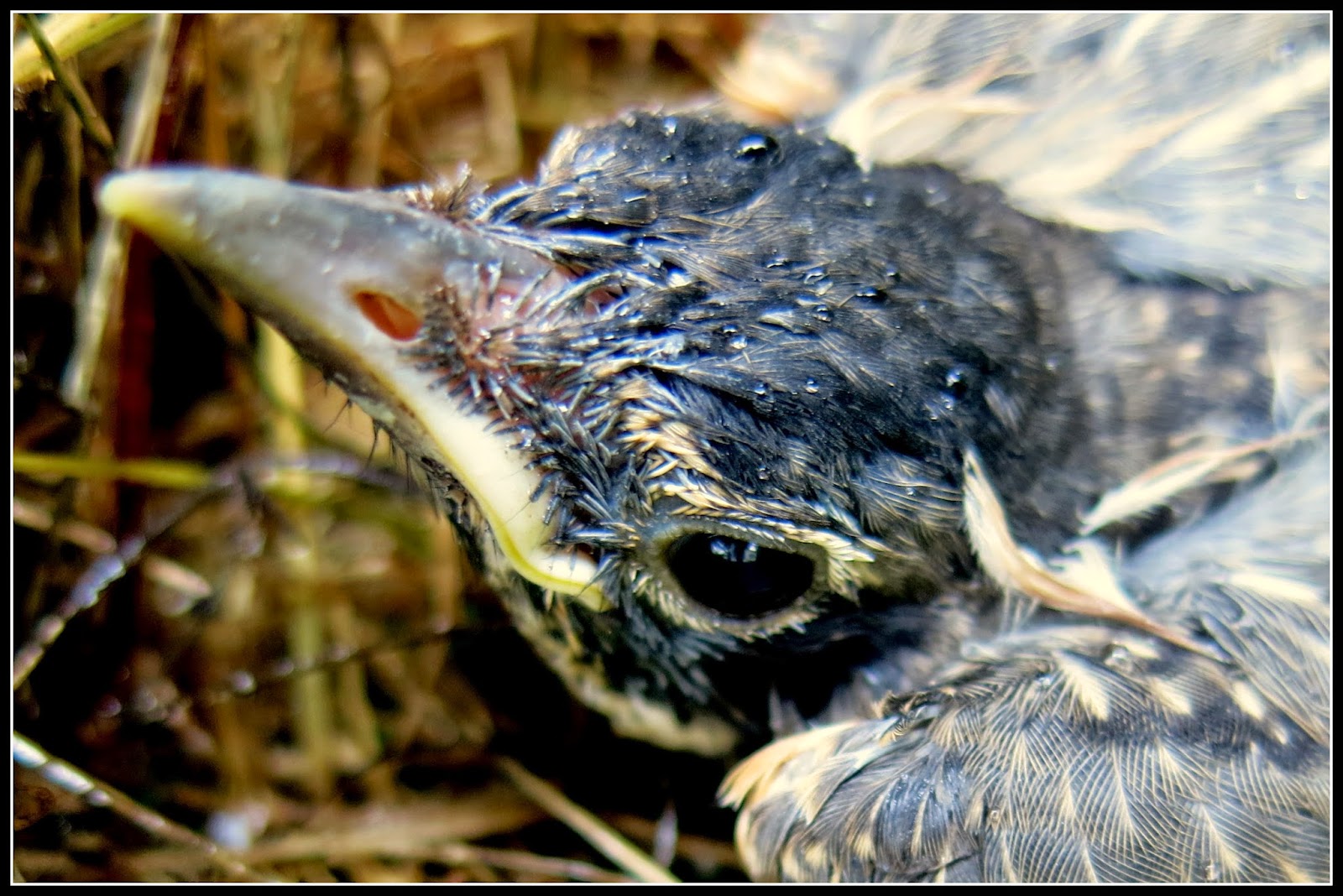
Its parents knew where this young one was and continued to care for it. That bit of red showing is not an injury but a berry that fell from a nearby bush.
The nest crashed down Monday morning and as of late yesterday (Wednesday) this young one was doing well, surviving overnights and a couple of downpours. Its parents kept close watch nearby, chirping loudly when we passed to check in.
We will be out of town for a few days, hopefully he will fledge and fly off before we return. And, maybe one day return to raise a family in one of our crepe myrtle trees.
Thursday, June 19, 2014
Last to Leave
This was the mama robin a couple of weeks ago — sitting and waiting . . .
And this was the last hatching ready to fledge and leave the nest, but in no hurry.
Under the watchful eyes of its parent who perched on the nearby patio fence.
We didn't see any other nest-mates before they left and hope they fly off safely.
Sunday, May 11, 2014
Mother's Day with Feathers
While she raised her family of four young robins (chicks).
Feeding time was always a busy time as both parents feed this always hungry group..

Saturday, May 3, 2014
Temporary Tenant
Only the female robin can brood the eggs which will hatch 12 to 14 days after incubation Both the male and female robin parents then play an active role in feeding the baby robins (called chicks) and will spend almost every hour searching for food, then returning to the nest every few minutes all day long, sunrise to sunset.
Th chicks will leave the nest (fledge) about 14 to 16 days after hatching. We expect to see these young robins hopping around the yard until their wings are strong enough for flight. Meanwhile, the adult robins will be hovering close by, feeding and protecting them until they become self-sufficient — just like most parents.
DO you have any recent yard wildlife visitors?
Sunday, April 6, 2014
Fanning the Nest
But lately, our overhead space is being invaded by house finches that have been trying to build a nest on the ceiling fan blades. The fan is directly above the rockers and definitely not a good nesting spot. Several times a day we've been clearing nesting materials (seen below) from the front porch.
If so, HOW did you handle it . . .
And, did it work ?
Saturday, March 1, 2014
Snow Birds
They're called "snow birds" since in most of the eastern U.S. they appear as winter sets in and retreat northward by springtime. Their appearance at backyard feeders in temperate areas is considered a sign of winter's arrival.
In North America, Black-eyed Juncos are one of the most common birds, found across the continent from Alaska to Mexico, California to New York. Recent counts place the total junco population at about 530 million. (Wonder who did all that counting?)
Dark-eyed Juncos are mainly seed-eaters and at feeders, prefer millet over sunflower seeds. During breeding season, they also eat insects, including beetles, moths, butterflies, caterpillars, ants, flies and even wasps.
Saturday, January 25, 2014
Snuggle & Share
Can be hard to do.
There's some who prefer to dine alone . . .
While others share together (even if briefly) . . .
We hope you are keeping warm during this very cold weather. Enjoy the weekend.
Friday, November 22, 2013
Seeing the Blues
This year there’s been an unusually large number of blue jays at the backyard feeders. They are often hoggish at the feeders, scaring other bird species away. To their credit, however, they are more colorful to see than the even more hoggish, but very unattractive, starlings and grackles.
But to their credit, the blue jay can be beneficial to other birds, as it has been known to chase predatory birds, like hawks and owls, calling loudly if it sees a predator within its territory. Jays have also been known to sound an alarm call when hawks or other dangers are near; smaller birds recognize this call and hide away. A blue jay may impersonate a raptor’s call, especially those of the Red-tailed and Red-shouldered Hawks, possibly to test if one is in the area or to scare off other birds that may compete for food sources.
A few months ago, this young bird was a frequent feeder visitor. Young jays can remain with their parents for one to two months. The male blue jay feeds the female while she sits on the eggs and when they hatch, both parents feed the young. Blue jays fledge in about 3 weeks. Sexual maturity is reached after one year of age.
Blue jays have quiet, almost subliminal calls which they use among themselves in proximity. While in other parts, blue jays migrate for the winter, they are usually seen year-round here in Virginia. 
Blue jays are known for their intelligence and complex social systems with tight family bonds. Sexes are similar in size and plumage, which doesn’t vary in color through the year.

Blue jays are mostly vegetarians and most of their diet is composed of acorns, nuts, and seeds, and also caterpillars, grasshoppers, and beetles. They also control insect populations by eating large numbers of tent caterpillars when they leave the tents. And, blue jays are credited with aiding the spread of forests as they often store acorns in the ground and fail to retrieve them.

The blue jay is the team symbol of the major league baseball team, the Toronto Blue Jays. It’s also the official bird of the province of Prince Edward Island in Canada.
Tuesday, October 29, 2013
Hedge Sitters


Do you also have breakfast with any backyard visitors?