Showing posts with label Canada. Show all posts

Wednesday, July 17, 2024

Dalvay-by-the-Sea

If the walls of Dalvay-by-the-Sea could talk, the tales they could tell of the Scotsman turned oil baron, two girls who grew and married into royalty, a father who cheated them of their inheritance, a caretaker and prohibition rum-runner who owned it and much more.
Now, this is an ideal summer home, which is exactly what this house was for many years on Prince Edward Island, Canada. It was an unexpected site we "discovered" when day-tripping on our May road trip to Maine and Canada. It may look familiar to some since 
Dalvay-by-the-Sea was featured in a film, Anne of Green Gables (1985) as the White Sands Hotel.

Alexander McDonald at Dalvay
While it's still known by its original name and is now a Canadian National Historic Site. 
This house was originally constructed by Alexander McDonald as a summer home. He was a very wealthy businessman (millionaire status) in the late 19th century. As President of the Standard Oil Company of Kentucky, he worked with John D. Rockefeller. McDonald was also the director of the Big Four Railroad, the Third National Bank, and the Carnegie Trust Company. Today, Dalvey is a summer resort open May to October with 25 guest rooms in the Main Inn and eight 3-bedroom cottages for larger groups were added in recent years.

On the day of our visit, the entire building was reserved as a retreat for female cancer survivors. The management graciously allowed us to walk around the main floor and tour the outer grounds as the events had not yet started. We learned much about the house; however, this post is about the original family that owned Dalvay-by-the-Sea than about the house, as their lives proved quite interesting.
Main reception desk for guest check-in
Exploring Dalvay, we learned about its original owner, a native of Scotland, who immigrated to the U.S. in 1833 and settled in Cincinnati, OH. By 1863, McDonald entered the oil business and became president of Standard Oil of Kentucky and also a very wealthy man. He wed Laura Palmer in 1862. Their daughter, also named Laura, married Edmund Stallo, a Cincinnati lawyer, and they had two daughters, Helena and Laura (third Laura). The McDonald's daughter Laura died of cancer at age 25 in 1895. She left her young daughter's care to her parents who later adopted the two girls. (There was no reason given as to why it wasn't her husband, but more on him later.)
The original entry doors still remain at Dalvay
The family vacationed on Prince Edward Island the summer after their daughter's death. McDonald bought 120 acres of land on the north shore to build a home. The plan was to spend summer vacations there in memory of their daughter. Years ago, it was common for the very wealthy to construct an elaborate seaside retreat because at the turn of the 19th century, it was how those who could afford it escaped summer heat of the city. One of their favorite locales was the U.S. East coast (Newport, RI and the White Mountains of NH) and Atlantic Canada for the cooler summer temps. Another fellow Scotsman, Alexander Graham Bell, had a summer home in Nova Scotia. It was built by Rhodes, Curry and Company, a Canadian construction firm which later built Dalvay.
The original Dalvay-by-the-Sea after completion
In late 1895, construction costs were close to $50,000 (imagine getting a house like this built for that now). Local building materials were used exclusively. The lower half of the house was built with Island Sandstone in natural boulder form, fireplaces were built with quarried blocks of the same. Most of the furniture was oak and mahogany. The extensive use of wood reflected a long-time Maritime building tradition. 
This is the main lobby that we came into from the front doors shown above. These furnishings are not original to the house. The McDonalds had traveled extensively and items they included in the house were sold in later years.
Home of Alexander McDonald in OH
The McDonald's Cincinnati, OH, home was called Delvay after McDonald's boyhood Scottish home. When the summer PEI house was built, it became Dalvay-by-the-Sea. The difference in spelling between the two homes is a mystery. The OH home, which sat on six acres, was demolished in the 1960s. The site is home to a Cincinnati Public School. 
Annual operating costs for Dalvay ran about $10,000, a huge sum even now. There was a large number of servants, caretaker and men to look after the horses and stable.  There was a covered bowling alley, a billiards room on the third floor and a sailboat for use on Dalvay Lake. The summer house was usually filled with guests as the family entertained often. Every season before leaving, McDonald hosted a dance for the local residents.
This main stairway leads to guest rooms on the upper floors
McDonald Mausoleum, OH
Laura McDonald died in 1903 and after that Alexander McDonald was reported to visit less often. In 1909, on his last visit to Dalvay, McDonald was unwell and reportedly bid the house goodbye. He never returned and died in 1910 in Long Beach, CA, at age 82. 

They are interred in the McDonald private mausoleum in Cincinnati, OH. 

McDonald's vast fortune was left to be shared between his two granddaughters, 16 and 17 years old at his death. The estate was worth roughly $15 million dollars making the young women two of the wealthiest women of their day. Their father oversaw the estate and was entrusted to keep it until they reached legal age.

Two Rich Young Women Marry
Laura & Helena
Both women planned to marry successful young men from the society roster. But, family members were convinced that they could make better matches by striking out for European royalty, and so they did. 
Laura married an Italian nobleman and Helena wed a French prince. Their futures looked great. 

But is wasn't as by 1930, their inheritance was as good as gone. Their father, Edmund Stallo, apparently not as financially savvy as his father-in-law, had invested in several sketchy schemes. His bad investing was really bad. 

The young women were unaware that as soon as Stallo was put in charge of their inheritance, he began to loot it. Eventually, they learned that their own father had spent nearly their entire inheritance; the large fortune Alexander McDonald left had dwindled to almost nothing. (Stallo not only ruined his daughter's finances, but also lost fortunes inherited by two successive wives. He died penniless in 1945 after being committed to a CA hospital for the insane by his third wife.)
Edmund Stallo and his daughters
Laura and Helena's lives changed since when the sister's money ran out, so did the husbands. Both marriages ended in divorce. Helena died of cancer in her 40s, nearly destitute. Laura moved to NYC and worked to support her family. (Helena’s grandson is NY born actor Rene Murat Auberjonois who played Father Mulcahy in the 1970 film version of MASH.)

What happened to Dalvay-by-the-Sea?
William Hughes, Dalvay's caretaker after McDonald's death, continued to look after the house until the family couldn't afford to keep it. Laura told Hughes that he could have the house for what was owed in back taxes. Hughes purchased it for just over $486 (what a deal) but had zero interest in keeping up the huge mansion, so it was sold for an undisclosed amount.
Lounge room at Dalvay-by-the-Sea
Its next owner, William O’Leary of Charlottetown was the brother of the Bishop of Charlottetown, who used Dalvay as a summer retreat. During this ownership many of the finer furnishing were removed from the house and sold.

It next went to a notorious rum runner during PEIs prohibition years. In 1932, Edward Dicks bought the property to operate as a summer resort. He spent so much money in upgrades that there was little left to market it. No marketing meant no clients and Dicks went bankrupt. In 1936, its new owner was George Delois, one of his creditors, and former PEI Lieutenant Governor. 

In 1938, ownership of Dalvay-by-the-Sea was transferred to the government when Prince Edward National Park was created. DeBlois bargained to retain a large, white family cottage on a piece of land across Dalvay lake; it remains private to this day.
Dalvay has an extensive and comfortable front porch seating area
In 1994 Dalvay became a National Historic Site of Canada. It's operated as a summer hotel and dining room in a lease agreement with Parks Canada. Major renovations started in 1995 are ongoing. A full dining room expansion was done off the main house to offer views of Dalvay Lake.
Patrick at Dalvay's main entrance
Original materials were used to retain the full Heritage Standard of the original house, including pine wood panelling for the ceiling to the maple hardwood floor. Exterior field sandstone was quarried locally and hand-built by local masons.
Beach views at Prince Edward National Park
If we are ever revisit this part of Canada, this is where we would consider staying. Dalvay-by-the-Sea not only offers beautiful views, but is within Prince Edward National Park.

Tuesday, July 2, 2024

Walking on the Ocean Floor

That's what these folks were seen doing on our recent road trip during a stop in New Brunswick Canada. This scene, a natural phenomena, was in Hopewell Rocks where the ocean floor was accessible for 3 hours before until 3 hours after low tide. 

These unique rock formations are on the shores of the Bay of Fundy at Hopewell Cape, New Brunswick, which has some of the world's highest tides, and is considered one of the most interesting marine wonders worldwide. It's taken thousands of years for the massive tides of the Bay of Fundy to sculpt these unusual formations. They stand 40 to 70 feet high (12–21 meters).

The large volume of water flowing in to and out of the Bay of Fundy modifies the landscape surrounding it. After the retreat of the glaciers in the region following the last ice age, surface water filtering through cracks in the cliff has eroded and separated the formations from the rest of the cliff face. Meanwhile, advancing and retreating tides and the associated waves have eroded the base of the rocks at a faster rate than the tops, resulting in their unusual shapes.
The rock formations that make up the Hopewell Rocks are called Sea Stacks and have been carved from the cliffs by time, tide and wind. They are commonly referred to as Flowerpot Rocks since at high tide only the tree tops are visible. There's over 20 free-standing sea stacks scattered along just over a mile (2 kilometers) of shoreline. 

The Hopewell Rocks Provincial Park website gives information on daily low tide times. The tides can vary daily with high tide as high 52 feet (16 meters) which gives the Hopewell Rocks one of the highest average tides in the world. Visitors can explore the beach on their own or join a Park interpreter. The website notes that the formations aren't ever 100 per cent safe. Sturdy footwear is recommended, although we saw folks wearing sneakers and sandals. Due to the mud, the ocean floor isn't handicap accessible; wheelchairs can be difficult to navigate.

The muddy bottom is because the Bay of Fundy tides are always in motion. As the tide flows over the mud flats, it moves the sediment and suspends it in the water. This sediment never fully settles and so results in mud. Swimming isn't allowed at the Hopewell Rocks and neither does the park allow the launching of private watercraft. 
If you're wondering about what looks like brown wet mud, that's exactly right and it's also slippery. Sturdy footwear is recommended, although we saw folks wearing sneakers and sandals. Due to the mud, the ocean floor isn't handicap accessible as wheelchairs can be difficult to navigate. 

The muddy bottom is because the Bay of Fundy tides are always in motion. As the tide flows over the mud flats, it moves the sediment and suspends it in the water. This sediment never fully settles and so results in mud. Swimming isn't allowed at the Hopewell Rocks and neither does the park allow the launching of private watercraft. 

We didn't walk on the ocean floor as we didn't want mud-covered shoes. Instead we watched from the observation deck, 99 steps above the ground. The deck had a washing station where shoes, feet, and pets could be cleared of mud. We saw a formerly white dog on the mud flats the day of our visit.
The large volumes of water flowing in to and out of the Bay of Fundy has modified the landscape surrounding it. When glaciers in the region retreated after the last ice age, surface water filtering through cracks in the cliff eroded and separated the formations from the rest of the cliff face. Meanwhile, advancing and retreating tides and associated waves eroded the base of the rocks at a faster rate than the tops, resulting in their unusual shapes.
Elephant Rock (Hopewell Rocks) before and after its 2016 collapse (CBC photo)
We missed seeing one of the most well-known Flowerpot Rock formations by nearly a decade. In 2016, Elephant Rock split and collapsed from ongoing erosion forces. It was one of the most photographed of these formations. When it was sheared nearly in half, an estimated 100 to 200 tons of rock fell to the ground. Elephant Rock was so popular that it's featured on New Brunswick's Medicare card. Names of some of the other formations are Bear, Dinosaur, ET and even Mother-in-Law.

Like so many popular sights, even natural wonders, this experience comes with an admission cost. The good news is that it covers two consecutive days and visitors are encouraged to visit at both high tide and low tide. Unfortunately, we bypassed that chance as we didn't have time to return a second day. We were continuing to Prince Edward Island on the next part of our road trip. 
Dorothy & Patrick at Hopewell Rocks, New Brunswick, Canada
I read that no Canadian vacation is complete without having experienced these rock icons. (Yes, I know that's an awful pun.) Even though we didn't walk on the ocean floor, just seeing it was an experience. If you get the chance to visit, by all means It's a sight that should not be overlooked. Our thanks to fellow blogger Rain for the recommendation.
Confederation Bridge links New Brunswick and Prince Edward Island, Canada
Leaving New Brunswick we travelled on the Confederation Bridge, a two-lane bridge  that links the province of Prince Edward Island with the mainland province of New Brunswick. Opened in May 1997, the 8-mile (12.9-kilometer) bridge is Canada's longest and the world's longest bridge over ice-covered water. If you enter PEI through the Confederation Bridge and leave through the same bridge, there is no entry charge but there is an exit charge, currently it's $50.25PEI is the only province in Canada where residents have to pay at its border to leave. 

A fellow blogger asked if residents also have to pay the toll and it seems that they do. According to an online article, tolls had been frozen a second year to support bridge users, especially PEI residents and businesses hit by high inflation.

I also read that the Confederation Bridge is a federally owned asset and that the Government of Canada has an agreement with the bridge operator, Strait Crossing Bridge Limited, to operate and maintain the bridge until 2032. The bridge operator has the exclusive right to collect all tolls.

Monday, June 17, 2024

These Falls Reverse

Dorothy, Rain & Patrick
To be clear, the Reversing Falls does reverse, but we didn't fully experience this unique event 
in Saint John, New Brunswick, Canada on our May road trip.

However, it's where we did have a great experience — a first-time meet-up with a fellow blogger Rain. As it happened, this was a first-time visit for all 3 of us. We met at the falls restaurant for conversation, refreshments and great views.

Of course if we had waited just longer, we might have seen this natural wonder in its totality, but time didn't allow that day. And, we would not be going by this area again on our road trip. Still, we saw at least a part of this daily event. While there, we read about the falls, watched a video, then walked on the Skywalk and watched the falls coming from the Bay of Fundy into the Saint John River.
The extended area from the restaurant at the falls is the skywalk area.
Us on the Skywalk at Reversing Falls

What are the Reversing Falls?
The Reversing Falls are a series of rapids on the Saint John River located in Saint John, New Brunswick, Canada, where the river runs through a narrow gorge before emptying into the Bay of Fundy. The semidiurnal tides (two high and two low tides of about equal size every lunar day) of the bay force the flow of water to reverse against the prevailing current when the tide is high. The rapids or "falls” are created by a series of underwater ledges which roil the water in either direction. This can cause a significant navigation hazard. Vessels can only enter or exit from the river at slack tide.
The Reversing Falls Rapids are created by the daily collision of the Bay of Fundy and the Saint John River. At different points in the tide cycle, there are three distinct interactions between these bodies of water.

At low tide the river empties into the bay causing a series of rapids and whirlpools. As tides rise they slow the river current for a brief period, slack tide. The Bay's tides continue to rise, gradually reversing the flow of the river; rapids form again, peaking at high tide. 

Slack tide generally is only 20 minutes and occurs when the Bay of Fundy waters begin to rise and slow the river's flow, eventually stopping it completely. This is the only time that sail boats and pleasure crafts can sail between the bay and the river.

At high tide, the Bay of Fundy tide continues to rise, gradually reversing the flow of the river, and rapids form again, peaking at high tide.

A full tide cycle takes 12 hours, 25 minutes. From high to low tide takes 6 hours, 13 minutes.

Now a tourist destination, the Reversing Falls have been an important industrial site for over a century. The Canadian Pacific Railway constructed the Reversing Falls Railway Bridge in 1885. This structure was replaced in 1922 and is now used by the New Brunswick Southern Railway. The railway bridge crosses the gorge immediately downstream from the falls, parallel to the Reversing Falls Road Bridge.
Irving Pulp & Paper, New Brunswick, Canada
The location of the falls was the site of a foundry and other light industrial operations on the east side of the gorge The large Irving Pulp & Paper Limited mill is on the west side. 
The paper company which has operated the pulp mill since purchasing it in the late 1940s, has encountered criticism for maintaining the facility at what is seen as one of Saint John's prime tourism spots. 

This criticism was most voiced in the 1980s and 1990s when the city government created Fallsview Park on former industrial foundry lands on the east side of the gorge. The park lookouts are considered a prime viewing location for the Reversing Falls Rapids. Unlike the Skywalk there's no cost to visit this park and use the lookouts.. 

Years ago, a popular travel book labelled the Reversing Falls with the distinction as being among the worst tourist attractions in the world. Admittedly, that does seem rather extreme. As we know from personal experience, reviews are subject to opinion and often even a bad review can attract more folks than not. In reading a number of online reviews from others who have also visited the falls, that review seems not to have deterred any.

Even though we didn't view the complete transformation, we enjoyed our visit. As the main purpose was a blogger meetup, this natural phenomena was an added bonus.

Since returning home, I've watched several online videos to see the full Reversing Falls effect. This drone video by Jesse Sullivan (only background music) is interesting if you are included to watch it. Total playing time is a bit over 7 minutes.

By the way, we did see a moose at the falls, luckily it wasn't on the roadways. This one was captive in the restaurant lodge area.
The Reversing Falls weren't the only natural wonder we experienced in Saint John, New Brunswick. A future post will show how it's possible to walk on the ocean floor, of course, at low tide. 

Thursday, April 4, 2024

Straddling Two Countries

The Haskell Library and Opera House
At first glance, It looks like any other Victorian-style building from the early 20th century, complete with stained-glass windows, a grandiose facade and a slate roof. But, appearances aside, this isn't just a grand old building. Here, the border between two countries bisects the building, leaving library users and theatre-goers in one country or the other.

Amazingly, the Haskell Free Library and Opera House (Bibliothèque et salle d’opéra Haskell) is a historic building that's located equally in the small cities of Derby Line, Vermont, U.S. and Stanstead, Quebec, Canada. At the time it was built, people in this rural region moved freely, between these borders, not so anymore.

Derby Line is the still rural Vermont town on the U.S. side of the border. Stanstead, Quebec, the small town on the Canadian side also has American roots and, according to its website, it was founded by pioneers from New England in the 1790s and once a haven for smugglers and bootleggers. As the town grew,  it became the first Canadian stop for the stagecoach that ran from Boston to Quebec City.

At the U.S. border in Derby Line, VT
How did we come across this place?

We were on a road trip to Derby Line, VT, last week to complete our application for Global Entry at the U.S. Customs and Border Protection (CBP) Office. This program allows expedited clearance upon arrival in the U.S. from travel abroad. We're (hopefully) planning to travel abroad at least once before year-end.  

The trip from Nashua, NH, to VT was 3 hours each way. We stayed overnight in the area. We had read about the Haskell library and knew that we wanted to visit it.

While the ornate stone two-story Queen Anne Revival-style building that houses the library and an opera house has two addresses, Canadian and American, there's only one entrance and it's on the U.S. side of the border, which is where we were too..

Americans can freely enter by the front door in the U.S. Canadians cross the border in front of the library, stay on the sidewalk and enter via the front door too. They return to Canada via the same route and cannot walk anywhere else in town. And, Americans cannot cross over the sidewalk into Canada. I admit to having crossed the line.

Passports aren’t required since this isn't a formal border crossing, but the library tells visitors to expect their movements to be monitored and carry an ID, just in case.The photo at the left shows how close the border is. This crosswalk is adjacent to the Haskell library. 

Canadians can freely access the library and must return back by the same route when they leave. Family reunions or cross-border visits are not allowed inside, banned after relatives, who were allowed to be in the U.S. or Canada, not both, began arriving for get togethers. The day we visited, a Canadian police vehicle was parked on the Canadian side monitoring the border line. A library volunteer we spoke to told us the border was monitored daily; however the patrol car wasn't there when we left. We had our passports with us, but they were not needed.

Martha Haskells & son Horace Stewart
The building's construction combines elements of the Queen Anne, Georgian and classical revival styles, typical of public libraries of that time. It was conceived and financed by Martha Stewart Haskell, a wealthy Canadian citizen, and her son Horace Stewart Haskell in memory of Stewart's parents, Catherine and Horace Stewart, and late husband Carlos Haskell, an American sawmill owner. 

According to available information, the Haskells purposely chose to build on the border so that Canadians and Americans would have equal access to the library and opera house when border restrictions were more fluid. 

Two large portraits of the Haskells are displayed in the entrance hall. As accounts go, Martha Haskell’s goal was to cheat the border. Accordingly, for years, Canadians and Americans would cross into each others’ countries to attend school, church and marry. Times have changed since then.

Construction began in 1901 and the opera house opened in 1904 as a profit-producing venture that would support the free public library which opened in 1905. 
It's easy to know which country you're in by the very unusual international border, this  black tape line that divides it down the middle. This dividing line was not accidental. It was added to designate the exact border line after a fire decades ago set off a fight between insurance companies over which had to pay for damages.
Patrick has one foot in two countries
We stepped across the tape on the floor and crossed from the U.S. into Canada. This atrium was the center but the circulation desk wasn't here years ago. It was originally positioned to block access to the stacks where the books were located. Small flags of both countries are provided so visitors have a photo opp with a foot in each country as Patrick did above. 
A wooden book used years ago
Years ago, library visitors didn't have free access to books because at the time (1904), books were more valuable and harder to come by. Library users would tell the librarian what they wanted or would give a wooden block of wood with the title — as shown in the above photo — then the book would be brought out. The circulation desk (shown in a photo below) was originally positioned to block access to the stacks where the books were located.
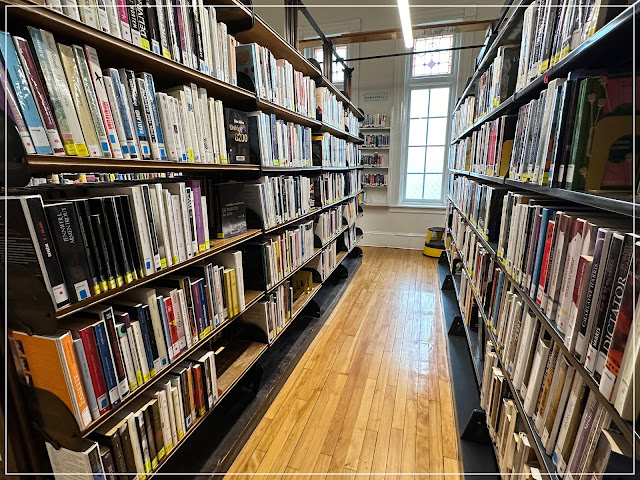
The Haskell library stacks are mostly the original shelves
Today, the library stacks can be freely accessed by library patrons and visitors alike. The library's collection numbers over 20,000 books, mostly in English and French with some Spanish titles as well. Most of this collection is located in Canada. 

The Opera House seating
Unfortunately, the opera house was closed to visitors on the day of our visit, so we didn't see the opera house interiors, this time.

Available photos showed a magnificent venue with a domed ceiling, original mahogany wooden seats and a balcony. The seats closer to the stage are pricier, wider, and have an armrest. We learned that cushions can be rented for the hard wooden seats, regular attendees bring their own.

The stage screens were done by an artist from southern Vermont hired by Horace Haskell. The one that's used most often is a Venice scene which includes a steamboat,  in the back of the scene as Haskell liked steamboats.

As in the library, the theatre is crossed by an international border. Most of the 400-seats are in the U.S. and the show is performed on a stage in Canada. 
Haskell Opera House balcony, Internet source
The opera house includes an arch that provides a clear view of the performance, decorative cherubs and wall murals are typical of early 20th century theatre decor. Performers here have included vaudeville, jazz, blues, rock, music and dance performers, many have left their signatures on dressing room walls.

"Benny"
This is the only moose we saw on our road trip despite the numerous Moose Crossing road signs. It's nicknamed Benny and is displayed in the library near the main desk. As with the flags near the entry way, it's a popular photo "opp."

The story goes that the huge moose was shot in new Brunswick, Canada, by a man named Hunt and that it didn't fit into the front door into his house. Many suspect that his wife refused entry and so it was donated to the library.

The clock in the photo below is original to the 1904 library opening. According to the library volunteer, who provided much information during our visit, it wasn't working for years until a patron repaired it and now it runs perfectly, she added, as long as a staff member remembers to wind it..
The original clock and main library desk
Over the years, some of the library rooms have changed uses. The children's room was the once the men's reading room, where men would recline with their newspapers, books, pipes, and cigars near the room's fireplace. Each room features a different locally-sourced wood, perhaps in tribute to Martha Haskell's sawmill owner husband. There are also several fireplaces, no longer in use except for decorative purposes.
The building has been classified a historic site in both countries. In the U.S., it was registered in the National Register of Historic Places (NRHP) in 1976 and has been included in Ripley's Believe It or Not. In 1985, the building was designated a National Historic Site in Canada and has been a provincial heritage site since 1977. Being on the international border, gives the Haskell library a unique distinction of being the only NRHP registered landmark above the 45th parallel.

If you're entering from the U.S., there's limited parking at the library in a small adjacent lot. You can see American and Canadian border crossings shown on granite markers. 
An illegal border crossing can be quite costly
If you plan to visit The Haskell Free Library and Opera House, its address is 93 Caswell Ave., Derby Line, VT or 1 Church St. Stanstead, Quebec depending on where you're traveling from. 

FYI in reply to comment: Yes, as with many places, the Haskell Library was closed for a couple years when the pandemic cancelled everything. Initially, it closed for a week, then a month and then 2 years. During the shutdown, money was raised to install insulated windows in the opera house. Before this was done, winter performances couldn't be scheduled as the facility was too cold, the season now includes winter performances. As to a query as to which country owns the building, I couldn't find a definitive answer, perhaps it's owned by both countries
Did anyone say that Spring was here? It certainly was not Mother Nature who has sprung a late April Fools' Day weather event here in New England with a nor'easter. This was the 7 a.m. view outside from our apartment windows today. 

Finally, here's a shout-out to my brother on his birthday today. He's celebrating in our home state of NJ, where the weather is just as miserable but only rainy.

He's officially a senior citizen, just like ourselves. This posted before photo shows him celebrating a much earlier birthday. I hope he enjoys a 🎂 cake today as well !

We're thankful to be celebrating after all these years.

🎉 Happy Birthday 🎈

Saturday, October 19, 2013

Scene(s) in Dunville

Dunville sky

As mentioned earlier, our recent Canadian road trip included  a stop to visit friends in Dunville, Ontario, where we saw a very large mudcat and an RCAF museum.

Farm scenesDunville silos

Driving along back roads, we saw sights that were similar to those back in our eastern shore VA home — farmland, farms and barns. Some of the most scenic buildings were the most run down ones, especially red barns.

Rundown red barnAnd, there were many nicer ones as well — also in red.

Red barns1Gray and white are also good barn colors from older ones to those in better condition.

Old gray barn

Old gray barn2

As Grenville was driving, I shot these scenes along the drive from Niagara Falls to Dunville without any pull-overs using a Canon Elph point & shoot.

Gray white barns