Showing posts with label Maine. Show all posts

Tuesday, August 4, 2026

Steaming on Moosehead Lake

That would have been a nice trip, but one that's no longer possible now as the steamboats that once operated on the largest lake in Maine are gone. Only one remains and is now diesel-powered. So, of course, we went on a road trip.
Cruising on a vessel that's the last-of-its kind and still cruising on the largest lake in Maine was a good reason to drive to Greenville, Maine, home of the Katahdin II. And, it also meant cruising on another largest state lake in New England. Recently, we toured the Lake Winnipesaukee, the largest lake in NH on a mailboat cruise.
Weather was overcast for most of our tour, thankfully no downpours
Moosehead Lake is very big — not only is it the largest in the Maine, but the largest completely within New England, it's the second-largest in New England after Lake Champlain and the largest mountain lake in the eastern U.S.
Vintage Steamboat advertisement
Years ago, before roads provided easy access and transport, Moosehead Lake relied on numerous steamboats to travel its very wide expanse. Speed wasn't a factor years ago.
Vintage steamboat loading  (Moosehead Historical Society)
Steamboat travel on Moosehead Lake dates to 1836 when as many as 50 boats worked on the lake carrying passengers, livestock, mail, supplies, equipment and even vehicles. These steamboats were the only means of transportation to large resorts, like the Mt Kineo hotel and to hunting camps and villages around the lake. 
Katahdin I steamboat (Moosehead Historical Society)
The first Katahdin was an 111-foot wooden-hulled steamboat built in 1896 for the Coburn Steamboat Company/ T
he vessel caught fire while towing a boom of logs, ran aground and burned in 1913. It was replaced by the steel-hulled Katahdin II (referred to as the "Kate") built in 1914 at Bath Iron Works in Maine and shipped in pieces by rail to Greenville, where it was reassembled. Both vessels were named after Mount Katahdin, the state's highest mountain derived from the Penobscot Indian word for The Greatest Mountain.
Katahdin II at dock in Greenville, ME
Katahdin II was converted to diesel power in the 1940s as diesel engines offered higher fuel efficiency, required smaller crews, and freed up cargo space. For the next 30 or so years, the ship hauled large timber booms (rafts) across the lake for paper companies. In 1975, it participated in the nation's last major log drive, afterwards it was in danger of being scrapped..  
Moosehead Marine Museum, Greenville, ME
And, it might well have met that fate, if not for a local citizens group who founded the non-profit Moosehead Marine Museum in 1977. Not only was the Katahdin spared but in 1978 it was added to the National Register of Historic Places (Being on the National Register of Historic Places means a building, site, structure, district, or object is officially recognized by the U.S. government as worthy of preservation for its historical, architectural, or archaeological significance.) 
Exhibits in Moosehead Marine Museum
The building that houses the Moosehead Marine Museum was built in 1904 and functioned as a Universalist Chapel before becoming a museum. It's open seven days a week late June to mid-October and houses maritime exhibits. It's also the ticket office for Katahdin cruises. The museum raised funds from federal grants and donations to keep up with the boat's maintenance and repairs.
The proginal plan was to use Katahdin II as a floating museum. However, after a marine inspection proved that, with repairs, the ship could be made seaworthy, extensive restorations were undertaken in the 1990s. As the last surviving steamer on Moosehead Lake, the Kate provides scenic tours and dining cruises during summer months for up to 225 passengers from its Greenville, ME base.
How did the lake get its unusual name? No one person gets that credit. The name evolved from early European settlers who used the descriptive term since, on a map, the lake's shape resembled the head and antlers of a moose. It seems appropriate that the state's largest lake was named after the second-largest land animal in North America. Not only that but Maine has the largest moose population in the lower 48 U.S. states. There's plenty of roadway signs cautioning motorists to watch for moose. Yet, as carefully as we've watched, we've never seen a moose.
Mount Kineo, Moosehead Lake, on a very overcast day
Moosehead Lake has over 80 islands in the lake, the largest are Sugar Island and Deer Island. The lake's most prominent geological feature is Mount Kineo located on a 1,150-acre peninsula that extends from the easterly shore of the lake, famous for being the largest mass of rhyolite volcanic rock in North America. With 700-foot cliffs that rise straight up from the water, it's the central feature of Mount Kineo State Park, a protected area of 800 acres managed by the Maine Department of Agriculture, Conservation and Forestry. 
Fellow passengers on Katahdin cruise
Unfortunately, we were only able to glimpse this mountain through overcast skies. It must bea very impressive sight on a clear day. While the weather was not perfect on the day of our Moosehead Lake cruise, it was still an enjoyable experience.
Soon, we’re considering a visit to another of New England's largest lakes — Lake Champlain in Vermont. Thabkfully, this road trip would be half the distance (3 hours) compared to the nearly 6 hour trip to Moosehead Lake..

Thursday, June 20, 2024

Anniversary in Acadia

Our recent road trip to Maine and Canada was a celebration that coincided with an anniversary — the 27th of our first date, which didn't occur in either of the places visited, but in our home state of New Jersey. When we lived there, and later in VA, we started taking road trips to celebrate special events, not that we needed a reason. 

Dogpatch Farm, Maine-made soap
A previous post detailed a stop at the Maine Lighthouse Museum in Rockland, ME, an unexpected and interesting visit. Our next stop was in Brunswick, ME, home of Bowdoin College. Like many New England towns, this was a mill town thanks to its proximity to the Androscoggin River. Brunswick was the site of the Brunswick Cotton Manufactory Company, the first cotton mill in the state built in 1809 to make yarn and only the sixth in the U.S. at that time. Brunswick was a major lumber producer with some 25 sawmills, some went for shipbuilding. 

The Brunswick Farmers Market had recently opened on the mall in downtown. Held rain or shine, Tuesday and Thursday, May to November, it's one of Maine's oldest farmers markets. As it was early in the season, there wasn't much produce. I made a favorite travel purchase—homemade soap.
Our walk at Brunswick-Topsham Land Trust
The Brunswick stopover was a revisit with friends, Jack and Nancy. When we all lived on the VA Eastern Shore, Patrick and Jack volunteered as Master Naturalists. Our visit included a stop at the Brunswick-Topsham Land Trust where we walked part of the trails and saw fields of daffodils, forget-me-nots and dandelions in bloom. 
Our accommodations at Bar Harbor Manor
Our anniversary destination was the town of Bar Harbor, located on Mount Desert Island where we stayed at the Bar Harbor Manor within walking distance of downtown. The town shares borders with Acadia National Park, which holds claim to some of the most stunning landscapes and diverse wildlife on the Eastern Seaboard. Open year-round., Acadia is located on the coast of Maine. Most of the park’s 47,000 acres are spread across Mount Desert Island, though portions of the park are on the Schoodic Peninsula and Isle au Haut. Bar Harbor is a popular base for visiting the park.
Hulls Cove Visitor Center at Acadia National Park, ME 
We began our visit to the park by a stop at the Hulls Cove Visitor Center where admission is purchased. All visitors must have one of these entrance passes: Standard Pass ($20-35), annual pass ($70) or America the beautiful Pass (Free admission) whether walking, biking, skiing, riding the Island Explorer or driving through the park.. Patrick's veteran status gave us to free admission. You can't see the Visitor Center from the parking area entrance. It's located 52 steps up the hill. (For those with special access needs, there's an entrance available through a back entrance.) 

Acadia National Park is the only national park in the state of Maine. It was first established as Sieur de Monts National Monument in July 1916 by President Woodrow Wilson but then was changed to Lafayette National Park in February 1919 when it became the first national park east of the Mississippi. It was not until January 1929 that it officially was named Acadia National Park.

The Back Story of Acadia
George B. Dorr 
Acadia's history, dates more than 10,000 years ago with the Wabanaki people (
“People of the Dawnland”). The 17th century brought fur traders and other European explorers, while the 19th century saw an influx of summer visitors, then wealthy families. Many conservation-minded citizens, among them was an American preservationist George B. Dorr (the "Father of Acadia National Park"). 

Dorr, heir to a New England textile fortune, spent most of his adult life overseeing the park's formation and expansion and worked to establish this first U.S. national park east of the Mississippi River. Acadia was first named Sieur de Monts National Monument by proclamation of President Woodrow Wilson in 1916 (Sieur de Monts was a that George Dorr gave to Pierre Dugua, a French Explorer and nobleman who came to Mount Desert Island in 1604.). It was re-designated Lafayette National Park in 1919 and then renamed Acadia National Park in 1929. 

Acadia possibly stems from “Arcadia,” a part of Greece that explorer, Giovanni Verrazano was reminded of as he sailed by in 1524. Today, it includes about 49,052 acres in three main areas. The largest is located on Mount Desert Island. Next, is an approximate 2,366 acre tract of land to the Northeast on the mainland at Schoodic Peninsula. Third, to the Southwest (accessible only by boat) is Isle Au Haut. Baker Island (Southeast coast) and Bar Island (north side of Bar Harbor) also have national Park land.
While Acadia National Park can look small on a map, the park encompasses nearly 50,000 acres along the Atlantic Coastline of Maine — including Mount Desert Island, Schoodic Peninsula, Isle au Haut, and other outer islands, 60 miles of coastline, 33 miles of scenic motor roads, 45 miles of carriage roads, and more than 150 miles of hiking trails provide numerous ways to explore the park.

Cadillac Mountain
The 27-mile Park Loop Road leads to many scenic viewpoints along the coast, through forests and to the top of Cadillac Mountain. During peak season, visitors need to purchase one of a limited number of National Parks vehicle reservation passes to drive on Cadillac Mountain Road and see its impressive summit and panoramic views. 
View on Cadillac Mountain
Cadillac Mountain, the tallest mountain on the Atlantic Coast of the U.S. at 1,530 feet (466 meters) is located within Acadia. It features exposed granite domes, glacial erratics, U-shaped valleys, and cobble beaches. It's named after the French explorer Antoine de la Mothe Cadillac
Panoramic view on Cadillac Mountain
For half the year, from October 7 through March 6, this mountain displays the first rays of daylight to touch the U.S., and the perfect place to catch the sunrise year-round. The sheer scale and beauty of the mountain attracts many visitors. Luckily, our visit was before May 25 as from then through Oct 22, vehicle reservations are required for Cadillac Summit Road between sunrise and sunset.
Cadillac Mountain is one of over 20 mountains on Mount Desert Island (MDI) that were pushed up by earth's tectonic and volcanic forces millions of years ago. If these once enormous glaciers hadn't sheared off their tops, it's been estimated they would be even higher than what remains today. 
Glacial remains on Cadillac Mountain
As glaciers moved across the landscape, sediment and rock of all sizes were trapped beneath the ice. This debris was pulled and dragged along the surfaces of the mountains. The smaller particles, such as sand, smoothed out the surfaces of the mountains and rock. The larger stones dug into the rock, leaving scratches that now line the sides and exteriors called striations. 
Jordan Pond, Acadia National Park
Jordan Pond is a tarn in Acadia National Park near the town of Bar Harbor, Maine. The pond covers 187 acres to a maximum depth of 150 feet with a shoreline of 3.6 miles. A tarn is a mountain lake, pond or pool, formed in a cirque (or corrie) excavated by a glacier. The word is derived from the Old Norse word tjörn, a small mountain lake without tributaries, meaning pond. 

The pond has clear water, with visibility normally 44 feet and sometimes recorded up to 61 feet, the deepest recordings in Maine. Jordan pond exhibits high levels of dissolved oxygen and low levels of plant nutrients and plant life. Some types of boating are permitted; however, people and pets are prohibited from entering the water as it is the water supply for the village of Seal Harbor.

Jordan Pond House
This restaurant and shop has a long tradition within Acadia National Park. It's on a hill overlooking a beautiful lawn along the Jordan Pond. The Jordan Pond House traces its history from 1847. The first settlers conducted a logging operation, establishing a small mill near the foot of the pond. The original farmhouse was built by the Jordan family of Seal Harbor, for whom the pond and house were named.
Jordan Pond House, Acadia National Park
Toward the end of the 19th century, the location became a popular recreational area for summer vacationers. The Jordan Pond House was turned into a small restaurant. The first popovers and tea were served here by the first proprietors, Thomas and Nellie McIntire around 1895. 

Jordan Pond Tea House, circa 1019
In 1928, John D. Rockefeller, Jr. purchased the property and donated it to the National Park Service in 1940. The McIntires operated the restaurant 50 continuous seasons until their retirement in 1945. In 1946, Rockefeller began a company to run the Jordan Pond House restaurant. The original building burned in 1979; the current building was completed in 1982.
Our anniversary treat, popovers filled with blueberry ice cream
Afternoon tea with popovers remains a popular, not to be missed, tradition on a visit to Acadia National Park. Reservations are usually required in season, luckily, the restaurant had re-opened the week of our visit, wait time was under an hour. Of course, after lunch, we each savored our own Jordan Pond House popover filled with blueberry ice cream.
This anniversary road trip continued into Canada. Future posts will include highlights from our visit there.

Monday, June 10, 2024

Maine Lighthouse Museum

One of the best things we've discovered about a road trip is that many times we don't know what we'll come across, and when unplanned or unexpected, all the better.
That's what happened in Rockland, Maine, on our recent anniversary road trip when we visited the Maine Lighthouse Museum. This museum houses the largest collections of lighthouse lenses, lighthouse artifacts and United States Coast Guard memorabilia (USCG) in the nation. The goal of the museum is to educate and promote not only the lighthouse but lifesaving as well.
Who knew?
Certainly not us and this museum is right here in New England, almost in our backyard so to speak. Along New England's 6,000 miles of coastline there are 200 lighthouses remaining and every state has at least one. 

Lighthouses were made from a variety of materials: wood, rough-hewn stone, brick, reinforced concrete, iron, steel, even aluminum and fiberglass. They were built on land, in the water, on islands, on top of ledges and cliffs, on breakwaters and piers and on caissons; at least five are on fort walls. Some are squat, others are tall and dignified. No matter their size, lighthouse are always impressive, even more so were lighthouse keepers who are included in the museum exhibits.. 

As we were driving through Rockland, we saw a sign for the museum and made a detour from our planned route to find the museum. Luckily, it was open on a weekday as the switch to summer hours came the week before after Memorial Day. Maybe, because it was a weekday with schools not yet out and limited vacationeers, but the day (Monday) and time of our visit (afternoon), we were the only visitors..

What's to See?
Everything to do with New England lighthouses. Museum exhibits include vintage Fresnel lenses, foghorns, marine instruments, life saving equipment, photographs, flags, buoys, fog horns and bells, lighthouse and ship models and Coast Guard memorabilia. There’s an exhibit dedicated to the fascinating and largely untold history of female lighthouse keepers. Many items on display are one of a kind and not found elsewhere. For anyone interested in lighthouses or American maritime history, it's a must-see stop. Patrick is a Navy veteran, so we couldn't bypass this chance to visit.

CWO4 Kenneth Black, USCG 
How Did It Begin?
The Maine Lighthouse Museum was founded by the late CWO4, Kenneth Black, who is recognized as one of the leading lighthouse preservationists in the U.S. A WW II Coast Guard veteran, Black saw action at the invasion of Okinawa. After the war, he served throughout New England and the Great Lakes in various capacities. He ended his Coast Guard career as Commander of the Rockland Coast Guard Station.

As the Officer in Charge of Coast Guard Station Rockland, Black gradually assembled the beginnings of the museum collection as he visited Coast Guard stations and bases in New England. He realized that while Maine doesn't have the most lighthouses (65 compared to over 150 in Michigan), it has some of the most historic and oldest ones. 

Black was Mr Lighthouse
When he retired from the Coast Guard, Black was the official curator of the First Coast Guard District. As a Coast Guard Commander, he had overseen the operation of many of the nation’s lighthouses. His interest is saving lighthouse artifacts began after he learned that many were being discarded as automation changed the way lighthouses had been operating since the late 1700s. 

He coined the phrase, Lighthouses are like people, they come in many different sizes, shapes and colors, and used it to promote the importance of lighthouse preservation.

USCG Station, Rockland, ME
After gathering countless maritime artifacts, Black received Coast Guard permission to set up a display at the Coast Guard Station in Rockland, ME, which evolved into the largest collection of lighthouses lenses and equipment in the country. When the exhibits overflowed this space, Black arranged for them to be loaned to the Shore Village Museum, 
which housed Civil War artifacts and some lighthouse memorabilia, now, working foghorns, ship models, flashing lights, search and rescue gear, bells, buoys and boats were added to the museum. For many, this was the first time, they were able to see so much maritime memorabilia. Black took on a new role as curator of the Shore Village Museum. 

Internet source
Black wasn't done collecting as he traveled throughout New England searching out more artifacts. His goal was not only to preserve the nation’s heritage, but to promote the study and appreciation of maritime history for future generations. The public responded as people stepped forward with donations. Some were easy to transport, others, like priceless Fresnel lenses, fog bells and foghorns weighing thousands of pounds took more effort. 

In 2005, when the collection, once again, outgrew its exhibit space, it was relocated to its present location, the restored Courier Newspaper building on Rockland's waterfront and renamed the Maine Lighthouse Museum. (The Shore Village Museum later closed.) The new museum now featured the largest collection of rare lighthouse lenses (especially Fresnel) of any U.S. museum. In 2007, the Museum of Lighthouse History in Wells, ME, merged its collection with the Maine Lighthouse Museum. This merger created the largest lighthouse museum in the U.S.

What are Fresnel Lenses?
Augustin-Jean Fresnel
The Fresnel lens was named after its inventor Augustin-Jean Fresnel, a French civil engineer and physicist. His research in optics in the 1820s led to the acceptance of the wave theory of light. The catadioptric (reflective/refractive) lens he invented was specifically for use in lighthouses and replaced metal reflectors with revolutionary stepped lenses of his design. This extended the visibility of lighthouses, saving countless lives.

Compared to other lenses of the time, Fresnel lens were thinner and lighter in design, which allowed more light to pass through them. Lighthouse lights became more visible at longer distances serving as guides to mariners and lessening shipwrecks. Fresnel lenses became the standard optical system for lighthouse lighting for years, many are still in use today. Sadly, Fresnel died at age 39 after a lifelong battle with tuberculosis. His name is forever associated with his invention.
Nearly all U.S. National Park lighthouses originally had a Fresnel lens. Many have been removed or replaced with more modern lighting mechanisms through advancements in technology. 
Fresnel lenses on display in the museum were amazingly beautiful to see up close.
Fresnel lens from Bakers Island Light, Salem, MA
The above lens was made by Chance Brothers Co. of England, a principal manufacturer or lenses and other lighting equipment and competitor to France in the production of Fresnel lenses. An innovation from Chance Brothers was the introduction of rotating optics, allowing adjacent lighthouses to be distinguished from each other by the number of times per revolution that the light flashed. Noted English physicist and engineer John Hopkinson invented this system while employed at Chance.
There are several dioramas and detailed lighthouse models on display. All of these were made to exacting detail to display the lighthouses and harbor scenes.
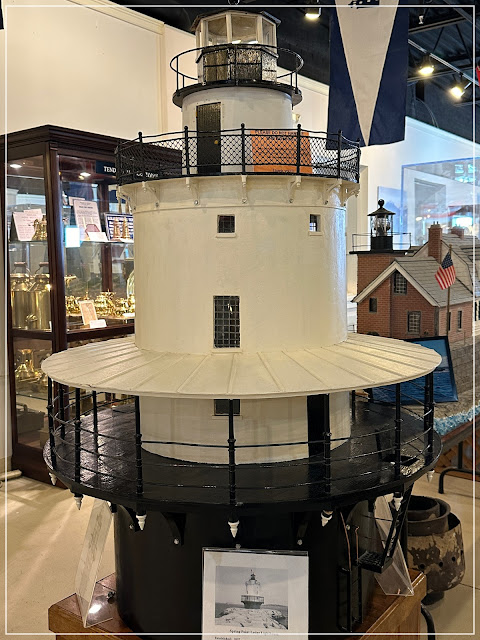
Spring Point Ledge Lighthouse, South Portland, ME
The above model is the Spring Point Ledge Lighthouse in South Portland, ME. It's the only caisson-style (sparkplug or bug light) style light station in the U.S. that visitors can walk to on the breakwater. The superstructure of this type of lighthouse type is built on concrete or metal. This lighthouse has been an integral part of the history of Portland harbor and Casco Bay since 1897; it was listed on the National Historic Register in 1988.
Fog bell formerly on Matinicus Rock Light
This 2000-pound bell was cast in Philadelphia, PA, in 1855 and installed on a wooden frame at the Matinicus Rock Light in Maine. Fog bells were crucial when dense fog interfered with the light's visibility. This one was in use during most of the tenure of Abbie Burgess as assistant light keeper from 1654 to 1875. She became well known for her bravery in tending the Matinicus Rock Light during an 1856 winter storm. She did so for a month when her father, the head light keeper, was away from the island. 
Many vintage photos and personal items of famous lighthouse keepers can be seen in display cases, including Robert Sterling, Fanny Mae Salter, Abbie Burgess, Ida Lewis and others. These individuals are as important to Maine’s lighthouse history as their artifacts. The museum ensures their extraordinary contributions to maritime history are not forgotten.
Early lifeboat, breeches buoy, foghorn displays
What looks like a round personal flotation device with a leg harness attached and works like a zip line is called a breeches buoy. This rope-based rescue device was used to extract people from wrecked vessels, or to transfer people from one place to another in situations of danger. Foghorns provide audible warnings of dangers to shipping like rocky coastlines, shoals, of the presence of other vessels when visual navigation aids are obscured in foggy conditions. 
Exhibits in the museum display different stories of bravery and dedication to the service of the men and women in the United States Coast Guard and United States Life-Saving Services. 
Display cases featured light house lamps and other memorabilia and artifacts.
As stated earlier, our stop at this museum wasn't planned, but was definitely an informative experience. The best part of a road trip is finding and learning about special places along the route and sharing, so now you know as well.
The Maine Lighthouse Museum is at 1 Park Drive in Rockland, ME, the heart of the Midcoast. The museum has summer hours after Memorial Day, Monday through Friday 10:00 am to 5:00 pm. Saturday and Sunday 10:00 am to 4:00 pm. After Columbus Day, hours are limited so it's best to call ahead. The museum closes January and February and in spring operates Thursday, Friday and Saturday.

Tuesday, July 11, 2023

Donut Miss Frosty's

Most people think of lobster or other seafood when considering food choices in Maine, but there's other indulgences as well. In Brunswick, ME, that means donuts.
Selection of donuts at Frosty's Donut Shop in Brunswick, ME
Since we missed celebrating National Donut Day on the first Friday in June last month, we made up for that oversight last weekend.
Frosty's, 54 Maine St, Brunswick, ME
Frosty's founders, June & Bob Frost
Frosty’s Donut Shop is located in the heart of downtown Brunswick, ME, ironically on Maine Street. It was established in 1965 by Bob and June Frost. Within a few years, their selection of traditional donuts, from glazed to frosted became well known in the area leading to a faithful following. Customers either made a stop here as part of their daily routine or found a reason to travel to Brunswick. (Luckily, we were already there for another event.)

The donut shop became an “iconic institution” in the community and recognition in regional and national recognition in publications such as Downeast, Travel & Leisure, and Saveur. 

The current name and location were not the original shop. The Frosts had originally bought into a Spudnut Donut Shop franchise for an initial investment of $5,000. They opened it near Bowdoin College in Brunswick. 

Vintage Spudnut Donut Ads
Spudnut shops, which predated Dunkin'® Donuts, were selling about 400,000 spudnut donuts made with potato flour annually. The American franchise grew to more than 300 shops at one time. While the parent company no longer exists, about 35 independent shops remain open in nine states. The name was originally coined by company founders Al and Bob Pelton of Salt Lake City, UT, who created a dry potato mix which made it feasible to franchise their creation.

The original recipe is based on a German folk recipe. Spudnuts were advertised with the slogan Coast to coast—Alaska to Mexico. Over the history of Spudnuts, there were over 600 stores throughout the U.S., Canada, and Mexico. A bow-tied donut character, Mr. Spudnut, appeared in ads, restaurants, and parades. In the late 1960s, there were 315 franchise holders, with combined annual sales of $25 million. Spudnut shops were the largest doughnut franchise in the U.S.

Two years after the Frosts relocated to the Maine Street location, business became slow and the shop name was changed to Frosty’s. (I'm not sure if the donuts continued to be made with potato flour.)

Bob and June Frost maintained the popular Frosty’s Donut Shop for 46 years until Bob closed its doors in June 2011, shortly after June's death. 

Nels Omdal and Shelby St. Andre
In 2012, Nels Omdal and his wife Shelby St. Andre, a local couple, who had also been loyal customers purchased Frosty’s. Omdal had a background in food production and restaurant management and his wife had experience in business and finance. They felt they had the skills and drive needed to grow the business throughout the state.

They didn’t know anything about making doughnuts.

The couple stayed faithful to the recipes and business model developed by the Frosts and Bob worked with them in the kitchen. The basic donut recipe remained the same. (Bob Frost died in June 2019 at age 85. )

Running the donut shop meant long hours. After taking over Frosty's, its new owners served donuts 7 days a week.  They expanded the business to four more retail locations throughout Maine—Augusta, Bath, Gardiner and Freeport—and delivered breakfast items to over 40 locations statewide. When the Covid pandemic hit, all shops were voluntarily closed. The Gardiner and Freeport closures closed permanently to maintain the long-term health of the company according to its owners.

Grenville & blueberry fritter
If you're in Brunswick, ME, on a weekend and looking for a sweet treat, stop into Frosty’s at 54 Maine St. The donut shop is open Friday to Sunday, 7 am to 2 pm, takeout only, no delivery. The menu includes raised donuts, cake donuts, rings, glazed twists, and bagels as well as hot and cold drinks.

In 2023, Frosty’s owners opened a production facility in Brunswick and now deliver breakfast items to over 40 locations throughout the state.

Although ALL of the donuts looked delicious, we can personally recommend the fritters. Grenville enjoyed a blueberry-filled one and mine was the traditional apple-filled variety.

Not only were both were both delicious ðŸ˜‹ but, of course, calories don't count when traveling 😉. . . isn't that right?