Showing posts with label trains. Show all posts

Thursday, December 4, 2025

Thanksgiving Getaway

We went on an extended Thanksgiving road trip visiting friends in our native NJ and in PA before spending the holiday with family members in PA. Our return to Nashua, NH, preceded the 5-inch snowfall this past Tuesday, December 2, the first of the season.

Most folks will agree that long-time friends are truly the best even if the get togethers are less frequent than we would like them to be because of distance and other reasons. Whenever we can, we connect with my high school friend, Sara, and husband, David, also NJ natives, who now reside in PA.
Christmas tree photo has become a tradition for us and friends, Sara & David
Many of our get togethers have taken place during the holiday season of either Thanksgiving or Christmas and we catch up with a meal and lots of conversation. At Christmas, there are always photos by the tree wherever we happen to meet. Thankfully, their tree had already been set up ahead of our visit.
Individual photos are always followed by a group "selfie" photo and we've always managed manage to fit everyone and the tree in the picture.
Thanksgiving dinner was celebrated with the grandchildren and their parents. The only one missing from the above photo was Patrick, the photographer.
The Christmas tree was set up and decorated by family
The family Christmas tree was set up and decorated as a group effort before everyone sat down to dinner.
Harrisburg, Lincoln & Lancaster Railroad train ride with Santa and the conductor
The train engine is a 1868 steam locomotive replica
There wasn't any Black Friday shopping for anyone, instead we all went on a family outing in Elizabeth, PA — riding on a narrated
train excursion through the Stone Gables Estate on the holiday decorated Harrisburg, Lincoln & Lancaster Railroad. 
Photos from the train ride and a group family photo (minus myself)
The ride featured a replica of an 1868 steam locomotive, pulling replicas of an 1848 Pioneer Coach and a mid-1860s Combine & Day Coach. (Stone Gables Estate is a biblical faith-based ministry/business. Its mission is to donate 100% of net profits to aid abandoned children worldwide.)
Selfies were taken by the hotel's holiday decos
Our Lancaster, PA, hotel was fully decorated the morning after Thanksgiving. Elves in the form of hotel employees worked to set up multiple tree displays and a gingerbread house in the lobby, all good photo opportunities, which we could not resist.
A variety of red cars in keeping with the season
While other family members left for their home on Saturday, we stayed for the weekend and traveled 30 min. from Lancaster to Hershey, PA, to visit America's Transportation Museum. The museum is dedicated to the preservation of automobile history and is also known as the AACA (Antique Automobile Club of America) Museum, which is rather confusing as the museum is not affiliated with that organization.

The 71,000 square foot museum opened in June 2003. It displays over 130 cars, buses, motorcycles and automobiles in themed settings from the 1890s to 1980s. Rather than display the cars in long rows, the AACA Museum incorporated an educational approach in its displays by adding scenery and set designs to complement the period in which each car was built. Vintage autos are shown in unique settings through the decades. 
Vintage Tucker autos in the museum
Major collections include the Cammack Tucker Collection, billed as the world's most extensive collection of Tucker automobiles. (The collection is named for David Cammack, a historian and collector whose entire collection was donated to the museum after his 2013 death.)

We spent over 2 hours touring this museum, a welcome escape from a cold and windy day outdoors. A future post will feature more of the displays. (I appreciate your comments on our Portugal visit. There's more to share, those posts will most continue in the New Year.)

Your Turn — Did you celebrate Thanksgiving with any traditions ? 

Thursday, May 22, 2025

Ticket to Ride

Our anniversary getaway wasn't a long-distance road trip but in state. We traveled 2-1/2 hours to Gorham, NH, stayed at the Glen House, the fifth hotel so-named and took a scenic railroad excursion. This post is a long-ish account of our adventure.

The Glen House is at the base of the Mt Washington Auto Road, across the street from the Great Glen Trails Outdoors Center where we boarded the SnowCoach for my February birthday adventure. Back then, we had stopped in for a look around the hotel. Talk about keeping things all in the family — the Libby family, which owns and manages the auto road, also owns this hotel and the Outdoor Center. 

Elihu Libby
The Libbys are descendants of Elihu Libby, who at the turn of the 20th century, bought the Glen House. In 1906, Libby also purchased the then-named Carriage Road, now called the Mt. Washington Auto Road known as the oldest man-made tourist attraction in North America. The 7.6 mile road climbs 4,618 feet from the base to the summit and it re-opened for auto travel last weekend. The drive averages about 30 minutes and while Patrick had considered driving it again, it wasn't the best weekend weather-wise, so it was a train ride this time.

More about the train ride later, first information on our lodgings. While the current Glen House is barely 8 years old, it's the fifth so named hotel in a series of grand resorts and hotels dating to 1852, in Pinkham Notch close to Mt. Washington in the White Mountains of NH. (The Glen is the historic name given to the picturesque valley at the base of the road.)

Hotels abounded in the area with the 1851 completion of the Grand Trunk Railway which established a route from Portland, ME to Gorham, NH, bringing more visitors to the area. (The Grand Trunk Railway operated in the Canadian provinces of Quebec and Ontario and in the states of CT, ME, MI, MA, NH, and VT.)
Photo of the first Glen House  (Internet source)
The first (future) Glen House opened in 1852, when J. Bellows converted a farmhouse into a hotel and sold it to Joseph M. Thompson, who expanded and renamed it to the Glen House. By 1866, the now grand hotel featured views of Mt. Washington, Tuckerman Ravine, and the northern Presidential Range. Guests could go to the summit of Mt. Washington on the newly opened Carriage Road, visit natural sites in the area, or relax in game rooms, parlors, library, dance, enjoy sports, go on a carriage ride, or enjoy a theater show. In 1869, Thompson drowned in a heavy rainstorm after going to check on his nearby sawmill.

The Milliken brothers (who I couldn't find details about) took control of the first Glen House after Thompson's death. Within a few years, the Milliken brothers had not only rebuilt, but again expanded the hotel. But, in 1893, this second Glen House also fell victim to a fire which completely destroyed it. 
Photo of the second Glen House (Internet source)
This time, it was not rebuilt and the Libby family of Gorham, NH, obtained the site and once again it was converted to housing. The servant's quarters, which were not destroyed, were expanded into a 40-room hotel that became the third Glen House. In, 1924, it too was destroyed by fire.
Photo of the third Glen House (Internet source)
In 1925, a smaller fourth Glen House was built serving winter sports enthusiasts and summer travelers. In March 1967, the hotel caught fire and burned to the ground.

Why did these old hotels burn down so often?
The 1860s saw a boom in NH tourism, especially to the White Mountains. which meant more people and possibly more chances of accidental fires or arson. Nearly all hotels were built from wood, making them highly susceptible to fire. Natural factors such as dry conditions, strong winds, and the presence of dry tinder could have contributed to the spread of fires. Fire safety measures were not sophisticated then compared to now. Fires spread quickly causing significant damage and usually resulted in total devastation. 
Photo of the current and fifth Glen House (Internet source)
In September 2018, the current and fifth Glen House opened on Rt 16 in Gorham, NH, outfitted with sprinklers and various safety measures. The 68-room, three-story year round hotel was built with sustainability features. It's heated and cooled by a geothermal system. Building insulation is a combination of spray foam and rigid panels. with LED lighting inside and outside. The Otis elevators regenerate energy when moving up or down, returning energy to the building for use elsewhere. Water fountains provide for filling reusable water bottles. An outdoor fire pit uses propane vs. wood, to help maintain the air quality standard in the Great Gulf Wilderness area west of the hotel. Future plans include installing solar arrays to increase onsite energy production.
Inerior features of current Glen House
The newest Glen House hotel was designed and built mainly by NH firms. It's owned by four families of the Mt. Washington Summit Road Co. of which the Libby family are majority owners. Coincidentally, the annual hotel ownership meeting was being held the weekend of our stay.
Ticket to ride on the Conway Scenic Railroad
Now, onto the train ride, which was the reason for our getaway to celebrate our 1st date anniversary. We had tickets to ride in First Class, costlier than coach seating, but we splurged as this was a once-a-year celebration.
Conway Scenic Railroad depot, North Conway, NH
Above is the exterior and interior of the Conway Scenic Railroad train station which is directly across the Green, the town center in North Conway, NH. The classic 19th-century train station is painted yellow with decorative white trim and red accents and is on the National Register of Historic Places. The Conway Scenic Railroad was established in 1995, running on a line established in 1875 and runs several historic cars. The Notch Train we traveled in consisted of a diesel locomotive Model GP-38; CafĂ© car, coach car, open seating car and first class car. 
Diesel engine on Conway Scenic Railroad Mountaineer excursion
This heritage railroad is owned by Profile Mountain Holdings Corp. It operates over two historic railway routes: a line from North Conway to Conway formerly part of the Conway Branch of the Boston and Maine Railroad, and one from North Conway through Crawford Notch to Fabyan once part of the Mountain Division of the Maine Central Railroad. The Conway line is owned by Conway Scenic, the Mountain Division is owned by the State of New Hampshire. Railroads once dominated the White Mountains. 
Open seating car on excursion train
Our trip was on the Mountaineer, a round-trip journey that starts at the main station in North Conway and takes a 4-1/2 hour journey some 50-60 miles through the Mt. Washington Valley and over rugged Crawford Notch to Fabyn Station, NH, and then back to North Conway. The excursion recreates the experience of travel abroad a post-WW II transcontinental streamlined train with passenger cars reminiscent of the 1950s era. In fall months, it's is a very scenic and popular New England trip.
First Class seating was very sparse on this first run of the season
Last weekend's excursion was only the second one of the 2025 season, the train was not crowded. The Mountaineer resumed operations in mid-May with only a Saturday run. High season is starting in June with weekly excursions on Tuesday and Saturday, then in July and August, there's excursions daily, except Monday. This schedule extends through the scenic New England fall season. High season seating is also higher priced. Yikes! our 1st class ticket will be $25 higher than last weekend.
Views along the train ride showing overcast & foggy conditions
While the weather outside was chilly and damp with on and off rain, we managed views of the Saco River and traveled across several viaducts (trestles) through rocky
Abel Crawford
crags at the top of Crawford Notch, which was named for Abel Crawford considered a pioneer of tourist industry in the White Mountains.
 Crawford and his family were early promoters of the area, as well as innkeepers, guides, turnpike builders and investors. Crawford arrived in the area in 1792 and built a cabin. In the Notch, the Crawford family constructed the Notch House and Crawford House, which was one of the White Mountains’ grand hotels. The first railroad to run through Crawford Notch opened in 1875 running from Portland, ME, to Fabyan, NH. 

Our journey to Crawford Notch included live narration mostly on the first half of the trip, less so on the return which passed the same landmarks in reverse. The narrator noted historic and scenic highlights along the route. Like much of the rest of northern New England, Crawford Notch was part of the homeland of the Abenaki tribe of Native American people. 

Many of the tales were quite unfortunate given the history of this area, which was filled with dangers in the early years. Untimely deaths occurred in many of the stories including the unfortunate tale of the Willey family, the fate of Nancy Barton who died while chasing her fiancé thief and the explosion of the Maine Central 505 in which two men died.
 The Willey House Inn and tavern (Internet source)
Samuel Willey Jr. and his wife, Polly, owned a farm in Lower Bartlett before relocating to Crawford Notch with their five children. They moved in hopes of starting an inn and soon after purchased the Old Notch House built in 1793. Then, Willey hired two men to enlarge and repair the house, turning it into a two-story home with stables and a barn which he then renamed The Willey House Inn and Tavern.

Its location was in a scenic valley filled with sugar maples and spectacular fall colors. The Willeys anticipated tourists would come for the White Mountains scenery, yet most visitors who stayed were NH and VT farmers passing through Crawford Notch heading to Portland, ME. In June of 1826, a severe rainstorm tore through the White Mountains causing a landslide across the Saco River. A mass of soil and vegetation slid into the floor of the valley close to the house. Afterwards, Willey built a nearby stone shelter where the family could flee if a landslide again threatened the valley. When another violent rainstorm and landslide in Crawford Notch imminent, the Willeys left their home. A search party found the couple, two of their five children and two hired hands in the stone shelter. Ironically, the rockslide missed the house entirely. It was situated near a rock ledge that divided the major slide into two streams leaving it intact. 
Painting of the area near the Willey House by artist Charles Codman (Internet source)
News of the Willey family tragedy spread, attracting tourists to the region captured by the story and awed by the house. In 1835, Nathaniel Hawthorne wrote The Ambitious Guest, a short story about the tragedy. Artist Thomas Cole, founder of the Hudson River School of Painting, painted a landscape, Distant View of the Slide that Destroyed the Willey Family. This literature and art drew people to the White Mountains, exactly who the Willeys had hoped would come.

Some folks tried to capitalize on the new interest in the region by converting the Willey house into a hotel and offering tours. Though unconfirmed, some say this story is the origin of the phrase gives me the willies. Mount Willey is named for the family. The WIlley Trestle, also named for the family, is 94 feet high and 240 feet long, spanning the Willey Brook between Mt. Willey and Mt. Willard. The Willey House is now an interpretive center within Crawford Notch State Park.

Another tale of misfortune was that of Nancy Barton who, in the winter of 1778, succumbed to frostbite and hypothermia while in pursuit of her fiancĂ© who had betrayed her and absconded with her life savings. According to Haunted Hikes of New Hampshire by Marianne O’Connor, 16-year old Nancy worked as a servant on Colonel Joseph Whipple's Jefferson, NH, farm. There she met and fell in love with farm worker Jim Swindell and shared with neighbors after he proposed that they planned to settle in Portsmouth, NH. Hindsight is always better as Nancy learned after she entrusted Jim with her savings, money earned working for Whipple.
Sign near site of Nancy Barton's death (Internet source)
Nancy left making arrangements to relocate to Portsmouth and Whipple and Jim conspired against her. Whipple supported the colonist fight for independence against the British in the Revolutionary War. The story goes he convinced Jim to steal her money and join the colonist army. Jim spent the money on a uniform. Learning her fiancĂ© had done her wrong, Nancy set off in pursuit despite being warned of a dangerous trip in winter. She ignored cautions and left packing a few clothes and without food. Her trip through Crawford Notch was on a 30-mile snow-covered trail, Her clothing became soaked crossing a brook where she sat to rest. A search party followed her tracks hoping to find her alive, instead they found her sitting on a rock, frozen to death and she was buried by the brook. Hearing of her death, Jim was overcome with guilt and died in a psychiatric hospital. 
Hikers at Nancy Falls, circa 1929 (Internet source)
The Nancy Brook Scenic Area commemorates her death. For centuries, hikers traveling in this area of the White Mountain National Forest have reported hearing cries and shrieks of laughter. 
Maine Central 505 crash site
(Internet source)
On July 3, 1927, the Maine Central #505 which was built by the American Locomotive Company (ALCO) in 1910 was called in to help a freight train up the grade in Crawford Notch. Due to a faulty water glass and a leaking boiler, the 505 exploded.

The blast severely injured the foreman and engineer, Oscar W. Clemons and Robert B. Morse who died a day later leaving 15 children between them. Later investigation determined that the explosion was most likely caused by an overheated boiler.

Crawford Notch is a major mountain pass through the White Mountains in New Hampshire. In 1771, a Lancaster hunter, Timothy Nash discovered it while tracking a moose over Cherry Mountain. He noticed a gap in the distant mountains to the south and realized it was probably the route through the mountains mentioned in Native American lore. Loaded with provisions, Nash worked his way through the notch to Portsmouth to share his discovery with Governor John Wentworth. There's evidence that the indigenous people of this region, the Abenaki, used a similar path through the White Mountains. European settlers found it in the late 18th century.
Switching the engine for the return trip to North Conway
At the Breton Woods station, the engine was switched for the return trip to the North Conway station. At this point, passengers usually are asked to switch seats with those on the other side, this way everyone can see the sights. As this trip was far from being fully booked, this wasn't necessary.
The Mount Washington Hotel as seen from the train
The route passed the stunning Mount Washington Hotel built between 1900 and 1902 by Joseph Stickney at a cost of $1.7 million. Stickney, a native of Concord, NH, made a fortune before age 30 as a coal broker in Pennsylvania. He envisioned the hotel as a luxurious getaway for urban dwellers looking to escape the city. This landmark hotel, now owned by Omni, was one of New Hampshire’s Grand Hotels. In 1944, it hosted the Bretton Woods Conference, which established the International Monetary Fund and the World Bank. It's a member of Historic Hotels of America, the official program of the National Trust for Historic Preservation.

Frankenstein Trestle (Internet source)
Laying railroad track in this part of the White Mountains was no easy job.. We passed over the Frankenstein Trestle, an engineering feat that's become a popular spot for hikers to see. 
The Mountaineer train crossed it twice on the journey. At 80 feet and over 500 feet long, this elevated train bridge was a trip highlight, but not photographed on board. 

If you're curious, its name has nothing to do with the Mary Shelley novel of the same name, instead the trestle is named after artist, Godfrey Nicholas Frankenstein who spent time painting in the area in the 1890s. He knew and had painted a portrait of Dr. Samuel Bemis, a Boston dentist and early photographer of the White Mountains who also owned most of Crawford Notch and was at one time called Lord of the Valley. Bemis named a lake, mountain, brook, ridge and locality in the White Mountains after himself. In 1875, when the Portland and Ogdensburg Railroad built the railroad through Crawford Notch, the trestle was named for his artist friend, Frankenstein. Originally made of wrought iron, it was replaced with a steel version in 1893. It just goes to show that having well-placed and influential friends can mean you'll always be remembered.
Hanging out of the open car while going around a curve
Despite the weather, this was a wonderful excursion. While a return trip during the fall at the peak of foliage season would be wonderful, the cost would be higher, plus we have other travel plans in that timeframe. But, if you're in the White Mountains of NH then, check out the Conway Scenic Railroad to relax and take in the view.
This wasn't the only adventure we shared on our getaway weekend. There was one the day before. And, we dined at a wonderful restaurant as well. More on those in future posts. Thanks too for your well wishes left on the previous post.

FYI, many photos in this post (aside from the Internet borrowed ones) were taken with a new digital camera bought a few weeks ago for upcoming travel. It's a Panasonic Lumix introduced in January 2025 as a travel camera. The cost was quite reasonable and it features a very long zoom in such a small package. The cost has  increased in the few weeks since my purchase. Details to follow in a future post. 

Tuesday, September 3, 2024

Ticket to Ride

Many recognize the post title as that of a 1965 tune by the Beatles. 
It's also what we used for a NH rail trip over Labor Day weekend. 

Along with friends, Judy and Randy, we boarded the Winnipesaukee Scenic Railroad in Meredith, NH. This was the starting and ending point for a 2-hour round trip along the western shore of Lake Winnipesaukee.
Ourselves and friends were all aboard and ready to depart
The Winnipesaukee Scenic Railroad in Meredith and Weirs Beach, NH, and the Granite State Scenic Railway in Lincoln, NH, share 54 miles of historic railroad track that dates to 1848, the time when Zachary Taylor was President, trains were pulled by steam locomotives and steam-powered automobiles were becoming popular.
Winnipesaukee Scenic Railroad (Internet Source)
During the mid-1800’s, the track was owned by the Boston, Concord & Montreal Railroad. Back then, it served as one of the primary routes north through NH for summer-time tourists who traveled from cities like Boston, Hartford and New York to the pristine lakes and mountains of northern NH as well as to points further north including the Northeast Kingdom of Vermont and Montreal, Canada.
Cloudy day views of Lake Winnipesaukee from the train
Has anyone ever seen one of these? It's called a foilboard and it lets the surfboard and its rider rise above the water's surface, allowing for fast speeds and increased maneuverability under a wide range of conditions — according to online sources.
Conductor Dave announced that was his last day after 31 years
Our 2-hour round trip was along the western shore of Lake Winnipesaukee. It's the largest lake in NH and is located in the Lakes Region at the foothills of the White Mountains. The Lakes Region of NH is in the east-central part of the state, south of the White Mountains Region and extending to the Maine border, so-named due to its many lakes and up to 273 bodies of water. Lake Winnie is the largest of these, followed by Lake Winnisquam, Squam Lake and Newfound Lake.
Pop's Clam Shell in Alton Bay, NH, always draws a waiting line in season
After the train excursion, we drove to Alton Bay for a first-time dining experience at Pop's Clam Shell, which fellow blogger Erika has posted about many times (sorry, we missed a meet-up this time). Pop's is a summer tradition and at the same location since 1945. It's family owned and has been operated by three generations of the Benton family featuring generous very large portions of fresh seafood, fried clams, onion rings and more. Of course, these are not the best food choices, but this was a holiday weekend and, most likely, a one-and-done stop for us (until the next time).
We shared this generous seafood platter
Pop's closes from 3 to 4 pm to restock and a line of customers starts forming right before reopening time. We arrived after 3 pm and waited with other customers. Like similar food places, Pop's opens seasonally on weekends only from May to June, opens 5 days from July through August, then returns to weekends only through September before closing for the season.
The most unusual "pickup" truck we've ever seen
Waiting for the reopening time, we walked around Alton Bay, which borders Lake Winnie, but without a downtown area. That's when we saw this unusual vehicle, a Tesla Cybertruck. Hard to believe this is classified as a pickup. The license plate was from Montana. We would have enjoyed a chat with its owner, who we never saw.
If anyone is considering a purchase, here's some info, no gas fuel is needed for this battery-only electric vehicle with a mileage range under 350 miles, towing capacity of 11,000 pounds. The 2024 Tesla Cybertruck has a starting sticker price of $80,240 and the top of the range, the Cyberbeast, starts at $100,240. The body is made of stainless-steel and, as we noticed, seems to attract fingerprints (not ours). Imagine the damage this could cause if it were to hit another vehicle !
A holiday weekend would be incomplete (for us) if we didn't enjoy hot dogs, so we indulged at a local ice cream stand.
It was a perfect day for an ice cream treat, but then what day isn't?
Also on the weekend, we were shot, but not injured. The shots were at the local retail pharmacy for a now-annual flu vaccine and updated Covid vaccine. Perhaps, you will be doing the same in weeks to come.

Thursday, May 25, 2023

We Celebrated in PA

It's been a while between blog posts and also blog visiting.
The reason is that we've been absent on a(nother) getaway.

More specifically, a road trip for our 26th anniversary, not our wedding date, that's in August. This getaway celebrated the anniversary of our first date in May 1997 — Yikes, 26 years ago!

One thing missing (purposely) on this trip was my notebook computer. Quite honestly, being offline for a while was refreshing. (I'll try catching up on your most recent posts ASAP.)

What we did . . .
As the post title said, we went to PA where we rode trains in Reading and Jim Thorpe, PA; toured an indoor auto consignment mall in Morgantown, PA and a unique 50s muscle car museum in Intercourse, PA; visited with youngest granddaughter and family (including a new grand puppy) in Lancaster, PA; and connected with friends in NJ and PA.

All that activity will not be included here. There's enough for future posts as long time blog readers know my penchant for lots of background on our getaways—maybe too much.

Our first destination, after a NJ overnighter and dinner with family, was Reading, PA, and our first train ride. Pennsylvania has a rich railroading history. The Reading Railroad (pronounced Redding) was once one of the largest and most influential railroads in the world. It began in 1833 as the Philadelphia and Reading Railroad as one of the first U.S. railroads and primarily hauled coal from anthracite coal mines in northeastern PA to Philadelphia. At its peak, the railroad had over 1,500 miles of track. 

Anyone who has ever played Monopoly may recall it's also the first railroad square in the game. By 1871, the Reading RR  had nearly cornered the lucrative coal market. Small by total mileage, it was the largest corporation worldwide by revenue due to its large mining operations. But, the need for this commodity declined after WWII ended. The railroad ran passenger trains, primarily in eastern PA and NJ, but ended operations in 1976 and sold most of its operations to Conrail.
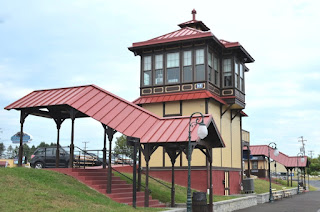
Reading Outer Station, Pottsville, PA
In 1983, the privately held Reading Blue Mountain and Northern Railroad (RBM&N)  began operations providing freight cargo service mainly for anthracite coal. Then, the railroad began passenger train service over a short portion of track with day excursions to various parts of PA. 

In May 2017, the RBM&N company began offering a round-trip excursion from the Reading Outer Station in Pottsville, PA, outside Reading, to Jim Thorpe, PA, using refurbished Rail Diesel Cars (RDCs). These cars were built by the Edward G. Budd Company  in the 1950s for railroad commuter use. The Budd Company, began in Philadelphia, PA, in 1912, and manufactured steel automobiles, passenger rail cars, and other transportation products.
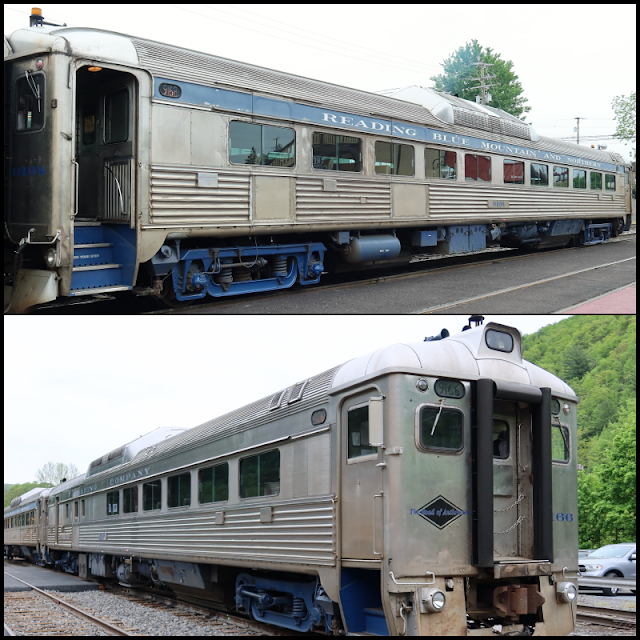
Budd Rail Diesel Cars run by the Reading, Blue Mountain & Northern Railroad
The Budd Rail Diesel Car, Budd car or Buddliner is a stainless steel, self-propelled diesel railcar. Between 1949 and 1962, 398 RDCs were built for passenger service in rural areas with low traffic density or in short-haul commuter service. They were less expensive to operate than a traditional diesel locomotive-drawn train with coaches and remain in service in the U.S., and several other countries as well.

The RBM&N Railroad owns and operates three self-propelled RDCs (9166, 9167 and 9168). The 9167 and 9168 cars are full coaches and the padded seats flip to face whichever direction the train is traveling. We could see everything, coming and going.

Our destination was Jim Thorpe, PA, which began as the village of Coalville in 1815, named as it was near a major anthracite coal seam which drew miners. Coal from the area fueled an expanding railroad system throughout the region. In 1918, Coalville was renamed Mauch Chunk, a Leni Lenape Indian name for a nearby mountain which means "Mountain of the Sleeping Bear."
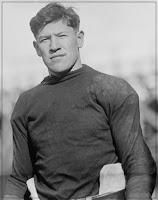
Jim Thorpe
By the 1950s, when coal was no longer in demand, it devastated the economy of the town, once considered one of the richest in America. Some enterprising residents began a fundraiser asking others to contribute A Nickel-a-Week to save the town. By 1954, $30,000 had been raised and what happened next is how it was renamed after the first Native American to win an Olympic gold medal for the U.S., who later became a professional athlete, but was not a native of PA and never lived in the state.

After Oklahoma, his native state, declined to erect a memorial, his widow, Patricia, struck a financial deal with Mauch Chunk officials to honor her late husband and his sports accomplishments. Thorpe's remains were relocated from Oklahoma and are now interred in a mausoleum just outside the town. The plan was to use Thorpe's fame to attract tourists, but while it received much national press, it didn’t immediately draw tourism to the former coal town. That took years of promotion. 
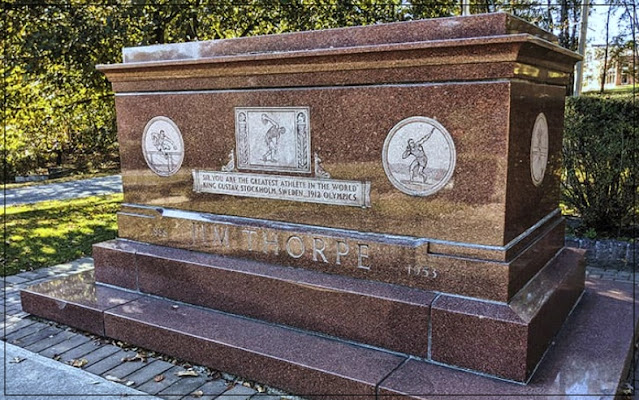
Final resting place of the town's namesake, Jim Thorpe
Today, visitors come to ride the tourist trains, view the area's natural beauty and view the unique historical architecture in the town, which includes Victorian, Federalist, Greek Revival, Second Empire, Romanesque Revival, Queen Anne, and Romanesque styles. 
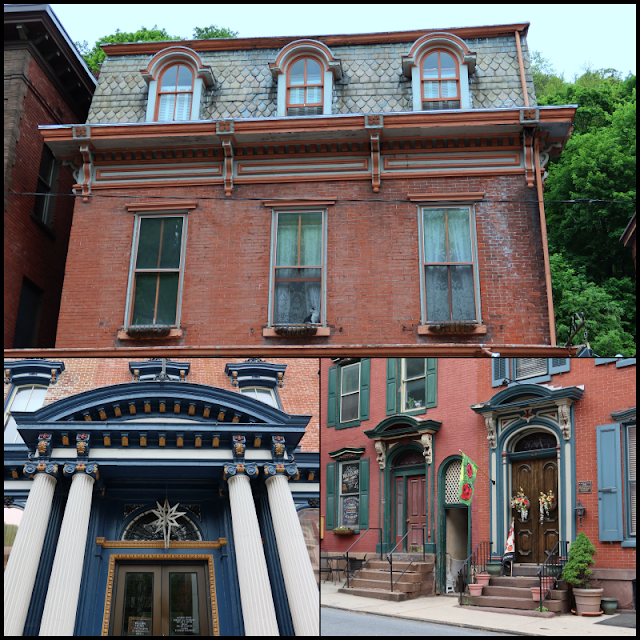
Some of the unique architecture in Jim Thorpe, PA
The historic buildings in Jim Thorpe feature very unique architectural details. The chimney pots, spirals and decorative gingerbread work are wonderfully preserved examples of late 1800 to early 1900s architecture. The town has been dubbed The Switzerland of America, a nickname derived from its picturesque scenery, mountainous location, steep hillsides, and narrow streets.
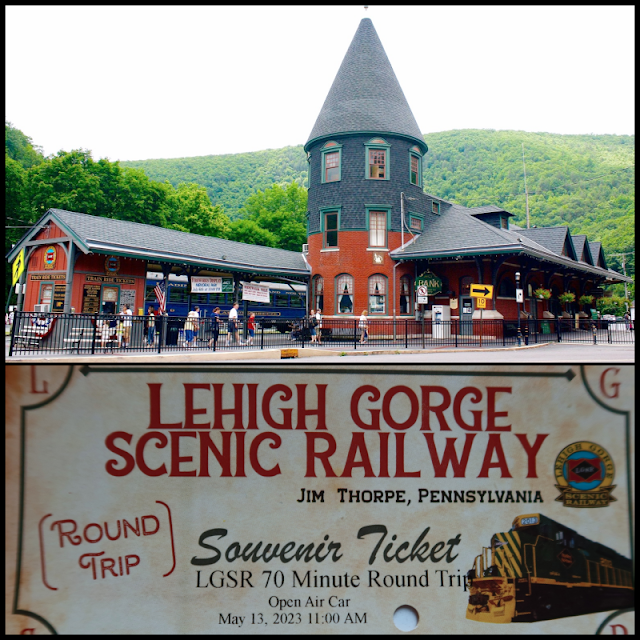
Train station in Jim Thorpe, PA, built by Central Railroad of New Jersey in 1888
Shortly after disembarking from our first train ride in Jim Thorpe, we boarded another train.
In 2005, after a railroad bridge was completed across the Lehigh River, a new passenger train operation and sister company to the RBM&N Railroad began and was named the Lehigh Gorge Scenic Railway. Trains operate from the vintage station formerly built in 1888 and operated by the former Central Railroad of New Jersey station. (We appreciated the connection to our home state.)
The 1-hour, 16-mile round-trip followed along the Lehigh River over bridges through Glen Onoko into Lehigh Gorge State Park. Most trains are diesel operated and the railroad primarily uses passenger coaches built as early as 1917. There are indoor seats in traditional train cars and open-air cars with bench seating. We opted for the open-air car which provided better views and let us walk around the car to see both sides of the track.
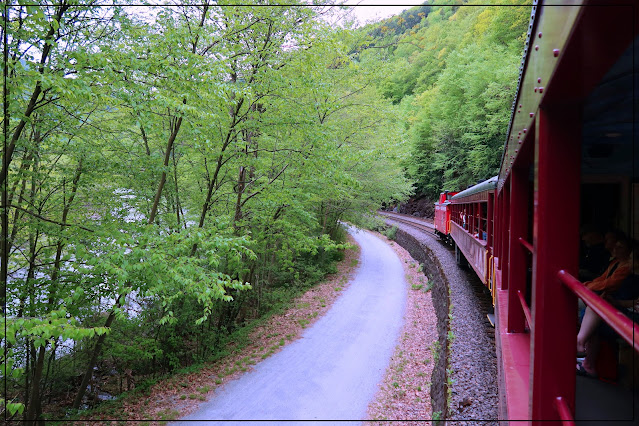
Most of the trip is within Lehigh Gorge State Park along tracks once owned by the Lehigh Valley Railroad. The D&L Canal Trail runs adjacent to the track and we saw many people walking and biking on this popular rail trail.
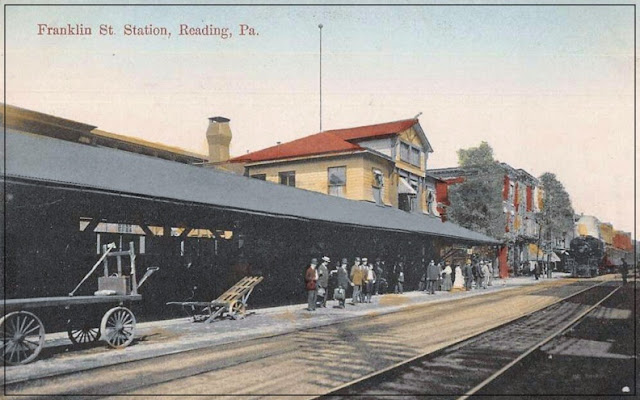
Franklin Street Train Station, Reading, PA, circa 1930s (online source)
Riding on trains wasn't all we did for our celebration. We dined in a former train and later bus station in Reading, PA. The Franklin Street Train Station was built in the 1920s as a stop along the Reading Railroad shipping and passenger Main Line to Philadelphia. It closed when diesel service was cancelled, remaining vacant. In later years, the Berks Area Regional Transportation Authority (BARTA) acquired and refurbished the building, then converted into a bus depot.
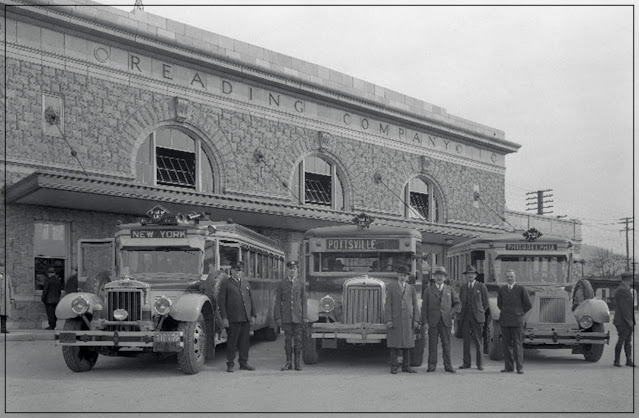
Bus service at former Reading, PA, train station (online source)
However, after bus service was discontinued because of low ridership, the building sat empty and abandoned. Damage from vandals, fires, and bird decimated the building over 40 years. Exterior stone walls were covered in graffiti, windows were broken or missing, wood rot was extensive, plaster was damaged from a leaking roof. The original train station benches were long gone and debris littered the building.
Exterior view of Saucony Creek Brewpub
It wasn't until 2017 that the vacant building was revived to host showings of This Is Reading, a site-specific installation that blended live performance and visual media to present a visual narrative about the city. In 2018, Saucony Creek Brewing Company leased the facility and opened a brewpub restaurant in July 2019.
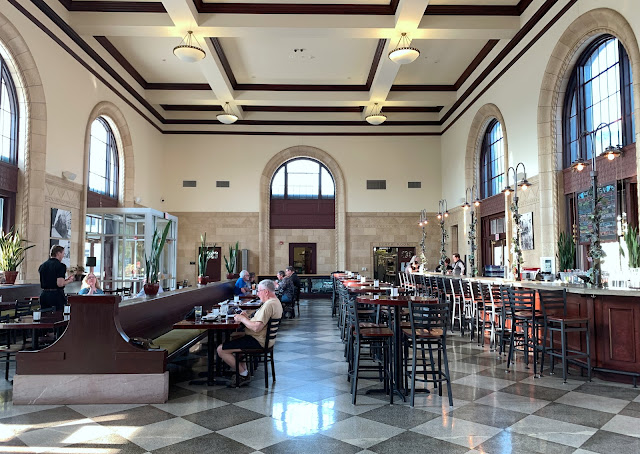
Interior View of Saucony Creek Brewing Company
The building is impressive and retains the feel of a classic train station with high ceilings and large windows. Rows of benches, like those that would have been used by waiting passengers 90 years ago, are the anchors of the dining area. None of the original benches or any remnants still remained in the building. The bench reproductions were based on historic photographs.

Norfolk Southern trains frequently use the former Reading Railroad tracks. On hearing the train horn, diners are encouraged to clap loudly until they have passed. We kept up that tradition too and clapped when a train passed. And, to answer a question in a fellow blogger's comment, the food was good. We went for an early dinner before more folks starting arriving after 6 pm.

We enjoyed ice cream on the trip; after all, it was a celebration !
After we returned home, catching up on things have kept me busy. This weekend hopefully will provide some catch-up time for blog reading.