|
| RI, the smallest U.S. state |
This is a long-ish post. I opted to combine more RI sites into one post vs. several posts. That said, there will be one more RI site in future.
The New England state of Rhode Island is the smallest state in terms of land mass. The five smallest states after Delaware are: Connecticut (another NE state), Hawaii and our home state of New Jersey.
While small in area, RI is definitely not small as far as interesting places to explore. On this road trip, we found several that were new to us.
Newport is perhaps the most well known RI city known and home to many well-known Gilded Age mansions such as The Breakers, Marble House, The Elms and others. All were called summer cottages, by the way-too-rich folks who built them and only spent a short time there each summer.
Last August, we visited several of these summer places. On this recent trip, we toured Rough Point, once owned by heiress Doris Duke.
Rosecliff Mansion
While all of these previously visited mansions have been paid admissions, this recent trip included FREE admission to another mansion, Rosecliff, with limited access only on the first floor. The second floor was closed due to ongoing renovations because of water damage. The mansion is 28,000 square feet with 30 rooms including 11 staff rooms, 2 trunk rooms, a sewing room and wardrobe room on the third floor.
 |
| Rosecliff Mansion in Newport, RI |

In 1891, Tessie and her sister, Virginia Fair, bought a spacious wooden cottage built around 1855. It was known as Rose Cliff and owned by diplomat George Bancroft, former U.S. Secretary of the Navy. Bancroft was well known for his rose gardens, Flower beds surrounding the house once had over 500 species of roses and roses still grew in the garden now.
 |
| Rear flower gardens at Rosecliff Mansion, Newport, RI |
 |
| Center ballroom windows at Rosecliff Mansion |
 |
| This ballroom is said to be the largest one in Newport, RI |
 |
| Heart-shaped grand staircase at Rosecliff Mansion |
 |
| Rosecliff Mansion main entry |
Rosecliff is now preserved through the generosity of its last private owners, Mr. and Mrs. J. Edgar Monroe of New Orleans, who gave the house, its furnishings and an endowment to the Newport Preservation Society in 1971.
Cliff Walk
A not-to-be-missed Newport experience is the 3.5 mile Cliff Walk which provides panoramic ocean views on one side and views of Gilded Age mansions on the other. The walkway is unique is that it's a National Recreation Trail, the first in New England, and is located in a National Historic District.


The public access Cliff Walk provides views of The Breakers, Marble House, Rough Point, and other prominent mansions from the Gilded Age as well as views into the Narragansett Bay.
 |
| Part of the Cliff Walk |
Cliff Walk is one of Newport's top attractions whether you walk part of (as we did) or the entire walk (as others have done). It's enjoyed by people of all ages. Current estimates have a quarter million trips made each year.
You pass at your own risk on the walk, a public right-of-way over private property. In spots just a couple of feet from the path are abrupt drops of over 70 feet. Wild bushes and weeds often hide this danger. There is plenty of signage along the route cautioning walkers to stay on the path.
The legal precedents for the Cliff Walk date back to 1663, when the charter granted by King Charles II promised Rhode Island colonists the right to fish along the shoreline.This right of public access to the shore was later guaranteed in the Rhode Island state constitution.
The coastline remained undeveloped until around 1880, when owners of the Gilded Age mansions started building a simple path along the coast, in sections. Over the decades, many disputes have erupted between landowners and the public about access to the walk, with wealthy owners sometimes erecting fences, boulders, or walls along the route.

 |
| yellow toadflax (left), hedge bindweed and common knapweed. |
 |
| Japanese honeysuckle, rugosa rose and rose hips |
FYI — those who have an iPhone (not sure if this works with other models) can do a plant ID after taking a photo or saving that was sent. Here's how: open the photo in the photos app, tap the "i" button at the bottom of the screen, then tap Look Up to use Visual Lookup to identify the plant.
Touro Synagogue
Touro Synagogue, dedicated in 1763, is the oldest synagogue building in the U.S.. This structure is steeped in history. It's widely considered as one of the 10 most architecturally distinguished buildings of 18th century America and the most historically significant Jewish building in the U.S. The synagogue is a National Historic Site in RI.
 |
| Touro Synagogue is the oldest in the U.S. |
The congregation was founded in 1658 by the descendants of Jewish families who fled the Inquisitions in Spain and Portugal and left the Caribbean seeking the greater religious tolerance that Rhode Island offered.
The Reverend Isaac Touro, born in Amsterdam in 1738, served as the spiritual leader of Jeshuath Israel in Newport, one of the first Portuguese Sephardic congregations in the American colonies. He built the synagogue that would be named for him. The synagogue was dedicated on the first night of Hanukkah in 1763.
President George Washington was the first head of a modern nation to openly acknowledge the Jews as full-fledged citizens of the land in which they had chosen to settle. In a letter to the "Hebrew congregation at Newport," written in 1790, President Washington pledged that our new nation would give "to bigotry no sanction and to persecution no assistance."
Written during Washington’s first term as President, this letter is believed to be his clearest statement of religious tolerance. In August 1790, congregants of the Touro Synagogue warmly welcomed Washington to their place of worship and their city.
 |
| Interior of Touro Synagogue |
Touro Synagogue stands as a symbol of religious freedom. It was designated a National Historic Site in 1946. The Ambassador John L. Loeb Jr. Visitors Center opened in 2009 with exhibits to further explore the history of Newport's early Jewish community and the origins of First Amendment rights. Each year, over 30,000 visitors visit the synagogue to see its interior and to pray.
Warren, RI
What makes this city so unique is that it's the smallest city in the smallest county in the smallest state. The population was 11,147 at the 2020 census.
 |
| A selfie in downtown Warren, RI |
After reading this fact in an issue of "Yankee" magazine, we decided to include a short stop in Warren. We found a thriving downtown with numerous local art and antique shops, waterfront restaurants and more.
 |
| Warren, RI, Town Hall |
The Town of Warren, RI, sits on the east bank of the Warren River, an arm of Narragansett Bay, and is bounded by the towns of Barrington, Bristol and Swansea, Massachusetts. Warren received its name in 1747 from the British naval hero, Admiral Sir Peter Warren, who was victorious at the battle of Louisburg in June 1745.
 |
| Street scenes in Warren, RI |
Settled in 1653 as part of the Massachusetts Bay Colony, Warren's working waterfront is one of the oldest in New England with more than 16 miles of shoreline, multiple marine-based industries.
Bristol, RI
Less than a 15 minute drive from Warren is the town of Bristol, RI. This deep water seaport is named after Bristol, England. Major industries include boat building and related marine industries, manufacturing, and tourism. This small harbor town has several claims to fame — a parade, marine museum and a mansion which features a 90-foot giant sequoia in the gardens.
What we had read beforehand is that Bristol hosts the oldest continuously celebrated Independence Day festivities in the U.S. The annual event attracts over 200,000 people from RI and worldwide. The elaborate celebrations have given the city its nickname of "America's most patriotic town."
The celebration began in 1785 when Rev. Henry Wight of the First Congregational Church, a veteran of the Revolutionary War, conducted the first historic celebrations referred to as Patriotic Exercises.
 |
| Street painted for Independence Day in Bristol, RI |
Since our visit was two weeks after July 4, we missed the festivities. However, evidence of just how seriously the holiday is taken was visible in the red, white and blue stripes seen on the parade route.
 |
| Bristol, RI, Art Museum |
The Bristol Art Museum is housed in a former mansion called Linden Place. It was built in 1810 by George DeWolf. The DeWolf family made their money in trading slaves. George’s family and descendants occupied the house for 177 years until the Friends of Linden Place, a non-profit group, assumed ownership in 1988. The house is considered the “architectural crown jewel” of Bristol. It was closed on the day of our visit.
 |
| Lyric Theater, Bristol RI, now and years ago |
The Lyric Theater, built in 1916, remains on the corner of Main and Miller Streets and evokes a memory of small town motion picture theaters.. As shown above, the theater originally featured a large marquee. After WWII, as with so many small theaters, this one struggled against larger chains which featured 10+ screens and modern amenities and ticket sales dwindled. The theater was sold in the late 1970s and converted to retail use. Since the 1990s, it's been the site of a gift shop.
Herreshoff Marine Museum
The other major claim to fame for Bristol, RI, is that it's home to the Herreshoff Marine Museum, a maritime museum dedicated to the history of the Herreshoff Manufacturing Company, yachting, and America's Cup. It was founded in 1971 by A. Sidney DeWolf Herreshoff and Rebecca Chase Herreshoff to preserve the accomplishments of this family company.
 |
| John Brown Herreshoff and Nathanael Greene Hereshoff |
The Herreshoff Manufacturing Company (1878–1945) was most notable for producing sailing yachts, including eight America's Cup defenders, and steam-powered vessels.. The company was founded in 1878 by two brothers, John Brown Herreshoff, a blind boatbuilder who had been in business since 1863, and Nathanael Greene Herreshoff, a naval architect and steam engineer.

The museum, is located near Narragansett Bay on grounds where the manufacturing company once stood. It features a collection of over 60 boats including Nathanael Greene Herreshoff's Clara, built in 1887, Harold Vanderbilt's Trivia, and the 1992 IACC yacht, Defiant. The Nathanael Greene Herreshoff Model Room contains over 500 yacht and steam yacht models and the Rebecca Chase Herreshoff Library holds a collection of books and manuscripts related to the company, the Herreshoff family, and yachting.

Even though I have minimal interest in boating, this museum was interesting as it is one-of-a kind and the boats on display were amazingly crafted.

However, Patrick (aka Grenville) has long been a sailing fan and as a former sailboat owner, he thoroughly enjoyed this stop.
Blithewold
Blithewold, a 33-acre summer estate, in Bristol, RI, is nationally significant in American history as one of the most fully-developed and intact examples of the Country Place Era in the U.S., and for its artistic value in representing the influence of the Arts and Crafts movement in this country.
 |
| Blithewold today |
The estate includes this 45-room mansion filled with family heirlooms and has an extensive garden and arboretum. The gardens contain over 1,500 trees and shrubs that grow along its borders. There are some 250 different kinds of plants with both native and exotic species. A few years ago, Blithewold, was named in Yankee Magazine's Best 5 Public Gardens in New England.
 |
| Bessie and Augustus Van Winkle |
Blithewold was the home of the Van Winkle family. Augustus Van Winkle, born in New Brunswick, NJ (another NJ connect) was heir to a family coal-mining operation in Hazelton, PA. He came to enjoy the Ocean State after attending Brown University in Providence, RI. His wife, Bessie Pardee Van Winckle, who also grew up in Hazleton, PA, and was heiress to a mining fortune. They purchased 70 acres of waterfront land in Bristol as a summer retreat away from their Hazleton, PA home to build what they called a "country home." Coincidentally, Van Winkle also purchased a 72-foot steam yacht from the Herreshoff boat building company in Bristol.
 |
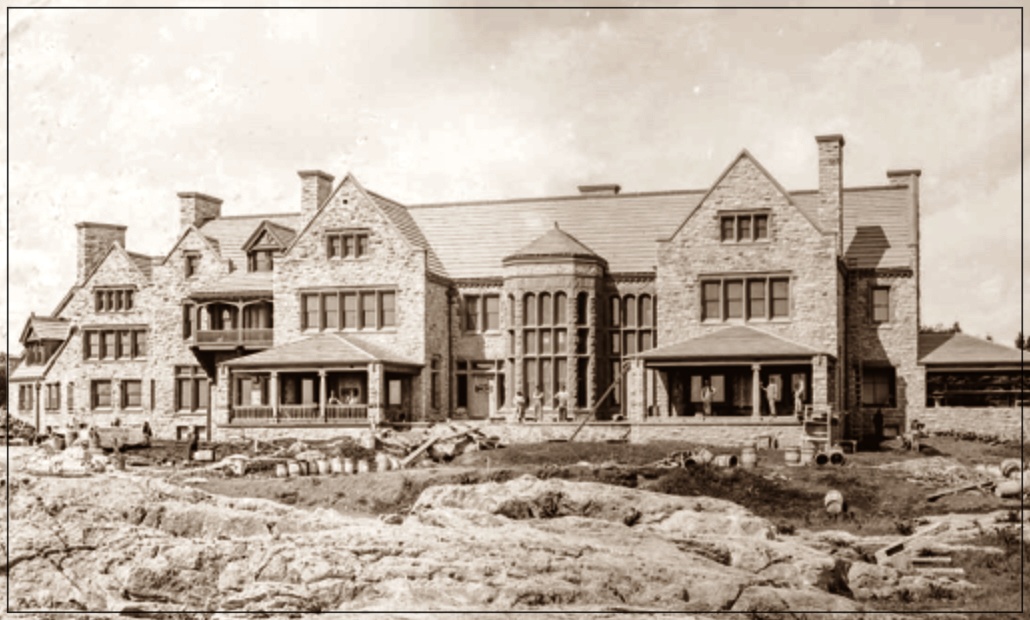
| Blithewold, an early photo |
The mansion was built in Queen Anne style in 1895 and named Blithewold (Old English for "happy woodland") but it was destroyed by a fire in 1906. The slow-moving fire within the walls could not be extinguished, but much of the furnishings and other objects were removed from the house. It was rebuilt as Blithewold II and designed in the English Country Manor style.
 |
| The Great Lawn goes to the edge of Narragansett Bay |
Bessie Van Wickle was an accomplished horticulturist who wanted enough land to establish gardens and an arboretum. Blithewold’s sweeping 10-acre Great Lawn rolls down to the water’s edge and boasts more than 1,500 trees and shrubs that grow along its borders. There are nearly 250 different kinds of woody plants in the collection with both native and exotic species.


 |
| The Christmas tree would be set up here |

The trees at Blithewold have attracted attention throughout its history. Landscape architect John DeWolf's handwritten notes from 1895 contain his original plans for the property. He designed an informal landscape of gently sloping lawns with wide borders of flowers, trees and shrubs.

DeWolf planted a Giant Sequuoia (Sequoiadendron giganteum) referred to as the “big tree” in 1911. A native of Bristol, DeWolf was formerly Superintendent of Prospect Park in Brooklyn, NY, where he had been growing the sequoia in a greenhouse.
 |
| The Big Tree and the bamboo grove (and us) |
The Bamboo Grove covers an area nearly the size of a tennis court, and is planted with Yellow-groove bamboo (Phyllostachys aureosulcata) which grows to 33 feet tall.
Today, aside from the mansion, it's the maturity of the gardens which is one of the defining features of this property. It attracts a range of visitors including botanists, garden groups and home gardeners looking for ideas and inspiration. It's also a popular site for weddings and other special events.
Thanks, for coming along if you have made it to the end of this post As fellow blogger, AC, aptly noted in his comment, we definitely DO NOT do tidbits. When putting this together it seemed better to go for everything at once vs. several posts. Yet, despite doing that, there's at least one more to come on this recent RI trip, but NOT this week.