Showing posts with label cars. Show all posts

Friday, June 13, 2025

This N That

Today is Friday the 13th ðŸ˜± all day.

If you have a fear of this date, your fear is known as paraskevidekatriaphobia. 
But, fear not, as this is the only Friday the 13th in 2025.

This post contains That N Thats — vintage cars, a theater mural, unique seating in a downtown Nashua NH, walkway, Father's Day and knee update — all in a single post. 

On Wednesday, the Hudson Senior Center, which we're members of, had an early Father's Day  vintage car show. While the turnout was smallish, here's a few of the vehicles.
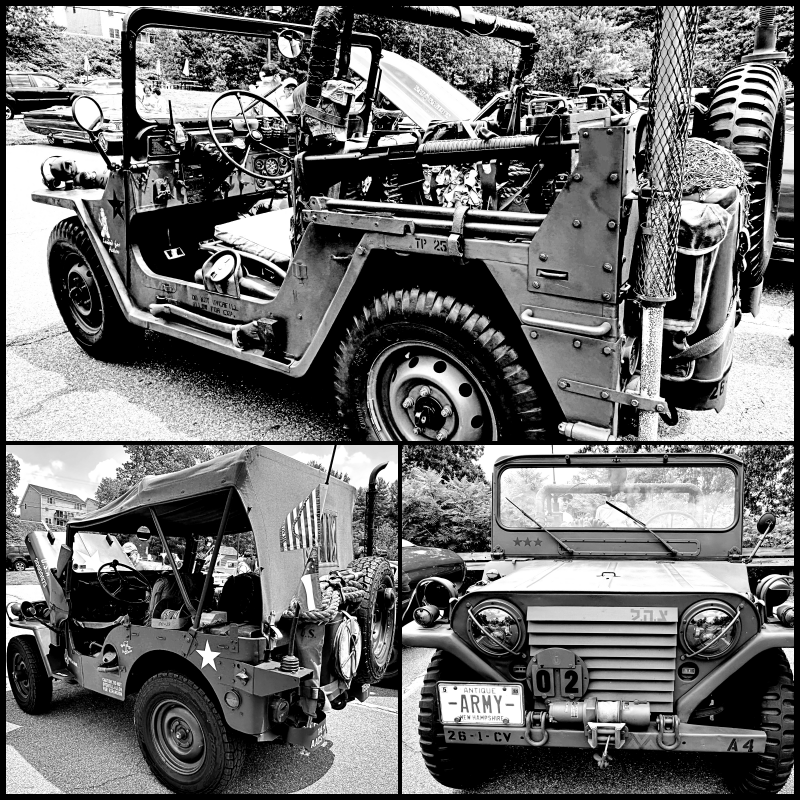
These two Jeeps are privately owned
These two Jeeps ere equipped with a lot of ordinance, including hand grenades, all of which were deactivated and served as reminders of what soldiers used in times of conflict.
Hudson's low-slung body gave it a sleek look uncommon for its time
This Hudson sedan was produced by the Hudson Motor Car Company produced sedans from 1909 until 1954, with production continuing under the American Motors Corporation (AMC) brand until 1957. Hudson was a medium-priced brand. It cost more than a Ford or Chevrolet, but less than luxury models like Packard. 
The Ford Galaxie was a best-selling convertible
The Ford Galaxie was a full-size car model produced by Ford from 1959 to 1974. It was a top-trim level car, often competing with the Chevrolet Impala and Plymouth Fury. The name was inspired by the Space Race and the excitement surrounding it. Initially, it was the top trim level for Ford's full-size cars. 
The Chevrolet Impala was in production from 1958 to 2020 for a total of 64 years. with some periods of discontinuation. It was among the better-selling American-made automobiles in the U. S. The model was discontinued primarily due to declining sales and a shift in consumer preferences towards SUVs and crossovers. 
Chevelle SS convertible is highly sought by collectors
The Chevelle SS (Super Sport) was available as a convertible starting in 1965 and continued to be produced as such through the 1970 model year. Chevelle was a mid-sized automobile produced by the Chevrolet division of General Motors (GM) in three generations for the 1964 to 1977 model years. It was one of Chevrolet's most successful nameplates that was retired in 1977 with the Malibu taking its place.
Hot rods reached their peak popularity in the US during the 1950s and 1960s, often referred to as the golden age of automobiles. This era saw a surge in interest in modifying classic cars for speed and unique customization. 
Mercury was a popular U.S. car in the 1930s and 40s
While this classic Mercury sedan has undergone some engine modernization, it was still a beautiful car. This sedan was part of the Mercury brand which was produced by the Ford Motor Company from 1939 to 2011. The brand was established to bridge the gap between Ford and Lincoln models.
An Oldsmobile from 1967 was easy to identify
The Olds 67 license plate refers to the 1967 model year of this Oldsmobile which was produced by General Motors. Oldsmobile produced a variety of models in 1967. Although Oldsmobile as a brand continued to produce cars until 2004, the specific models that were introduced or redesigned in 1967 would have ceased production at the end of that model year to be replaced by their 1968 counterparts. 
This vehicle looked like a modified PT Cruiser
The Chrysler PT Cruiser was produced from 2001 to 2010. Production began in 2000 for the 2001 model year and ended in July 2010 with the last PT Cruiser coming off the assembly line. A convertible variant was available from 2005 to 2008. Car enthusiasts enjoy modifying and customizing vehicles to enhance performance, appearance or both. This car is a popular choice for such projects.  Some PT Cruiser modifications, such as those inspired by classic hot rods, are designed to attract attention and showcase creativity. 
The Ford Ranchero model was a car-truck
For car buyers who couldn't decide between a sedan or pickup truck, there was the Ford Ranchero, which was produced from 1957 to 1979. This was a coupe utility vehicle, also known as a car-truck, that combined the features of a sedan and pickup truck. Unlike a standard pickup truck, the Ranchero was adapted from a two-door station wagon platform that integrated the cab and cargo bed into the body. A total of 508,355 were produced during the model's production run. We learned that the one above had belonged to the current owner's grandfather and was all original after being stored in a barn and later a garage.
This mural was recently completed on the walls of the Court Theater which is the primary stage used by a local children's theater group, The Peacock Players.
A new mural in downtown Nashua, NH
The mural is one of the newest in Nashua, NH, completed by Positive Street Art (PSA), which has been responsible for creating many colorful downtown murals in the city.

New seating options in downtown Nashua, NH
The top photo shows a walkway that leads from Main Street to the Nashua Public Library, and is known as Library Walk. Last month, the above seating areas fabricated by MakeIt Labs were installed here. (MakeIt Labs is New Hampshire's first and largest maker-space, a unique non-profit organization run by a volunteer staff.) Full disclosure, I tried the new seating and none were very comfortable.

This Sunday is Father's Day and while the calendar changes annually, it's always celebrated on the third Sunday of June. Below are photos of our fathers, who passed away years ago.
Happy Father's Day to ours (Patrick's top & Dorothy's bottom)
Did you know that according to Hallmark — about 72 million Father's Day cards are exchanged in the U.S. annually. It's the fourth-largest card holiday (after Mother's Day). The most popular dad gifts are cards, outings, and clothing, but a survey revealed that what most fathers wanted was to stay home or spend time with family. If you are fortunate enough to have your father nearby, do celebrate this day with him. Time is priceless.

Last, an update on my left knee posted about previously. After a 6-week orthopedic follow-up and PT sessions, I’ve been discharged with at-home exercises, The orthopedic PA (physician's assistant) advised that an MRI could be done if wanted, which she neither recommended nor discouraged, so I opted out (for now). There's recurring, but not persistent, discomfort due in part to arthritis.

Enjoy Your Weekend Everyone
It's another ☔️Saturday in Nashua, NH, the 13th consecutive rainy weekends
Just a Coincidence?

Tuesday, July 30, 2024

Green, Red & In Between

The colors in the post title refers to the mostly green and red sports cars on display at the "Show of Dreams" car show in Hudson, NH, sponsored by British Cars of New Hampshire (BCNH) last weekend. On display were some 200 cars in 25 classes of British, American and International antique and classic cars. The show was a fund raising event with entry fees paid by car owners donated to the New Hampshire Food Bank. 

2024 Show of Dreams poster
BCNH was established in 1991 by a member of the New Hampshire Chapter of British Motor Cars of New England, headquartered in Fall River, MA. Since there were no activities in NH or Southern Maine, NH, car enthusiasts formed a new club to fit the needs of British sports car enthusiasts here. 

As membership grew, BCNH sponsored its first annual British Car Show in June 1997, attracting over 100 British car owners from throughout the New England area. BCNH has held the "Show of Dreams" annually aside from its cancellation in 2021 due to Covid, and always benefitting an area organization.

Having attended this show previously, we noticed, once again, that the most prominent car color was what's become known as "British Racing Green" or BRG. 
Perhaps not everyone knows why it's called that or how it became recognized as the official color of international motor racing in the UK. Curious to learn more, I did find out and soon you will as well.

Why BRG is the Official Color of Motor Sports in the UK
In the early 1900s, British racers were effectively barred from competition in the because the national speed limit on all British roads was very low. Car racing on public roads was illegal. To compete, UK racers traveled to mainland Europe, where speeds were higher. When Britain first competed in 1902, it had to choose a different color from its national colors of red, white and blue. Racers in Italy, Germany, and France had already made that trio of British colors their own. 
So, when Britain hosted the 1903 Gordon Bennett Cup the following year on a closed course at Athy in Ireland, the British adopted Shamrock green which later evolved into various shades of "British racing green."

In combination with the need to paint the cars a different color, the 1902 Gordon Bennett Cup was won by the British driver Selwyn Edge, ensuring that his home turf would play host for the 1903 race. Because of the British restriction on road speed, the race was held in Athy, near Dublin. British racers, in deference to their hosts for the home race, the British cars were painted a dark shade of emerald green.
There's no exact hue for BRG which is a collection of emerald to dark green nuances. The term denotes a spectrum of deep, rich greens. "British racing green" in motor sport terms meant only the color green. Its application to a specific shade has developed outside the sport. Over the years, BRG has deepened in shade akin to  “forest green.” It's still associated with many heritage British brands of cars like Jaguar, Aston Martin, Lotus, Land and Range Rover. 
What about Racing Red?
Red is traditionally popular with sports cars and drivers who want to stand out. The bold color makes a car appear flamboyant and sporty. Rosso Corsa or 'Racing Red', is the historic international color of Italian racing cars. Since the 1920s Italian race cars of Alfa Romeo, Maserati, Lancia, and later Ferrari and Abarth have been painted in "racing red." Wile there may have been some Italian models in this show, all the autos above are British makes. 
Various shades of both green and red were prominently on display at last weekend's show when looking down the lineups of cars.
Yellow is viewed as an exotic color for sports cars. It's the actual color of Ferrari Racing. Auto fans are familiar with the iconic Ferrari logo of an all-black horse prancing on a yellow background. Yellow is the main color in the iconic Lotus emblem; the center car in the collage above bears that emblem.


While there were a number of cars in blue, this color wasn't the most featured color.  The McLaren sports car shown above is made by McLaren Automotive, a British luxury automotive manufacturer based in Woking, England. The main products of the company are sports cars produced in-house in designated production facilities. Sadly, the company's founder, Bruce McLaren, died in 1970 at age 32 when his race car crashed. He was testing a new McLaren car when the rear bodywork broke up.

We spent a couple of enjoyable hours at this show looking at these sports cars, none of which we will ever own and which their owners proudly showed off. It's always nice to find a weekend event so close by and free as well. 

Thursday, June 15, 2023

A Mall of Cars

The post title is not very imaginative or creative, but after thinking about it for way too long, my decision was to just go with what this post is all about—a LOT of cars. This post is a(nother) photo overload, but with so many classics on display, it was unavoidable.

Our late May trip to PA, in addition to family visits, included two train rides and a stop at a private car museum (previously posted about)All required an admission fee. And, we also saw another car collection at Classic Auto Mall in Morgantown, PA. While this former mall isn't a museum, it has more cars on display than some auto museums.
Classic Auto Mall is a former mall in Morgantown, PA
Did I mention it's Free, very large and completely indoors so there's no worries about the weather outside, no matter what the season.
The ex-mall interior is completely filled with cars, walkways and former storefronts
Unlike auto consignments that only offer online inventory, Classic Auto Mall is a car museum and sales floor showroom for well-used and some one-of-a kind vintage cars. Located on 8 acres, this 336,000-square foot facility has over 600 vehicles on consignment with floor space for up to 1,000 vehicles.  
 Styling and colors were real stand-outs
Here's a size comparison: In 1910, Penn Station in NYC was 8 acres; this facility is the size of that former station. Another way to describe the size is that it equals six football fields.
Hood ornaments were very distinctive in years past
What is always amazing to see is how autos years ago were so much more stylistic and even colorful than modern cars now when one looks the same as another. Today's cars have more plastic and fiberglass parts compared to the metal on most vintage autos. 

Opened in 1985 as a clothing outlet mall, this building was later a furniture outlet mall. Closed in 2011, it was empty for years. Its past history can be seen on furniture signs displayed above showroom windows; even one for a former Food Court.
Car rears are interesting too; the Olds Rocket 88 (middle) was touted as a muscle car
Finding the vacant mall, two partners each had a goal: One needed storage space for a large private collection, the other wanted to start a business. They agreed to accomplish both.
Trucks were as unique as automobiles in both color and styling
Classic Auto Mall opened in early 2018 and according to the website has sold more than 1,200 vehicles on over 60 websites worldwide as well as through the showroom and on the auto mall's website. Walk-in customers are welcome to visit and check out vehicles up for sale. If you're just visiting to see the collection, like ourselves, you can stay as long as you want. 

These car fronts are just a representative look at many amazing designs
The barn find collection (
vehicles found in barns or garages) has about 400 classic autos and trucks from the early 1900s and later. Some have been restored, others remain in the same condition as found. None of these vehicles are for sale.  
There were many vintage trucks and tractors in the collection
Owners can store and offer a car for sale with no upfront or monthly fees for an initial 90-days. When it sells, the owner pays a 10% commission. Most cars come from a 300-mile radius; some are consigned from as far away as CA and TX. According to what I read, about 95 percent of sales are from Internet traffic. 
Street rods were represented in a large floor display; all were for sale
When a car arrives, it's brought into a dedicated garage to be checked over, then brought into a a dedicated auto photo studio. Pictures are taken and every detail is shown, including any rust, dings or dents. Every vehicle gets a detailed write-up that outlines its history.  
Every bit of floor space and showrooms had vintage vehicles
The facility and grounds have ample space for indoor and outdoor events, like car shows and car club meets. A 28-acre paved, lined and lighted parking lot has space for 2,500 vehicles.

Stringo® vehicle mover
We wondered how cars were moved around the mall because while there's a lot of floor space, most of it is filled with neatly aligned vehicles. We learned that inventory changes daily and about 20 cars are added every week. This can make moving them a challenge.

Cars are moved using a heavy-duty Stringo® vehicle mover with a single person operating it. Engines are never started as the mover and operator guides cars in and out of tight spaces, keeping the indoor space free from auto emissions.

The auto mall four wings facing north, south, east and west, all filled with vehicles. There's an estimated $4 million worth of vehicles in the east wing alone. While some museum pieces are roped off, most cars are openly displayed on the floor space.
So many to see that it was difficult to select a favorite color or style
The Classic Auto Mall also houses player pianos, wooden carousel horses and a giant, working Wurlitzer music box from a carousel, but it wasn't playing during our visit.
This 1973 Straightly was a most unusual auto
This 1973 one-of-a-kind Straightly was custom built for a never-released film, The Daughter of Bonnie & Clyde, based on a novel by Layton Brent. Despite being advertised in Variety and the media the film did not make it to theaters. This custom body consists of aircraft aluminum on a 1955 Chrysler chassis. The car was in CA for years and previous owners are said to include Hugh Hefner and Steve McQueen. It's now up for sale at a price of $46,000. 
While his car was in the auto mall, Batman was not around
The Batmobile was another unusual vehicle. It was displayed in a roped-off area, so a closer look was not possible. As far as I could determine, this one was not for sale. 

Grenville is more into cars than myself, but nevertheless I found this auto mall a more than interesting look at cars that were once not only modes of transportation, but beautifully designed. This stop was an unexpected "find" and definitely worth the visit. 

Classic Auto Mall is every day, except Sunday, and located at 6180 Morgantown Road, Morgantown, PA, if you're planning a future road trip. This stop was an unexpected "find" but definitely worth the visit. A car aficionado would easily spend hours here.

We've experienced trains and autos recently. Our next mode of transport will be by air as we're traveling (further) in late fall.

I will catch up on blog reading over the next few days as we spent the past weekend visiting family in RI.

Tuesday, June 6, 2023

PA Cars Have Muscle

Imagine having your own personal collection of high performance cars and building a barn-like museum to house them. 
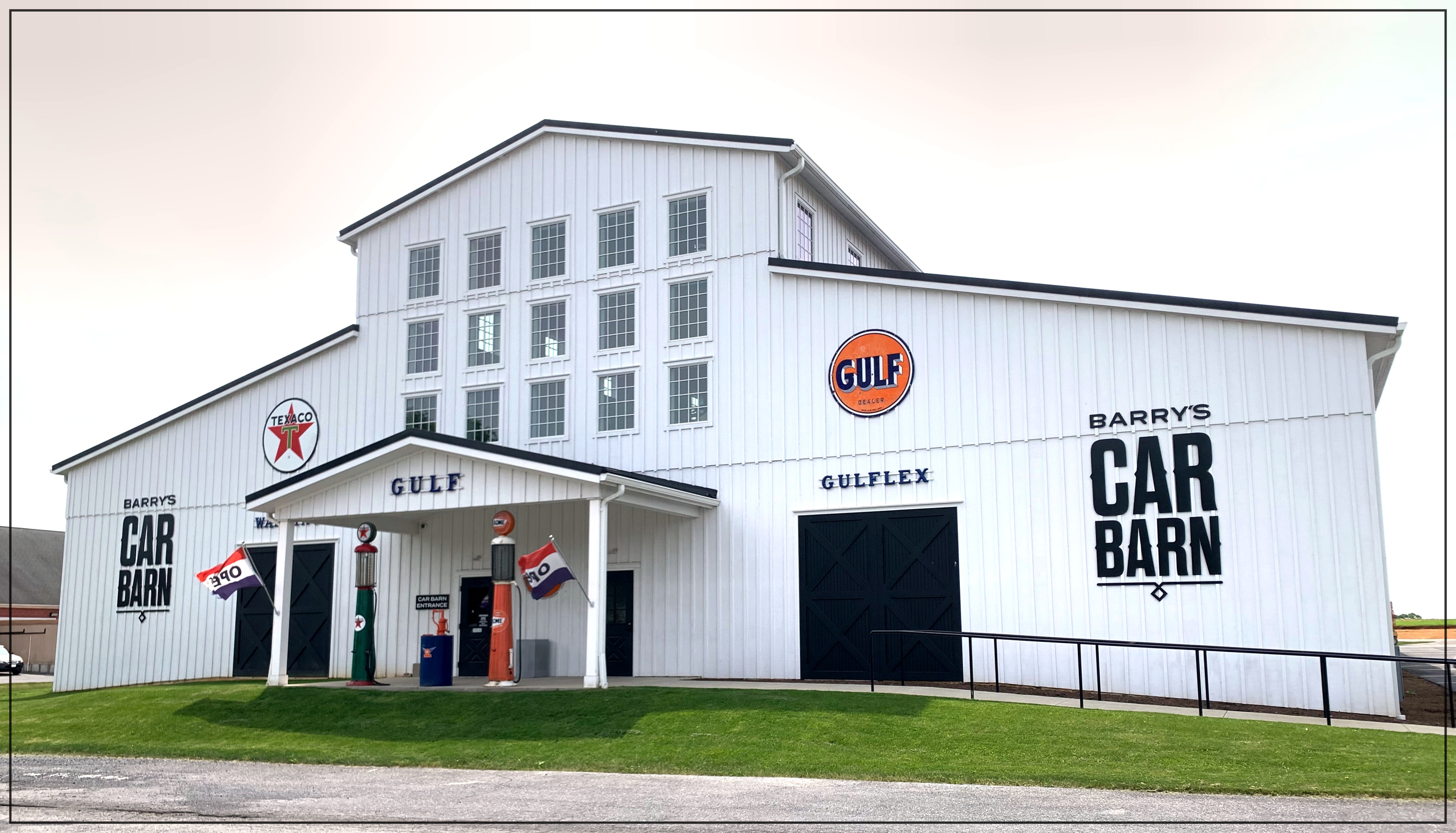
Barry's Car Barn in Intercourse, PA
It's not something, most folks could do, but that's what Barry Baldwin, a 70+ year old Lancaster County native, businessman and entrepreneur did that. InApril 2021, he opened a classic car museum in the small town of Intercourse, PA, featuring American muscle and sports cars from the 1950s to 1970s plus vintage autos, motorcycles, and car-related items. 

While Grenville is more the car aficionado than myself, I've always enjoyed seeing vintage autos. The expression they don't build them like they used to really applies to all these cars.
This museum was a stop on our PA road trip in May
This museum was a planned stop on our May anniversary road trip to PA. We bypassed it at first as although it's far from a small building, it's set back from Old Philadelphia Pike with no signage at a short driveway leading to it. There is a $13/person admission for this private museum. That expense balanced out as the same day we visited a larger and free auto collection, just 15 miles away (more in a future post).
Panoramic of car barn interior
There's more to see in this car museum than unique vintage autos. Walls are covered in gas company signs and other memorabilia with a number of free-standing vintage gas pumps too.
Gas company logos cover the museum walls
The red Pegasus flying horse logo above was used by Mobil starting in 1934 with ads boasting: A new sign rises to guide America's car owners to the gasoline and service they want. It remains among the most recognized corporate symbols in American petroleum history.
Vintage motorcycles include Harley Davidson, Indian and Triumph models
We didn't do a count, but there's over 50 cars in the barn, all visible down two main aisles, this includes 15 Chevrolet Corvettes, a row of Ford Shelbys, street rods, vintage 1930s autos and rare motorcycles like these Indians, Harley Davidsons, and Triumph.
Baldwin, who has owned cars from when he could legally drive, bought his first collectible car in the 1960s.  His interest in cars dates from working at his father's car repair and gas station in Gap, PA. That station was started in 1922 and is still in the Baldwin family. 
Lineup of Chevrolets, including many Camaro models
Of course, collecting vintage cars is not an inexpensive venture, so it helps if you own a large company. Baldwin heads an electrical and mechanical contracting business with six PA locations and several hundred employees. 
A good looking vintage sports car in the collection
Reportedly, Baldwin doesn't look for specific vehicles and instead buys unrestored, partially and fully restored cars that he likes. While he's also sold cars, his goal is to showcase the collection in this museum.In addition to the ones displayed here, there's more stored elsewhere in various states of restoration. Future plans are to rotate vehicles as they're ready to be shown here.
Two convertibles: Vintage Mercury coupe and Jaguar sports car
Admittedly, my knowledge of muscle cars is very limited, but I learned that most were known for having powerful engines and a broad, boxy shape. 
Chevrolet Impala and Pontiac GTO models
The muscle car term is often used for mid-1960s and early 1970s special editions of mass-production cars designed for drag racing. The term usually applies to a two-door, rear-wheel-drive, small to midsize car with a large, powerful eight-valve (V8) engine. It entered the general vocabulary through car magazines and automobile marketing and came into general use for performance-oriented street cars.
Grenville and 1958 Chevy Bel Air
Grenville was excited to find a 1958 Chevrolet Bel Air. He once owned a 1956 model in the same Nassau Blue color. This GM model debuted in 1950 and was produced by General Motors from 1950 to 1975. The car was named after a wealthy Bel Air neighborhood in Los Angeles, CA. Models were distinguished by the Bel Air name script in gold lettering.

The popular Bel Air was part of an entire series of top of the line Chevy hardtops, sedans and convertibles along with the Nomad, 210, and 150 models. Consumers had made Chevrolet the top auto maker and Bel Air was at the core of Chevrolet's popularity. 

Ad for Olds 88 Rocket engine
It was interesting to learn that the first U.S. muscle car was introduced in our birth year, 1949 when General Motors introduced the Oldsmobile Rocket 88 car in January, named after its engine design.

The powerful new V8 rocket engine in the Olds 88 was designed by American inventor and engineer Charles Kettering. His design was aimed at putting a big engine in a smaller car at an affordable price, and it succeeded. It hit the highways in 1949 with a starting price of under $4,000.

America’s first muscle car had a streamlined design and body style, termed FuturamicThe “Rocket” name which some GM executives disliked was so popular that the Olds 88 was produced until 1999. Collectors have bid up to $100,000 for a 1949 model at some auctions.
Vintage car ads for 1949 Oldsmobile Rocket 88
The Olds Rocket 88 could be purchased with a deluxe trim package that added chrome and a clock, but cost up to $100 more for a radio. The 1949 model had a top speed of 97 mph and coupled sports car performance with the usability of a family car. It featured modern post-war styling and soon became the brand’s best-selling model. (Some Olds 88 facts: The Rocket-powered Olds inspired a popular slogan, Make a Date with a Rocket 88. The song, Rocket 88, recorded by Jackie Brenston and the Delta Cat, reached #1 on the Billboard R&B chart and is often cited as the first rock & roll record.)
Chevrolet Corvette line-up
On one side of the museum is a pristine row of Chevrolet Corvettes, which are not muscle cars, despite some misconceptions. Corvettes are sports cars, super lightweight with an aerodynamic design and fiberglass construction. Unlike muscle cars which focus more on power, they bank on speed and a more refined design. The Corvette line of two-door, two-seater luxury sports cars has been manufactured and marketed by GM, under the Chevrolet marque, since 1953.
1954 and 1955 Chevrolet Corvette models
The top photo shows a 1954 Corvette with a hand-molded fiberglass white body. If you look close at its fender, you can see the weave of the fiberglass material under the paint. Below it is an almost identical 1955 model, but with a machine-pressed fiberglass body and a V8 engine. 
1956 Chevrolet Corvette
This nearby 1956 aquamarine Corvette is as great-looking as when its first owner drove it off a showroom floor.
Line-up of mostly Ford Mustang Shelby cars
One side of the museum features an entire line ↑ of iconic Ford cars, most are Mustang Shelby muscle cars with a couple of Ford Thunderbirds too. The Shelby Mustang is a high-performance variant of the Ford Mustang and has a large engine as modified by the late Carroll Hall Shelby, an automotive designer, race driver and entrepreneur who established Shelby American. (The most expensive car here is reportedly a 1967 Shelby 500 which Baldwin has estimated to be valued between $175,000 to $275,000. Sorry, there's no photo.)
Chevrolet Chevelle SS
The 1970 Chevrolet Chevelle LS6 is only one of 4500 that were produced. It includes a 450HP V8 which was the most powerful engine produced that year. Its owner paid an added $263 for the bigger motor, and it makes the car worth $80-$90,000 today.
1931 Ford Model A and 1947 Mercury Woodies
There are two woodies in Baldwin's collection: the 1931 Ford Model A (top) is only one of 851 produced. This model was the Ford company's second big success after the Model T. Below, the 1947 Mercury station wagon was an eight-passenger station wagon which at the time was the most expensive model in the Mercury lineup, selling for $2,207 (imagine that). (A woodie is the term applied to a wood-bodied automobile either made of wood or styled to resemble wood elements, that was a popular station wagon type in the 1930s-40s) 
Two restored street rods
The automobiles on display span numerous makes and models like these two street rods. Some retain original parts; others have been fitted with updated conveniences like backup cameras and remote locks.
Grenville and Packard similar to one his grandfather owned in NJ
While I didn't find any cars that were owned by members of my family, Grenville found a second one. This beautiful Packard was similar to one that his grandfather owned and drove for his limo service in South Orange, NJ.

Eventually, the car barn will house a second-floor brew pub and restaurant that will overlook the display floor. Now, it's the museum that attracts tourists and residents. Many have either owned a car like one in the collection or know someone who did, like Grenville. Others, like myself, enjoy seeing these vintage motorcars which someone else had the funds to assemble.

If you're traveling in the Lancaster area, Barry’s Car Barn is at 3504 Old Philadelphia Pike, Intercourse, PA (PA Route 340) opposite the popular Kitchen Kettle Village, which will make it easier to find for anyone else.