Showing posts with label seasonal. Show all posts

Wednesday, March 29, 2023

It's That Time

Many places have four seasons—did you know that New England has 5?

It's called Mud Season and it coincides with the spring season.

New England's 5th season is Mud Season
One day there might be several inches of snow and the next day it's sunny and 50℉. These weather and temperature swings combine to create this 5th season in New Hampshire, Maine and Vermont.  

Maybe you're wondering if Mud Season is a really big deal. If you live in New England, it's a way of life for several weeks as venturing out on unpaved roads by foot or auto is a slushy mess. It's worse on hiking trails, and there's a lot of those in the White Mountains of NH and the Green Mountains of VT.

A hiking trail in Mud Season: online source
Think of it like an extended thaw because that's what Mud Season is—the time between winter and spring when the combination of snow, rain, and melt produces very wet ground conditions  which leads to mud. The exact time period is weather-dependent, but it usually starts around the snowmelt in late March (now) or early April. 

What Causes It? When snow melts and spring rains start, the ground can only hold so much
water. Varying temperatures result in a slow thaw. Lower ground levels stay frozen longer and prevent water from draining, so it gets trapped at surface level.

Walking in mud: online source
Warm days the past couple of weeks have led to sloppy conditions on many trails in Mine Falls Park in Nashua, NH, where we have enjoyed hiking.
Trail use is limited in many spots, caution is advised. Whenever there's a muddy trail, it's best to find another spot to hike; walking in mud is never an enjoyable experience. 

On hiking trails, deep wide mud puddles often take up entire sections. Walking around muddy areas or walking on the edges of trails tramples vegetation, widens the trail, and causes more damage to both the trail and the environment.

Oversaturated trails are vulnerable to damage from soil compaction and erosion. Water erosion and wind carry soil away leaving rocks and roots exposed; soil compaction degrades the trail by reducing its ability to absorb water, causing more flooding. It's become such an issue that some state forest trails close for a while in Mud Season.

When does Mud Season End? Sometime in mid-May to early June when stronger sunlight starts to dry things out. Mud Season usually ends around Memorial Day, which seems like a long time. It's not an exact timeframe due to climate change. 

Some New England cars during Mud Season
If walking in Mud Season is an experience, driving in it is more so. It's been compared to driving in snow where slow and steady is best. Driving through mud results in a very dirty car at best and, at worst, the car could veer off the road. Most likely, there's as many happy car wash owners during Mud Season as during winter. 
The L.L. Bean Maine Boot is available in many styles
Mud Season is when a iconic New England fashion comes into use—the easily recognized boot which was created by Leon Leonwood (L.L.) Bean to solve the problem of soggy boots. In 1912, Bean designed
Leon Leonwood Bean
 a boot based on the comfort and flexibility of a leather upper plus the durability of a rubber-soled work boot. The goal was to keep his feet warm and dry 
when hunting in western Maine. 

Setting up shop in his brother’s basement, he manufactured 100 pairs of a Maine Hunting Shoe and promoted it in a mailer sent to out-of-state sportsmen. Bean was so sure of his product that he offered a 100% satisfaction guarantee. While this was a good marketing concept, unsatisfied customers took him up on the offer and 90 pairs were returned. 

The problem was that despite Bean's innovative design, the single-line stitching tore through the rubber and separated completely from the leather upper. 

A man of his word, Bean issued refunds and borrowed money from his family to redesign the boot with a more durable rubber. It was reinforced by triple-line stitching to ensure the rubber and leather would not separate. The triple-line stitch is still a signature of the L.L.Bean Boot.

Babe Ruth letter to L.L. Bean
Over the years, Bean’s reputation for quality and customer care grew. He received letters and photos from outdoorsmen and women countrywide. One loyal customer was baseball great, Babe Ruth, who wrote his own letter of appreciation in 1934.

The Bean boot (Maine Hunting Shoe, Bean Boot or Duck Boot) is one of the most recognizable pieces of footwear in American outdoors history. The 8-inch, unlined tan boot is so popular that several years ago there was a nationwide shortage. 

In addition to the triple stitching, another feature that has never changed is the signature rubber sole. For many, this alone makes it an outdoor must-have during Mud Season when the boot does what Bean designed it to do—keeps feet dry.  

Now, after all this about Mud Season and Bean boots, you might wonder if we have a pair. The answer is No. There's an L.L. Bean outlet store in Nashua, NH, where we tried them, and didn't find them very comfortable. 

Triple stitched, rubber soled 8-inch tan Bean Boot

Thursday, September 8, 2022

Fall is Here at Home

It's Fall —at our home, at least as the weather here in Nashua, NH, finally is starting to feel and look more autumnal. By the way, that word (autumnal) was in a recent issue of Yankee Magazine, about fall in New England. So, a perfect choice to use here.
Fall decos🎃🌻 went up outside our apt a couple weeks ago before the recent Labor Day weekend, traditionally considered the end of summer. Summer temps were unusually high for New England this year, so thinking cooler was definitely on my mind. Here's the 10-day forecast for Nashua, NH. Maybe wishful thinking helped just a little ?
Temps were still in the high 80s and near 90 when theses all came out of hibernation from a tub in the storage unit, after all, isn't that where seasonal decos go? At least that's where happens here. Thankfully, the storage unit is on the same floor as our apt, just a walk down the hallway. There's no garage storage in the underground parking area.
Of course, regular readers of this blog may already have seen most of these decos in autumn posts for several years. There have been some slight yearly variations, but not many.
My decorating plan was to replace most of these with new decos from the local Dollar Tree, where nearly all were purchased over the years. When, I found out that the taller scarecrows were still being sold, only now cost $1.25 each, the old ones would do just fine, once again. Some of the smaller scarecrows were not even available this year.

So, the old saying, If It Ain't Broke, Don't Fix It worked for my decorating plans, once again.
Curious about the origin of that ↑ phrase, I did some online sleuthing and found out this idiom has only been documented since 1977, although many believe that it's much older than that.

Pres. Carter & Bert Lance
It's said to have originated in the USA in the 20th century attributed to Thomas Bertram Lance, known as Bert Lance, a close adviser to President Jimmy Carter during his 1976 campaign. Lance was director of the Office of Management and the Budget in Carter's cabinet. In May 1977, he was quoted using the phrase in the newsletter of the US Chamber of Commerce.

While Lance certainly popularized the phrase, it's believed to have originated as a colloquial phrase in southern states years before his celebrated use. However, it began, within a few short years, if it ain't broke, don't fix it became so established as a part of the language that it's become a cliché.

So now you and I, once again know, the rest of the story; you're welcome too.

Your turn—ready for cooler weather in your area?

(If you live in CA and nearby states, hopefully the dual issues of extreme heat and rolling blackouts will be improving soon.)

Thursday, October 15, 2020

Safest Crop in Chester

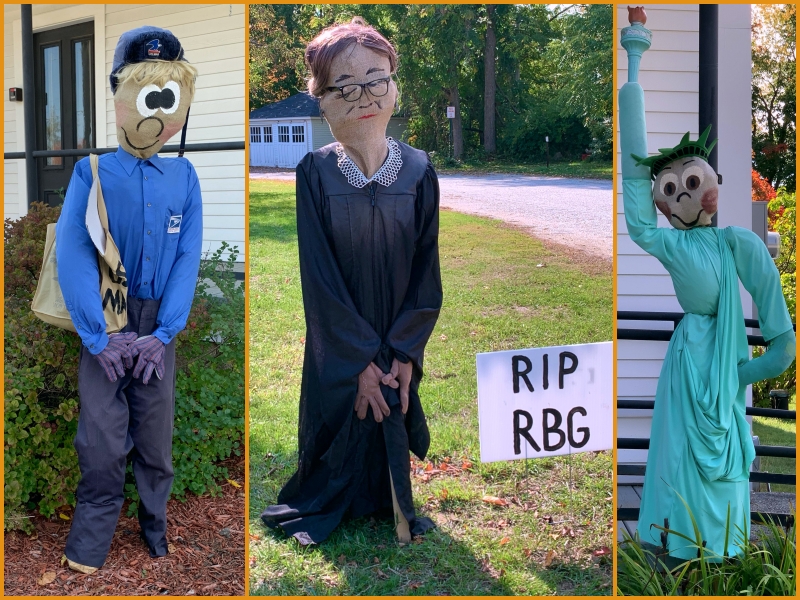
It's the time of year once again when scarecrows and pumpkin people increase the population of  many New England towns—Some more so than others.
Driving through the town of Chester, NH, is a leisurely drive most days, but since 2010 it's become a fall destination for many people, and this year, ourselves included. 

In a year of social distancing, this is an event which can be done from driving along Routes 102 and 121, but on busy weekends it's harder to slow down to see all these seasonal scarecrows that are anything but “standard.”

Chester is considered one of the oldest towns in NH. Every October, its population is temporarily increased by up to 1,000 seasonal residents. This quintessential New England village features many stately 18th and 19th century residences. Railroads bypassed the town later in the 19th century, and the lack of new development helped preserve the town’s appearance.

Town residents definitely have a sense of humor and a lot of whimsical creativity as hundreds of scarecrows can be seen throughout the town. Estimates place the current number at close to 1,000 as 100 new kits are sold each year since the project started a decade ago.


The Chester Historical Society (CHS) started the now traditional displays as a fundraiser, selling 60 scarecrows the first year. The project was the brainchild of  member Jackie Brown. Residents purchased the kits and created the very personalized scarecrows. Since then, the scarecrows have become a town tradition.

Each kit includes a painted burlap face and sticks to help the figure stand. No two faces are alike. Only 100 kits are made each year, but the scarecrow population keeps growing as residents add to their collections.

The CHS announces when the scarecrow bodies go on sale, usually the second Saturday in September. No advance orders can be placed and they sell out fast, usually before the end of the month. A purchase/donation is for a painted burlap head and wooden body frame.

Scarecrows are made by CHS members who create the kits at a “Scarecrow Sweatshop,” Some members cut out the scarecrow heads from burlap material, others paint faces, sew heads and then iron them. Jackie's husband, Don Brown, president of the historical society, creates the wooden body structures. The couple is also represented by scarecrows ↓.

Many figures take up seasonal residence along Routes 102 and 121, and many are congregated where three properties listed on the National Register of Historic Places — Chester Village Cemetery, Chester Congregational and Baptist Church, and Stevens Memorial Hall — converge. (The National Register of Historic Places is the U.S. federal government's official list of districts, sites, buildings, structures and objects deemed worthy of preservation for historical significance.) According to an online site, Chester may be the only NH town with listed properties occupying three of four intersecting corners. We were able to park, then safely walk to view a collection of scarecrows in this area, including some of the ones below.

Many residents spend much of the year planning the elaborate creations, each with its own story to tell. It's been reported that many people know what they’re going to do next year, even before the kits are available. Each year, residents change their scarecrow creation, with the exception of the historical figures and town heroes which they are encouraged to retain each year.


No two are alike, all are all responsible for slowing traffic and turning heads. Many figures represent historical and literary personages: George Washington stands guard over a cemetery where Revolutionary War soldiers are buried; Edgar Allen Poe stands with a copy of The Raven by the Chester Village Cemetery with a raven perched on his shoulder. Ben Franklin flies a kite.
Others are simply whimsical. The seasonal residents span decades and represent everything from pop-culture icons, to popular tv shows, classic movies, funny puns, and even horror. The front yard of one residence featured Marilyn Monroe, Little Orphan Annie, and Alfred Einstein

Not only have the scarecrows grown in number and creativity over 10 years, so have the number of Scarecrow Peepers who show up every October as well. It has put Chester, NH, on many fall road trip destinations. One year, the town was featured in an AAA story which drew visitors from many non-New England states.


Sometimes, you can go to a town’s online site and read about residents griping about one thing or another, not so in Chester, NH, in October where the town talk is usually about one thing — scarecrows. It’s happy and people are positive — that’s a very good thing these days.

Scarecrows stay up the entire month of October and go into hibernation after Halloween. By no means did we even come close to seeing all the scarecrows throughout the town’s 26 miles of roadway. We plan to start earlier next year.


The concept of scarecrow people isn't new. Many projects can be found throughout the U.S. and abroad too; it's also the name of a reggae band. For aficionados willing to travel (when they can), there’s a very unique scarecrow site along Highway 5 outside of Suomussalmi, Finland, where over 1,000 scarecrow-like figures, The Silent People (Hiljainen kansa) stand in a field. Created by artist Reijo Kela in 1988 these simple wooden bodies are made of bog-like material and straw hair and wear colorful clothing which is changed twice a year. 


The artist has never explained his purpose preferring that viewers come up with their own interpretations. A popular theory is that they represent those lost during a battle that took place during the Winter War of 1939-1940 between Finland and Soviet Russia.

Internet source

Motorists term the sight amusing or scary. The figures are constructed of peat heads covered in straw hair. The cross-shaped wooden bodies are draped with colorful clothing that is collected through donation and changed by the Suomussalmi Youth Workshop which maintains the installation.


For now, we plan to continue viewing local scarecrow installations. The downtown scarecrows are back along Main St, Nashua, NH, and will be featured in a future post.

Wednesday, November 6, 2019

Falling Down

No, I'm not talking about Grenville or myself taking a fall, but the leaves falling down in Mine Falls Park in Nashua, NH, a short walk from our mill apartment.

I've posted about this park in the past. Its seasonal beauty is always worth exploring again. Come along for a walk and don't forget to crunch the leaves as you walk along.

Photos in this post were taken on three separate outings in early to mid-October when the foliage was plentiful and very colorful. Recent wind and rain storms have blown off most of the leaves. In the coming months we'll explore the park in snow.

Mine Falls Park is one of the most popular areas in the city. The park is located in the heart of the city and covers 325-acres that include forest, wetlands, and open fields. The park is bordered on the north by the Nashua River and on the south by the Millpond and canal system.


The park property was part of a large complex owned by the Nashua Manufacturing Company, which harnessed the river's flow to power its textile mills downstream on Factory Street. When the mills closed in 1948, a new owner sold the Mine Falls land to the a group of local businessmen, the Nashua, New Hampshire Foundation.


The name Mine Falls dates to the 1700s, when low quality lead was thought to have been mined from the island below the falls. In the early 1800s, the potential of the Nashua River to drive the wheels of industry was recognized. Workers used shovels and mules to dig a three-mile long canal. It's no longer used for industrial purposes, and the walking trail along the canal was bursting with fall colors 2 weeks ago when we walked it.


In 1987, the Nashua River Canal and the Nashua Manufacturing Company Historic District (the Millyard) were placed on the National Register of Historic Places. In 1992, the park trails were designated as part of the New Hampshire Heritage Trail system, which extends 130 miles along the Merrimack River from Massachusetts to Canada.


In addition to the walking/hiking trails, Mine Falls Park has a lot of other sport and recreational activities such as kayaking, fishing, cross-country skiing, snow-shoeing, and biking with no admission or parking fees. Several sports fields are used for baseball, lacrosse and soccer. Park trails are used for high school cross country training.

Mine Falls Park is located within the second largest city in the state of NH. Yet, when we're out walking, there's no distracting sounds, aside from humans, dogs and wildlife on the trails. In addition to its extensive trail network, the park has several wildlife viewing points like the one below. 

In late spring to early June, large-mouth bass and sunfish can be seen in the canals. The wetlands provide nesting sites for red-winged blackbirds, song sparrows, and mallards among others. We've also seen Canada Geese, herons and swans on our walks.
Of course, the trees are home for many bird species, including year-round chickadees, nuthatches, blue jays and woodpeckers. Chipmunks, squirrels, beavers, muskrats, turtles otters and raccoons are usually spotted the river and canal or in the woodlands. During a recent walk, Grenville found a conveniently located tree seat.

Fortunately for us, Mine Falls Park is a short walking distance from our apartment. The mill residence we live in was formerly the Nashua Manufacturing Company.
We go to the park as often as possible and appreciate that it's so close to our residence. It's a very scenic way to exercise. Thanks for coming along; hope you enjoyed the views.

Wednesday, September 18, 2019

Autumn is Outside Our Door

Autumn has arrived and that means changing the decorations outside our apartment entry. Since we don't decorate for the season inside the apartment, this grouping greets us (and others) daily. The tall scarecrows, which have been hanging out for several fall seasons, were joined by a couple of smaller versions this year.
This frog and penguin always hang out outside our door and also have some companions.
There's more scarecrows and pumpkins on the walls and our front door. 
This overall photo shows the entire seasonal scheme, which was really low-cost. All the scarecrows, pumpkins, fall leaves, and wall plaques were from a local dollar store. The penguin and frog statues and the garden flags traveled from VA with us. 
How about you — any fall decorations outside your doorway?