Showing posts with label Vermont. Show all posts

Thursday, April 4, 2024

Straddling Two Countries

The Haskell Library and Opera House
At first glance, It looks like any other Victorian-style building from the early 20th century, complete with stained-glass windows, a grandiose facade and a slate roof. But, appearances aside, this isn't just a grand old building. Here, the border between two countries bisects the building, leaving library users and theatre-goers in one country or the other.

Amazingly, the Haskell Free Library and Opera House (Bibliothèque et salle d’opéra Haskell) is a historic building that's located equally in the small cities of Derby Line, Vermont, U.S. and Stanstead, Quebec, Canada. At the time it was built, people in this rural region moved freely, between these borders, not so anymore.

Derby Line is the still rural Vermont town on the U.S. side of the border. Stanstead, Quebec, the small town on the Canadian side also has American roots and, according to its website, it was founded by pioneers from New England in the 1790s and once a haven for smugglers and bootleggers. As the town grew,  it became the first Canadian stop for the stagecoach that ran from Boston to Quebec City.

At the U.S. border in Derby Line, VT
How did we come across this place?

We were on a road trip to Derby Line, VT, last week to complete our application for Global Entry at the U.S. Customs and Border Protection (CBP) Office. This program allows expedited clearance upon arrival in the U.S. from travel abroad. We're (hopefully) planning to travel abroad at least once before year-end.  

The trip from Nashua, NH, to VT was 3 hours each way. We stayed overnight in the area. We had read about the Haskell library and knew that we wanted to visit it.

While the ornate stone two-story Queen Anne Revival-style building that houses the library and an opera house has two addresses, Canadian and American, there's only one entrance and it's on the U.S. side of the border, which is where we were too..

Americans can freely enter by the front door in the U.S. Canadians cross the border in front of the library, stay on the sidewalk and enter via the front door too. They return to Canada via the same route and cannot walk anywhere else in town. And, Americans cannot cross over the sidewalk into Canada. I admit to having crossed the line.

Passports aren’t required since this isn't a formal border crossing, but the library tells visitors to expect their movements to be monitored and carry an ID, just in case.The photo at the left shows how close the border is. This crosswalk is adjacent to the Haskell library. 

Canadians can freely access the library and must return back by the same route when they leave. Family reunions or cross-border visits are not allowed inside, banned after relatives, who were allowed to be in the U.S. or Canada, not both, began arriving for get togethers. The day we visited, a Canadian police vehicle was parked on the Canadian side monitoring the border line. A library volunteer we spoke to told us the border was monitored daily; however the patrol car wasn't there when we left. We had our passports with us, but they were not needed.

Martha Haskells & son Horace Stewart
The building's construction combines elements of the Queen Anne, Georgian and classical revival styles, typical of public libraries of that time. It was conceived and financed by Martha Stewart Haskell, a wealthy Canadian citizen, and her son Horace Stewart Haskell in memory of Stewart's parents, Catherine and Horace Stewart, and late husband Carlos Haskell, an American sawmill owner. 

According to available information, the Haskells purposely chose to build on the border so that Canadians and Americans would have equal access to the library and opera house when border restrictions were more fluid. 

Two large portraits of the Haskells are displayed in the entrance hall. As accounts go, Martha Haskell’s goal was to cheat the border. Accordingly, for years, Canadians and Americans would cross into each others’ countries to attend school, church and marry. Times have changed since then.

Construction began in 1901 and the opera house opened in 1904 as a profit-producing venture that would support the free public library which opened in 1905. 
It's easy to know which country you're in by the very unusual international border, this  black tape line that divides it down the middle. This dividing line was not accidental. It was added to designate the exact border line after a fire decades ago set off a fight between insurance companies over which had to pay for damages.
Patrick has one foot in two countries
We stepped across the tape on the floor and crossed from the U.S. into Canada. This atrium was the center but the circulation desk wasn't here years ago. It was originally positioned to block access to the stacks where the books were located. Small flags of both countries are provided so visitors have a photo opp with a foot in each country as Patrick did above. 
A wooden book used years ago
Years ago, library visitors didn't have free access to books because at the time (1904), books were more valuable and harder to come by. Library users would tell the librarian what they wanted or would give a wooden block of wood with the title — as shown in the above photo — then the book would be brought out. The circulation desk (shown in a photo below) was originally positioned to block access to the stacks where the books were located.
The Haskell library stacks are mostly the original shelves
Today, the library stacks can be freely accessed by library patrons and visitors alike. The library's collection numbers over 20,000 books, mostly in English and French with some Spanish titles as well. Most of this collection is located in Canada. 

The Opera House seating
Unfortunately, the opera house was closed to visitors on the day of our visit, so we didn't see the opera house interiors, this time.

Available photos showed a magnificent venue with a domed ceiling, original mahogany wooden seats and a balcony. The seats closer to the stage are pricier, wider, and have an armrest. We learned that cushions can be rented for the hard wooden seats, regular attendees bring their own.

The stage screens were done by an artist from southern Vermont hired by Horace Haskell. The one that's used most often is a Venice scene which includes a steamboat,  in the back of the scene as Haskell liked steamboats.

As in the library, the theatre is crossed by an international border. Most of the 400-seats are in the U.S. and the show is performed on a stage in Canada. 
Haskell Opera House balcony, Internet source
The opera house includes an arch that provides a clear view of the performance, decorative cherubs and wall murals are typical of early 20th century theatre decor. Performers here have included vaudeville, jazz, blues, rock, music and dance performers, many have left their signatures on dressing room walls.

"Benny"
This is the only moose we saw on our road trip despite the numerous Moose Crossing road signs. It's nicknamed Benny and is displayed in the library near the main desk. As with the flags near the entry way, it's a popular photo "opp."

The story goes that the huge moose was shot in new Brunswick, Canada, by a man named Hunt and that it didn't fit into the front door into his house. Many suspect that his wife refused entry and so it was donated to the library.

The clock in the photo below is original to the 1904 library opening. According to the library volunteer, who provided much information during our visit, it wasn't working for years until a patron repaired it and now it runs perfectly, she added, as long as a staff member remembers to wind it..
The original clock and main library desk
Over the years, some of the library rooms have changed uses. The children's room was the once the men's reading room, where men would recline with their newspapers, books, pipes, and cigars near the room's fireplace. Each room features a different locally-sourced wood, perhaps in tribute to Martha Haskell's sawmill owner husband. There are also several fireplaces, no longer in use except for decorative purposes.
The building has been classified a historic site in both countries. In the U.S., it was registered in the National Register of Historic Places (NRHP) in 1976 and has been included in Ripley's Believe It or Not. In 1985, the building was designated a National Historic Site in Canada and has been a provincial heritage site since 1977. Being on the international border, gives the Haskell library a unique distinction of being the only NRHP registered landmark above the 45th parallel.

If you're entering from the U.S., there's limited parking at the library in a small adjacent lot. You can see American and Canadian border crossings shown on granite markers. 
An illegal border crossing can be quite costly
If you plan to visit The Haskell Free Library and Opera House, its address is 93 Caswell Ave., Derby Line, VT or 1 Church St. Stanstead, Quebec depending on where you're traveling from. 

FYI in reply to comment: Yes, as with many places, the Haskell Library was closed for a couple years when the pandemic cancelled everything. Initially, it closed for a week, then a month and then 2 years. During the shutdown, money was raised to install insulated windows in the opera house. Before this was done, winter performances couldn't be scheduled as the facility was too cold, the season now includes winter performances. As to a query as to which country owns the building, I couldn't find a definitive answer, perhaps it's owned by both countries
Did anyone say that Spring was here? It certainly was not Mother Nature who has sprung a late April Fools' Day weather event here in New England with a nor'easter. This was the 7 a.m. view outside from our apartment windows today. 

Finally, here's a shout-out to my brother on his birthday today. He's celebrating in our home state of NJ, where the weather is just as miserable but only rainy.

He's officially a senior citizen, just like ourselves. This posted before photo shows him celebrating a much earlier birthday. I hope he enjoys a 🎂 cake today as well !

We're thankful to be celebrating after all these years.

🎉 Happy Birthday 🎈

Monday, June 5, 2017

Bear With Us

Recently we took a road trip to celebrate the 20th anniversary of our 1st date and posted highlights here

What wasn't shown was our trip to "bear" country, not to see live bears — but teddy bears.


Vermont Teddy Bear Company is now the largest U.S. teddy bear manufacturer with an output of 150,000 bears annually. It began in the 1980s when a Vermont resident, John Sortino, found that his children’s stuffed toys, including teddy bears, were non-USA made. Working from his garage, he stitched together a bear and named it “Bearcho,” (an ode to Groucho Marx). Sortino later added movable body parts, re-naming the bear “Buddy.”
During the first year, he sold 200 bears from an outdoor market in Burlington, Vermont. When a visiting tourist asked to have one sent to her home, he added packaging and mailing bears and created the "Bear-Gram." It featured a customized teddy bear placed in a box (complete with "air hole"). Today, bears are still packaged this way.

Sortino opened a factory in 1985, followed a decade later by the facility we visited in Shelburne, Vermont. Another factory is in Newport. Each bear consists of 20 parts and 14 layers of fur. There are various stations along its path to completion, such as the Sewing Station, where parts are stitched inside-out to hide the seams and the Stuffing Station, where, a machine shoots recycled bottle fillings into the bear at 100 mph. 


Not only are all teddy bears assembled in Vermont, but most of the component materials come from America as well; the bear "fur" is made in Wisconsin. The eyes of every bear contain the phrase “Born in Vermont” as does a rear tag.
Each bear comes with a lifetime guarantee and will be repaired or replaced, at any time, as long as the tag on the bear’s rear is identifiable. Injured bears go to the Bear Hospital for treatment. If the injury is too serious, the bear will be replaced. During our factory tour, we saw several bear "tragedies" including burned when used as a pot holder, chewed by a dog, melted in the dryer, and run over by a lawn mower. 
We met the "head" (or rather very large) bear" during our factory tour. And, we couldn't leave (actually we could have, but decided not to) and brought home our own teddy bear, who we named "Shelby."


Sunday, December 9, 2012

Salvaged in Vermont

There's junk and then there's salvage. Know the difference?

1102 Vermont Salvage16

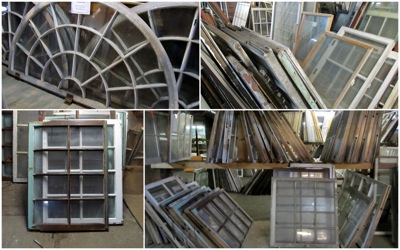
Junk is what some folks call trash and others call treasure. But, salvage is something totally different, especially architectural salvage which often recycles the past. One of the most interesting salvage warehouses is Vermont Salvage in White River Junction, VT, a former railroad center that has reinvented itself as an artists' colony.

1102 Vermont Salvage15

Vermont Salvage is headquartered in a former grocery supply building, where it started some 25 years ago. It's easily found in the center of town, across from the train station. For the past 25 years, Vermont Salvage has specialized in salvage items. But, you won't find knick-knacks or flea market items there, just LOTS of things salvaged from homes, schools, hospitals, military bases and businesses. This diversity of salvage jobs means that there is a constantly changing and very unique on-site. 

Maybe you're searching for a new sink, toilet or tub — no matter what color, you just might find it here. Maybe you just need some windows or a door, perhaps a period fireplace mantel or some unusual seating. And, if you can't find just what you're looking for, just ask and you may also learn the history behind a find — every piece HAS a story.

1102 Vermont Salvage91102 Vermont Salvage41102 Vermont Salvage101102 Vermont Salvage13

If you plan to visit in winter, bundle up because it's  unheated. And, be sure to wear comfortable shoes so you explore ALL 3 floors encompassing some 30,000 square feet of inventory space. There's lots of categorized AND some uncategorized treasures.

IMG 6085

We spotted these beige and orange benches from the Fairway Bowling Alley in Natick, MA,  which featured candlepin bowling, a uniquely New England sport, that uses smaller balls and skinnier pins than traditional bowling, making it harder to score points. Fairway was founded in 1956 and closed in 2011, nearly 56 years afterwards. Vermont Salvage acquired all  the alleys and some other nostalgic items from Fairway. Some of the alleys will be re-purposed into dining room tables.

At one time, many banks had grates and windows like this — look at the lettering above this one — fitting for this time of year.

bank grate

(If you can't make out the lettering on the bank teller's window above, it reads Christmas Club . . . are these still around?)

Wednesday, November 21, 2012

Quechee Gorge

Did you know that New England has its own (little) Grand Canyon and that it's in Vermont?

Quechee Gorge collage

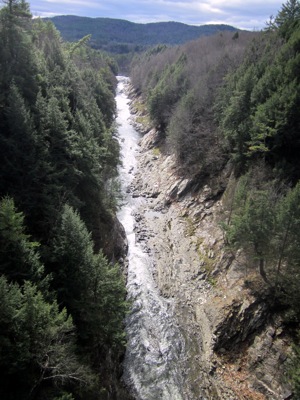
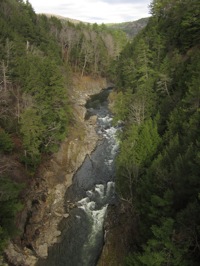
The 1.4 mile long Quechee Gorge (say KweeChee) on the Ottauquechee River has been called Vermont’s Little Grand Canyon. It's one of New England’s most popular natural wonders — best of all, you can see it FREE. (Just avoid the touristy souvenir shops in the nearby Quechee Village.)  

quechee gorge1

Quechee Gorge can be seen from the Quechee Gorge Bridge on Vermont Route 4A in the Town of Hartford. The drop from the Quechee Gorge Bridge to the bottom of the gorge is roughly 165 feet.

How did it happen?
It was formed by glacial activity when the climate cooled (about 100,000 years ago) the Laurentide Ice Sheet formed in northern Canada, flowed south over New England, burying the Ottauquechee River underneath ice and snow. The ice sheet has been estimated to have been at least 1 mile thick.
 
quechee gorge2As it started to warm up, some 13,000 years ago, the ice sheet started melting, but instead of flowing straight into the Connecticut River like before, it flowed into the arm of a huge lake, Glacial Lake Hitchcock and backed up behind a dam of gravel left by the ice melt.  When the dam broke, the Ottauquechee River turned south wearing away the bedrock until it cut all the way through creating a huge waterfall and the gorge. 

Quechee Gorge is now part of the 612-acre Quechee Gorge State Park. The land was originally owned by the A. G. Dewey Company, a major wool processor in the 19th century. Dewey established a mill about 1869 and  became a successful wool processor, employing as many as 500 people, who lived in the mill village. Water from the falls and the mill pond just above the gorge powered the facility. In 1841, Dewey began making reworked used wool called shoddy. By 1936, the mill was the oldest one in the country making shoddy wool; it was used to make Boston Red Sox and New York Yankees baseball uniforms, and U.S. Army and Navy blankets. The mill closed in 1952 and relocated to Enfield, New Hampshire. Over the next several years, nearly all of the mill houses and buildings were demolished. Remains of mill and dam can still be seen at the head of the gorge.

Quechee was known for a picturesque covered bridge at the site of the old Quechee mill. In 2011, the bridge was severely damaged by flooding as a result of Tropical Storm Irene. Irene did more damage in one day to the state's old bridges than is typically done in a decade. Many of them had stood for more than 100 years. The bridge is under repair (image from Burlington (VT) Free Press pre-Irene).

Quechee bridge

Monday, November 19, 2012

New England Rock Solid

Granite is considered a "rock of ages" because not only is it among the oldest rocks in existence, but it's said to last forever — as cemetery memorials show.
ROA facility
A visit to the aptly named Rock of Ages Company in Graniteville, south of Barre, Vermont, bears this out. This granite quarrying and finishing
company was founded in 1885; granite had been quarried in the area since the 1820s. The arrival of the railway later in the century provided a way for this stone to get to markets elsewhere in any quantity. Granite is not only hard and durable, but very heavy — a one-foot cube weighs over 170 pounds.
The company was originally named BM&V after its founders, George B. Milne, James Boutwell, and Harvey Varnum. In 1914, BM&V hired an advertising company to rename the company and increase its visibility. The name "Rock of Ages" was chosen after the religious hymn of the same name. From then on, all Barre granite from the BM&V quarries was marketed as "Rock of Ages," gaining name-brand recognition for the granite. The name proved so successful that it was adopted by the company when it incorporated later that year.
Rock of Ages soon became a combination of several companies that continued to expand, acquiring local companies and quarries in New Hampshire, Georgia and Quebec, Canada. Its quarries produce the highest combined volume of dimensional granite in North America. Rock of Ages now owns and operates over 40 quarries and is the largest supplier of granite memorials (tombstones) in the country. It also supplies cut stone to building construction projects all over the World. Since 1984, it has been owned by Swenson Granite, a family-run company that has run quarries in New Hampshire for over 100 years.
Rock of Ages1
Granite was originally quarried using primitive techniques which implemented hand saws and explosive charges to blast away the "benches" of the quarry. Modern techniques have evolved to include diamond-tipped wire saws and water jets.
The Rock of Ages Company employs about 230 people at its Graniteville location where it maintains the "E. L. Smith Quarry" considered the world's largest "deep hole" granite quarry, which mines Devonian Barre Granite. We were not able to see the actual quarry, site of a location shot in the 2009 Star Trek film. However, we were able to see the VERY large manufacturing facility to watch granite products being produced, nearly all of which were memorial headstones.
Rock of Ages2
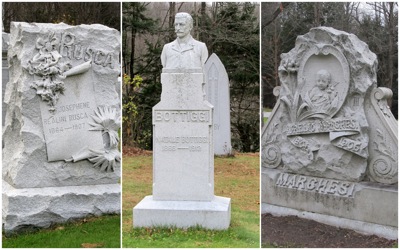
At nearby Hope Cemetery in Barre, VT, the memorials stand as a tribute to the many stone cutters and artisans interred there. The cemetery is referred to as a "museum of granite sculpture." The front entrance of the unlocked cemetery is manned by two unnamed granite sentries.
Hope sentries
Hope Cemetery was established in 1895. Originally, it contained 53 acres. Since then, it has expanded to a total of 65 acres. Edward P. Adams, a nationally known landscape architect, created the original plan for the cemetery. There are over 10,000 monuments made of Barre Gray granite. The master artisans of Barre, many Italians who immigrated in the late 19th and early 20th centuries, worked the Barre Gray granite blocks into memorial designs.
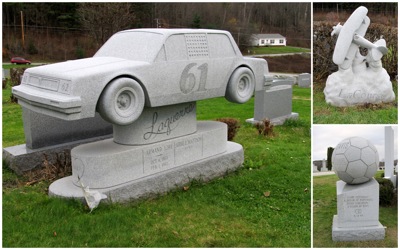
Silicosis, a respiratory disease caused by granite dust, was common among these artisans and sculptors who were breathing it in every day, which led to an abnormally high death rate.  Many sculptors designed their own tombstones to showcase their skill. It is estimated that 75% of the tombstones in Hope Cemetery were designed by those interred there. Ornate stone carvings include a soccer ball, bi-plane, and a half-size replica of a race car (#61) in memory of local driver Joey Laquerre, Jr, who died in a 1991 snowmobile mishap.
Hope memorials
The monument of Elia Corti was hand carved from a single piece of granite by his brother. The seated life size figure appears to be contemplating for an eternity; the detail work in the clothing are quite amazing.The tomb of William and Gwendolyn Halvosa is shaped like a bed with the couple shown in pajamas and holding hands, their tombs stretched out before them. Carver Louis Brusa's grave features a sculpture called "The Dying Man" that shows Brusa being held by his wife as he succumbed to silicosis in 1937. Ventilation equipment added to stone carving buildings in the mid-1930s eliminated the hazard.
Hope memorials3
Other memorials are in geometric shapes and forms of nature, while others are more 'traditional.'
Hope memorials4
Hope memorials5
Hope Cemetery is a popular roadside destination that can be toured free of charge at your own pace with many more interesting, unusual and VERY unique memorials.