Showing posts with label lighthouse. Show all posts

Tuesday, August 20, 2024

Weekend on the Cape

Our weekend getaway was to the Cape Cod a popular summertime destination in the neighboring New England state of Massachusetts.

Grenville was here to participate in the International Lighthouse Lightship Weekend (ILLW). Usually held on the third full weekend in August, this event attracts more than 500 lighthouse entries located in over 40 countries. 

The ILLW is one of the most popular amateur radio events. It's free, there are very few rules and there's no prizes for contacting large numbers of stations.

A ham radio friend, Randy, who lives in Nashua, NH, also went to Cape Cod to participate. They both set up at the Nauset Light. Grenville set up his equipment in the back of his car as shown in the photo above. He made over 20 contacts, mostly in the U.S.
The Nauset Lighthouse and Keeper's Cottage, which is privately owned
The Nauset Lighthouse Nauset Lighthouse, listed on the National Register of Historic Places, is on the Cape Cod National Seashore near Eastham, MA. Built in 1877, it stands 48 feet high and is made of cast iron with a brick lining. It was originally located in Chatham, MA, as a twin to one that's still there. When a smaller wooden lighthouse in Eastham was retired in 1923, this tower was dismantled, moved from Chatham to Eastham and reconstructed about 200 feet from the edge of the cliff near the relocated keeper's house. 
Grenville and Randy atop the lighthouse with one of the light keepers
In the 1940s, Nauset Light was painted red and white as a daytime indicator. In 1981, the Fresnel lens was replaced by two rotating aero beacons. Due to coastal erosion it was too close to the edge of the cliff. In 1996, when less than 35 feet remained, the Nauset Lighthouse was moved in one piece some 300 feet to a new site across the road adjacent to Nauset Light Beach. 
The light is owned by the National Park Service. It's leased to and maintained by the Nauset Light Preservation Society. Upkeep is entirely funded by donations. The lighthouse is open to visitors during certain times. 
Dirt bomb confection
We shared a dirt bomb this weekend in Cape Cod. It's a very popular confection. We shared one from the Cottage Street Bakery in Orleans, MA, as we'd already indulged in another treat before deciding to try it. Next time, we'll know better. The trick is to get there early as these treats sell out fast.. 
The Cottage Bakery in Orleans, MA, is well known for its dirt bomb
No, this is not to be confused with a dirty bomb, that's an entirely a different thing. This is an unusual name for a delicious treat described as a cross between a cinnamon sugar doughnut and a muffin. In the muffin world, this is the bomb, as in it's the best.

What exactly is it? A dirt bomb is a nutmeg-infused muffin that, still warm from the oven, is rolled in melted butter, then tossed in cinnamon sugar until generously coated. The “dirt” is the cinnamon sugar in which the muffins are rolled after baking. 

There's nothing definite on how the name originated. It comes from the original dirt bomb made at Bantam Bread Company in Bantam, CT. This family-owned business, started in 1996.
These colorful blooms were on the grounds of The Cove Motel, our weekend accommodation in Orleans, MA.
The Ice Cream Cafe was a short walk from the motel. Of course, we enjoyed our favorite treat.
This is a SOOC (straight out of cellphone) image captured yesterday morning from the motel grounds as we were leaving.

Cape Cod was popularized by Patti Page (the "Singing Rage") who was the top-selling female singer of the 1950s with a 1957 hit tune, Old Cape Cod. The tune was credited with putting the Cape on the map and helping to establish it as a major tourist destination. It's been hailed by natives as the "unofficial Cape Cod Anthem." Ironically, Page recorded the song during a day trip to NYC. She had never visited Cape Cod until after it was released and became a hit.

This is a celebration week for us — our 25th wedding 🥂 anniversary is upcoming. We're planning to celebrate all week an Nashua, NH, details to follow. Our special getaway will be in early October on a week-long trip to Tuscany.

Monday, June 10, 2024

Maine Lighthouse Museum

One of the best things we've discovered about a road trip is that many times we don't know what we'll come across, and when unplanned or unexpected, all the better.
That's what happened in Rockland, Maine, on our recent anniversary road trip when we visited the Maine Lighthouse Museum. This museum houses the largest collections of lighthouse lenses, lighthouse artifacts and United States Coast Guard memorabilia (USCG) in the nation. The goal of the museum is to educate and promote not only the lighthouse but lifesaving as well.
Who knew?
Certainly not us and this museum is right here in New England, almost in our backyard so to speak. Along New England's 6,000 miles of coastline there are 200 lighthouses remaining and every state has at least one. 

Lighthouses were made from a variety of materials: wood, rough-hewn stone, brick, reinforced concrete, iron, steel, even aluminum and fiberglass. They were built on land, in the water, on islands, on top of ledges and cliffs, on breakwaters and piers and on caissons; at least five are on fort walls. Some are squat, others are tall and dignified. No matter their size, lighthouse are always impressive, even more so were lighthouse keepers who are included in the museum exhibits.. 

As we were driving through Rockland, we saw a sign for the museum and made a detour from our planned route to find the museum. Luckily, it was open on a weekday as the switch to summer hours came the week before after Memorial Day. Maybe, because it was a weekday with schools not yet out and limited vacationeers, but the day (Monday) and time of our visit (afternoon), we were the only visitors..

What's to See?
Everything to do with New England lighthouses. Museum exhibits include vintage Fresnel lenses, foghorns, marine instruments, life saving equipment, photographs, flags, buoys, fog horns and bells, lighthouse and ship models and Coast Guard memorabilia. There’s an exhibit dedicated to the fascinating and largely untold history of female lighthouse keepers. Many items on display are one of a kind and not found elsewhere. For anyone interested in lighthouses or American maritime history, it's a must-see stop. Patrick is a Navy veteran, so we couldn't bypass this chance to visit.

CWO4 Kenneth Black, USCG 
How Did It Begin?
The Maine Lighthouse Museum was founded by the late CWO4, Kenneth Black, who is recognized as one of the leading lighthouse preservationists in the U.S. A WW II Coast Guard veteran, Black saw action at the invasion of Okinawa. After the war, he served throughout New England and the Great Lakes in various capacities. He ended his Coast Guard career as Commander of the Rockland Coast Guard Station.

As the Officer in Charge of Coast Guard Station Rockland, Black gradually assembled the beginnings of the museum collection as he visited Coast Guard stations and bases in New England. He realized that while Maine doesn't have the most lighthouses (65 compared to over 150 in Michigan), it has some of the most historic and oldest ones. 

Black was Mr Lighthouse
When he retired from the Coast Guard, Black was the official curator of the First Coast Guard District. As a Coast Guard Commander, he had overseen the operation of many of the nation’s lighthouses. His interest is saving lighthouse artifacts began after he learned that many were being discarded as automation changed the way lighthouses had been operating since the late 1700s. 

He coined the phrase, Lighthouses are like people, they come in many different sizes, shapes and colors, and used it to promote the importance of lighthouse preservation.

USCG Station, Rockland, ME
After gathering countless maritime artifacts, Black received Coast Guard permission to set up a display at the Coast Guard Station in Rockland, ME, which evolved into the largest collection of lighthouses lenses and equipment in the country. When the exhibits overflowed this space, Black arranged for them to be loaned to the Shore Village Museum, 
which housed Civil War artifacts and some lighthouse memorabilia, now, working foghorns, ship models, flashing lights, search and rescue gear, bells, buoys and boats were added to the museum. For many, this was the first time, they were able to see so much maritime memorabilia. Black took on a new role as curator of the Shore Village Museum. 

Internet source
Black wasn't done collecting as he traveled throughout New England searching out more artifacts. His goal was not only to preserve the nation’s heritage, but to promote the study and appreciation of maritime history for future generations. The public responded as people stepped forward with donations. Some were easy to transport, others, like priceless Fresnel lenses, fog bells and foghorns weighing thousands of pounds took more effort. 

In 2005, when the collection, once again, outgrew its exhibit space, it was relocated to its present location, the restored Courier Newspaper building on Rockland's waterfront and renamed the Maine Lighthouse Museum. (The Shore Village Museum later closed.) The new museum now featured the largest collection of rare lighthouse lenses (especially Fresnel) of any U.S. museum. In 2007, the Museum of Lighthouse History in Wells, ME, merged its collection with the Maine Lighthouse Museum. This merger created the largest lighthouse museum in the U.S.

What are Fresnel Lenses?
Augustin-Jean Fresnel
The Fresnel lens was named after its inventor Augustin-Jean Fresnel, a French civil engineer and physicist. His research in optics in the 1820s led to the acceptance of the wave theory of light. The catadioptric (reflective/refractive) lens he invented was specifically for use in lighthouses and replaced metal reflectors with revolutionary stepped lenses of his design. This extended the visibility of lighthouses, saving countless lives.

Compared to other lenses of the time, Fresnel lens were thinner and lighter in design, which allowed more light to pass through them. Lighthouse lights became more visible at longer distances serving as guides to mariners and lessening shipwrecks. Fresnel lenses became the standard optical system for lighthouse lighting for years, many are still in use today. Sadly, Fresnel died at age 39 after a lifelong battle with tuberculosis. His name is forever associated with his invention.
Nearly all U.S. National Park lighthouses originally had a Fresnel lens. Many have been removed or replaced with more modern lighting mechanisms through advancements in technology. 
Fresnel lenses on display in the museum were amazingly beautiful to see up close.
Fresnel lens from Bakers Island Light, Salem, MA
The above lens was made by Chance Brothers Co. of England, a principal manufacturer or lenses and other lighting equipment and competitor to France in the production of Fresnel lenses. An innovation from Chance Brothers was the introduction of rotating optics, allowing adjacent lighthouses to be distinguished from each other by the number of times per revolution that the light flashed. Noted English physicist and engineer John Hopkinson invented this system while employed at Chance.
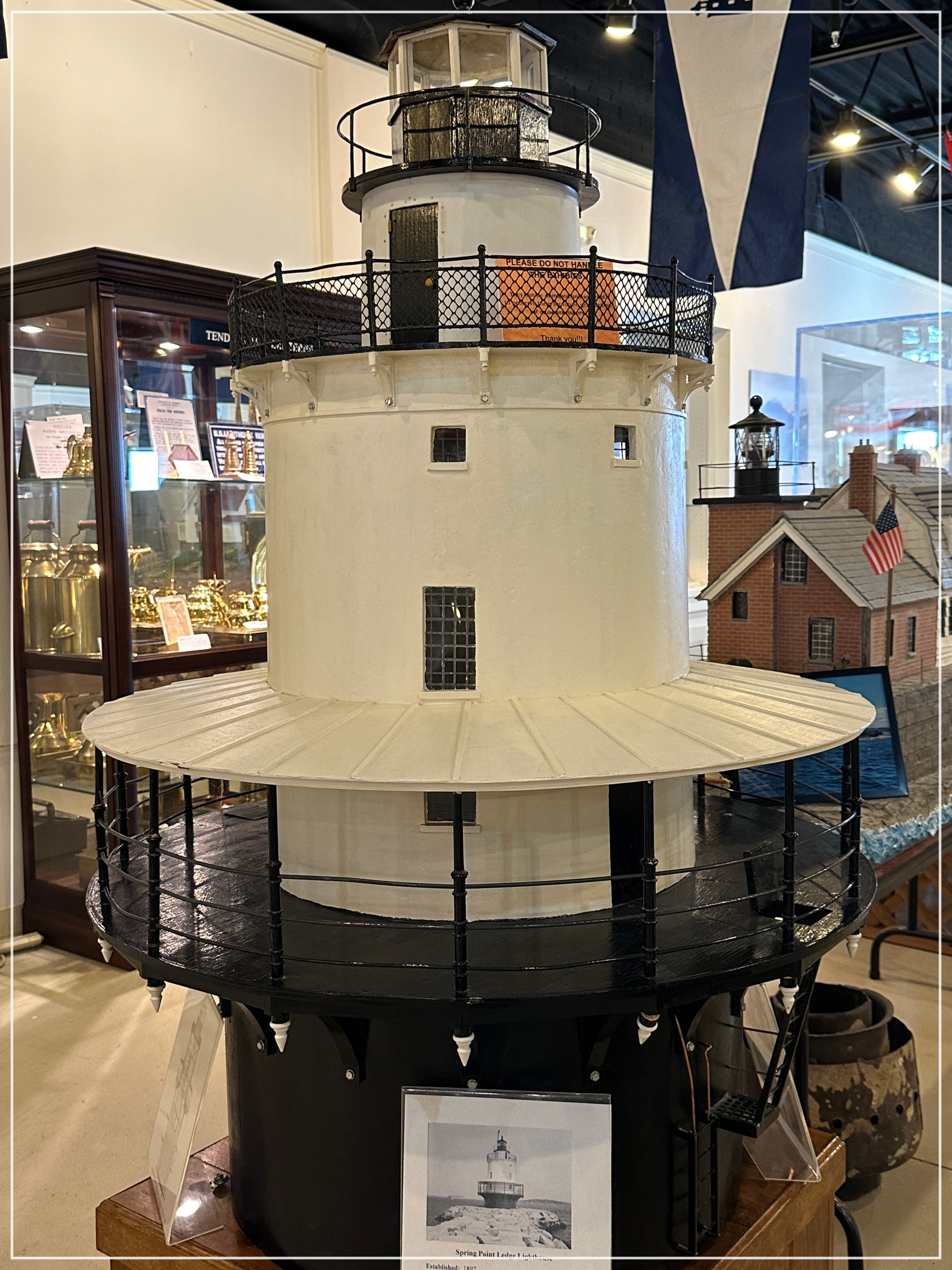
There are several dioramas and detailed lighthouse models on display. All of these were made to exacting detail to display the lighthouses and harbor scenes.
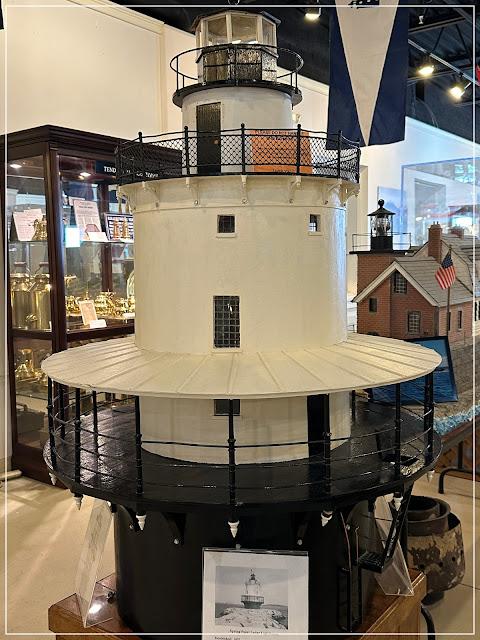
Spring Point Ledge Lighthouse, South Portland, ME
The above model is the Spring Point Ledge Lighthouse in South Portland, ME. It's the only caisson-style (sparkplug or bug light) style light station in the U.S. that visitors can walk to on the breakwater. The superstructure of this type of lighthouse type is built on concrete or metal. This lighthouse has been an integral part of the history of Portland harbor and Casco Bay since 1897; it was listed on the National Historic Register in 1988.
Fog bell formerly on Matinicus Rock Light
This 2000-pound bell was cast in Philadelphia, PA, in 1855 and installed on a wooden frame at the Matinicus Rock Light in Maine. Fog bells were crucial when dense fog interfered with the light's visibility. This one was in use during most of the tenure of Abbie Burgess as assistant light keeper from 1654 to 1875. She became well known for her bravery in tending the Matinicus Rock Light during an 1856 winter storm. She did so for a month when her father, the head light keeper, was away from the island. 
Many vintage photos and personal items of famous lighthouse keepers can be seen in display cases, including Robert Sterling, Fanny Mae Salter, Abbie Burgess, Ida Lewis and others. These individuals are as important to Maine’s lighthouse history as their artifacts. The museum ensures their extraordinary contributions to maritime history are not forgotten.
Early lifeboat, breeches buoy, foghorn displays
What looks like a round personal flotation device with a leg harness attached and works like a zip line is called a breeches buoy. This rope-based rescue device was used to extract people from wrecked vessels, or to transfer people from one place to another in situations of danger. Foghorns provide audible warnings of dangers to shipping like rocky coastlines, shoals, of the presence of other vessels when visual navigation aids are obscured in foggy conditions. 
Exhibits in the museum display different stories of bravery and dedication to the service of the men and women in the United States Coast Guard and United States Life-Saving Services. 
Display cases featured light house lamps and other memorabilia and artifacts.
As stated earlier, our stop at this museum wasn't planned, but was definitely an informative experience. The best part of a road trip is finding and learning about special places along the route and sharing, so now you know as well.
The Maine Lighthouse Museum is at 1 Park Drive in Rockland, ME, the heart of the Midcoast. The museum has summer hours after Memorial Day, Monday through Friday 10:00 am to 5:00 pm. Saturday and Sunday 10:00 am to 4:00 pm. After Columbus Day, hours are limited so it's best to call ahead. The museum closes January and February and in spring operates Thursday, Friday and Saturday.

Monday, August 21, 2023

Anniversary Adventures

Celebration ice cream in Cape Cod
As you may have noticed we have them quite often. So when people ask what us what are you doing special for your anniversary? Our reply is that every day is a celebration — why not?

Today is our 24th wedding anniversary. 

We're celebrating with dinner at home including a glass (or two) of wine. As has become our tradition when traveling, we celebrated with ice cream on this past weekend's getaway to Cape Cod, near the same area visited in July to celebrate Grenville's 🎂.

Rather than a sightseeing trip, this excursion was a ham radio event that Grenville and his friend, Randall, participated in called Lighthouses on the Air. This annual event was held last Saturday and Sunday (August 19-20). It main goal is to establish ham radio contact with other operators especially those operating from other lighthouse sites and also to promote awareness of ham radio which would remain operational in emergency situations.
Grenville and his equipment setup
Grenville and Randall spent most of Saturday at the Nauset Light. The basic format is that ham radio operators will set up either in or near a lighthouse and operate part of the whole weekend. Visitors can watch the operators as they make contacts and learn more about ham radio while they come to see the lighthouse, which unfortunately wasn't open for public tours on Saturday. 

Nauset Light is quite possibly the most well-known and photographed lighthouse on Cape Cod and is located within the boundaries of the Cape Cod National Seashore. 
The Nauset Light is the logo for Cape Cod Chips and on MA license plates
Even if you never visit this lighthouse, you may have seen it in store snack aisles. That's because it was used as the logo for Cape Cod Potato Chips. The popular kettle chip company is headquartered in Hyannis, MA, and was started there in July 1980 by two small business owners. It also appears on a "Cape Cod & Islands" special license plate introduced in 1996. 

Nauset Light is a restored lighthouse on the Cape Cod National Seashore near Eastham, MA, erected in 1923 using a 1877 tower that was moved here from the Chatham Light. The tower is a cast-iron plate shell lined with brick and stands 48 feet high. Fully automated, the beacon is a private aid to navigation. The tower is located adjacent to Nauset Light Beach.
The tower that eventually became Nauset Light was constructed in 1877 as one of two towers in Chatham. They were known as the Twin Lights and the Chatham one remains there today. The color of Nauset Light was originally all white, however, in the 1940s, the top section of the tower was painted red, as a daytime indicator and creating the iconic appearance seen today. It's particularly striking when shot against a clear blue sky.

This lighthouse was moved to Eastham in 1923 to replace the Three Sisters of Nauset, three small wood lighthouses that had been decommissioned. 
Vintage postcard showing the Three Sisters Lighthouses
A brief history of these lighthouses: in 1836, Eastham residents petitioned the Boston Marine Society to recommend to the U.S. Congress the construction of the Nauset Lights, because of many shipwrecks occurring off shore. The Congress granted funds to build suitable lighthouses to provide a light halfway along the eastern coast of Cape Cod and three 15-foot high masonry towers were built, in a straight line along the crest of the cliffs, painted white with black lantern decks. 
The relocated Three Sisters Lighthouses
They were nicknamed The Three Sisters as from sea they looked like women in white dresses with black hats. For some 55 years, these lights helped avoid shipwrecks. As years passed, the lights were getting too close to the cliff’s edge. Moving them intact was not possible and they were replaced. Three new and slightly larger wooden lighthouses, shaped to resemble the prototypes were raised 30 feet west of the original sites bearing identical markings and using the lenses from the originals. They were reunited in 1989 and are on Cable Road in Eastham, MA.
Steps ascending to the lighthouse and descending view
The Nauset Light was added to the National Register of Historic Places in 1987 as Nauset Beach Light. By the early 1990s, coastal erosion caused the light to be less than 50 feet from the edge of the 70-foot cliff on which it stood. In 1993, the Coast Guard proposed decommissioning the light. The non-profit Nauset Light Preservation Society (NLPS) was formed and in 1995, it leased the lighthouse from the Coast Guard. 
View from inside

The Society arranged for both the tower and a nearby brick oil house to be relocated to a location 336 feet west of its original position in November 1996. By that time, it was perilously close to the cliff's edge, about 37 feet. 

The light was lit again in May 1997. The Coast Guard then transferred lighthouse ownership to the National Park Service. In May 2004, the NLPS signed a partnership agreement with the National Park Service (NPS) of  the Cape Cod National Seashore. 

The NPS operates the light as a private aid to navigation. The NLPS covers expenses related to the site through memberships and donations. Tours of the tower are available in summer from the NLPS which operates and maintains and the site. Myself and the wife of Grenville's radio buddy were treated to a private inside tour by one of its members.
Great together - Chatham Band Concert & Lobstah Roll
Friday was both a delicious and entertaining day as we enjoyed two quintessential New England traditions — our first lobstah 🦞 roll of the summer and an outdoor band concert. 

The 8 pm concert was in Kate Gould Park on Main Street in Chatham, MA, performed by the 37-member Chatham Band. These free concerts have been held here since the late 1940s. While it is said that it never rains on a Summer Friday night concert, it can be cancelled due to bad weather. The weather looked iffy after some torrential downpours Friday, but by late afternoon skies had cleared and the concert went on. It was a wonderful event that harkened back to summer concerts of days gone by, Nice to see that this tradition continues in Chatham.

Speaking of traditions, long-time NJ friends sent us this card. We immediately smiled on seeing it, not only for the front penguins illustration and the good wishes it contained, but we'd seen it before. They've unknowingly sent this same card for the past 3 years knowing that we liked penguins. The first one received in 2021 was framed and hangs in our bedroom. When the second one came in 2022, it produced a laugh. When this same card arrived in 2023 we shared the coincidence with them. No, they didn't stockpile this card. Amazingly, it was bought separately each year.

This post detailed how we spent our pre-anniversary celebration. But, we're not done since in a couple of weeks comes a really big getaway; we're going to Amalfi, Italy. It's an overdue anniversary replacement trip for the planned Rocky Mountaineer railway trip that was canceled 3 years ago due to you-know-what. Unfortunately, due to the difficulty in obtaining a refund from RM, we've decided to not consider a future trip with that company.

Thanks to everyone for the Anniversary well wishes 💐.  All were appreciated.

Wednesday, October 27, 2010

Mainely Lighthouses

Ram Isld Ledge Light (4)
There are over 60 lighthouses in and along the coast of Maine. We managed to see or visit 1/10th of these  – listed below – on our road trip. All of these lighthouses have interesting and varied histories which can be accessed by the links.

One is for sale. Can you guess which one? (answer below)
Spring Point Ledge Light and Owls Head Light
owls head lighthousespring point ledge 
Portland Breakwater Light (the Bug) and  Portland Head Light
portland breakwater lighthouse portland head light 
Ram Island Ledge Lighthouse and Rockland Breakwater Lighthouse
ram isld ledge light rockland breakwater light
For sale: a hard-to-access, 105-year-old, wave-swept lighthouse on treacherous rock outcroppings at the entrance of Portland Harbor. No utilities and no functioning pier. Opening bid is at  east $10,000.

Ram Island Ledge protrudes 1,300 feet from Ram Island and is only exposed at low tide. The granite tower was built in 1905 on a granite block foundation with an attached skeletal pier. It is 77 feet tall from its base to the middle of the round lantern. 
The Coast Guard conveyed the lighthouse to the General Services Administration (GSA), which is handling the auction sale. Here’s a plus – the Coast Guard will continue to maintain the navigational aids, the light and the foghorn. 

Wondering if there were any takers? 
As of mid-September, there were 47 bidders and a high bid of $190,000. Registered bidders were allowed to inspect the lighthouse in late August – weather and seas permitting. Very calm water is needed to touch a boat's bow to the surrounding rocks. Once docked, bidders would climb a 30-foot exterior ladder to get inside the lighthouse. (Did I mention there were no utilities?)

So you weren’t looking to buy a lighthouse. How about a customs house or federal building? There’s some interesting real estate being  auctioned by the U.S. Federal Government. Check out the listings on the GSA Property Utilization and Disposal site.

Monday, October 18, 2010

Owls Head Light

Owls Head is a town in Knox County, Maine, incorporated  in 1921. Some historians feel that the name comes from the Indian word  “Mecadacut,” meaning Owls Head. Another theory is that sailors named it for for the shape of the promontory, which they thought resembled the head and neck of an owl. The town is home to the Owls Head Light and the Owls Head Transportation  (more about this museum later).

DSCN6969Owls Head Light is on the grounds of Owls Head Light State Park, which is open to the public – the lighthouse is not. The station was built in 1826 at the southern entrance of Rockland Harbor on the west side of Penobscot Bay. Like the Rockland Breakwater light, the Owls Head Light was built to guide heavy ship traffic carrying limestone out of the area in the 1800s.The 30-foot, white cylindrical tower sits atop a tall, tree-studded promontory. In 1856, the original lamps and reflectors were replaced by a Fresnel lens that remains in use and is visible for 16 miles.

The Owls Head Light was one of the last U.S. lighthouses to be automated and was operated by lighthouse keepers until 1989. ItDSCN6974 is owned by the U.S. Coast Guard and is situated inside Owls Head Light State Park. A wood frame keeper's residence was added in 1854 and serves as housing for U.S. Coast Guard personnel. Over the years, a boathouse (1894), oil storage building (1895), bell tower (1906) and generator house were added. The boathouse and bell tower have been removed. A wooden walkway was rebuilt in 2004-05 and provides pubic access to the light.

lighthouse collage Owls Head State Park provided beautiful vistas on a clear day.

owl park collage DSCN6999 DSCN7003