Showing posts with label GA. Show all posts

Wednesday, March 30, 2022

GA Coke & Fried Chicken

Did you know that Atlanta is not only the capital city of Georgia GA and the state's most populated city, but it's also the home of Coca-Cola?
The World of Coke Museum, cousin Kathie and Us (Atlanta, GA)
The company's headquarters are on Pemberton Place which is a few blocks from its museum dedicated to the popular soft drink and called, no surprise, The World of Coca-Cola. On our February road trip we visited it when we spent time in GA to see my cousin. The museum, which showcases the history of the Coca-Cola Company, opened in May 2007 and replaced a previous exhibit space founded in 1990 in the former Underground Atlanta. We went on a very crowded Sunday and admission is charged: adults $18, seniors $16; youth to age 12 $14, toddlers free with paid adult admission; veterans Free. 

Dr. John Pemberton
The location is named in honor of  Dr. John Pemberton, recognized as the inventor of Coca-Cola. Pemberton created the original Coca-Cola formula in 1885 in a large kettle, which is featured in a museum exhibit. His creation contained cocaine—in the form of an extract of the coca leaf. This led to the “Coca” part of the beverage’s name. The “Cola” in the name comes from the kola nut, which contained caffeine, another stimulant. At the time of Pemberton's creation, cocaine was legal and a common ingredient in medicines, considered as not harmful when consumed in small doses.

Pemberton, a doctor and pharmacist, was also a Confederate army veteran who suffered a saber wound in 1865 at the Battle of Columbus (GA) in the final month of the Civil War. After experimenting with pain relief, he became addicted to painkillers, mainly morphine and began seeking a cure for his addiction. In 1866, he began experimenting with painkillers that would be morphine-free alternatives drawing on his study of herbal medicine, he often used plants substances in his formulas.

Pemberton's French Wine Cola Ad
After experimenting with coca and coca wines, he developed a recipe called Pemberton’s French Wine Coca advertised as a nerve tonic cure-all. The product was an alcoholic beverage, mixed with coca, kola nut, and a wild shrub, damiana. It included extracts from coca leaves in a limited amount, not enough to cause cocaine addiction. (The use of coca leaves was later removed from the formula.) In the nineteenth century, patent medicines were unregulated, unlike today. Health benefits could be claimed without proving effectiveness or dangers.

The remedy was sold as a cure for depression and anxiety, especially for women. Because it included alcohol, an issue arose when the city of Atlanta introduced alcohol prohibition in 1886 which also disallowed the sale of wine. 

Early Coca-Cola Ad
Pemberton had to create a non-alcoholic and new version of the popular product. He worked on creating on a formula that would appeal to a wider group of people. The wine was removed as he created a sweetening syrup from the coca leaf and kola nut and dropped any alcohol reference. Pemberton called his formula the ideal temperance drink, both on the label and in advertising.

The product's name was coined by Frank Mason Robinson, Pemberton’s bookkeeper, from the two main ingredients. Robinson, who recognized that the two curly ‘C’s would look great in advertising, hand lettered a banner in the curved flowing script that remains one of the most recognizable and famous logos in the world even now. 

In 1886, Pemberton took the syrup to Jacob's Pharmacy, a popular Atlanta soda fountain, for tasting. In summer months and in hot southern towns, the local pharmacy soda fountain was a time-honored and well-known American institution. 
Jacob's Pharmacy, Atlanta, GA, circa 1886 (now demolished)
At the pharmacy, Pemberton's syrup was added to carbonated water thought to be very good for one's health and often used in popular “cure-all” mixtures. The combination was sampled by customers who praised the drink and called it, excellent
Vintage Coca-Cola advertising
As with his previous formula, Pemberton's new product was labelled as a cure-all and was described as a valuable brain tonic to help nervous issues, headaches, hysteria, depression and as a general stimulant and health booster. The new drink was also said to stimulate students and all brain workers and advertised as Delicious and Refreshing, a theme continued in later years. It was initially sold only in pharmacies and a soda fountain glass cost five cents. 
Early Coca-Cola Soda Fountain Ad

Pemberton advertised heavily, using banners, newspaper advertisements and hand-painted oilcloth signs on store front awnings. He added the word, drink, to let people know that the new beverage was a soda fountain refreshment.  On May 29, 1886, the first Coca-Cola newspaper ad appeared in The Atlanta Journal, inviting thirsty citizens to try the new soda fountain drink. Despite initial praise, the new drink was not an immediate hit and averaged less than 10 sales a day the first year. 

This lack of sales is possibly what led Pemberton to sell a majority of his business to various business partners before his death, including fellow pharmacist Asa G. Candler who purchased the recipe for $1,750 in 1887. 

After buying the rights to Coca Cola from Pemberton, Candler launched a new marketing campaign for the beverage. Under Candler’s management, distribution expanded to soda fountains beyond the Atlanta area. In 1892, he established the Coca-Cola Company and began large scale production in 1899 as a soft drink, bottled and canned it for retail sale.

Sadly, Pemberton didn't live to see the widespread success of his formula. He died in 1888 at age 57 in from stomach cancer. A skilled pharmacist and chemist, he was active in medical reform and a respected member of the state’s medical establishment. On the day of his funeral, sales of Coca-Cola were suspended for the day as city pharmacists closed their shops in tribute to one of their own and attended the funeral services. Candler served as one of the gentleman pallbearers. Pemberton's laboratories remain in operation 125 years later as part of the Georgia Department of Agriculture.
Vintage Coca-Cola Advertisements
Three years after Pemberton’s death, Candler bought up all the interests in Coca-Cola for a total investment of $2,300. In 1919, the Candler family sold the company for $25 million to a group of investors who expanded it into a global enterprise. Candler also served as the 41st mayor of Atlanta from 1916 to 1919.

What began as a health tonic in 1886 was being sold in every U.S. state by 1900. The company now sells an estimated 1.9 billion bottles per day in over 200 countries making the Coca-Cola Company among the most widely recognized consumer products worldwide. The secret formula for Pemberton’s invention was kept in a SunTrust bank vault since 1925. In late 2011, it was moved to a vault that's now part of the Coca-Cola museum. 
Coca-Cola Ads from 1940s
The logo that remains one of the most recognizable and famous ones in the world was created using Spencerian script, a standard writing script for American business correspondence from 1850 to 1925. After that, widespread popularity of the typewriter obsoleted it as a prime method of business communication. (Other product name logos recognizable in Spencerian script are those for the Ford Motor Company and Kellog's.)
Coca-Cola Ad from 1942
Coca-Cola preceded the soft drink, Pepsi-Cola, by just a few years. While Pemberton created Coca Cola in 1886, the first Pepsi-Cola was created in 1893, also by a pharmacist, Caleb Bradham, in New Bern, NC. Bradham created a formula to duplicate the success of Coca-Cola and sold it under the name "Brad's Drink." Seeking a better name, Bradham bought the name "Pep Kola" from a local competitor changing it to Pepsi-Cola. Pepsi is taken from pepsin, a digestive enzyme used in Bradham's original formula. Introduced in 1898, its name implied its origin as a health tonic and the drink proved popular. In 1902, Bradham incorporated the Pepsi-Cola Company. And, just as Coca-Cola no longer contains cocaine, Pepsi-Cola no longer has pepsin as an ingredient.
Mary Mac's Tea Room, Atlanta, GA
If Coca-Cola is Atlanta's most iconic drink, fried chicken is one of its best-known foods, and one of the best places to eat it is at Mary Mac’s on Ponce De Leon Ave. It's been named Atlanta's Dining Room and has been recognized as an iconic Atlanta institution.

There’s nothing in Atlanta quite like it. The surroundings are comforting and the food is classic Southern cooking.

Mary Mac’s always draws a crowd of hungry diners. There's usually a waiting line on weekends. My cousin advised we get there early to avoid the surge of diners after Sunday services. She was right. There was no waiting line when we arrived before noon, but a lengthy waiting line by the time we exited.

Mary Mac's was just one of 16 tea rooms that populated Atlanta in the 1940s and has remained in the same location since opened by Mary MacKenzie in 1945. After WW II ended, women established restaurants all over Atlanta. Back then, a woman couldn’t simply up a restaurant, especially in the South, so many female proprietors used the more refined Southern name, “tea room.” Mary Mac’s Tea Room (originally Mrs. Fuller’s Tea Room) seated 75 guests in one dining room. Today, it's the only original tea room still in operation with six dining rooms and is one of the city’s five-largest restaurants.

Mary MacKenzie (L) & Margaret Lupo (R)
Mary MacKenzie ran the tea room from 1945 to 1962 when one of her employees, Margaret
Lupo, became the new owner. Lupo turned heads for making her dining room unsegregated because as she said, You were all equal folk at the table. In 1992, after 30 years, Lupo was ready to quit the business. She reportedly trained its next owner, John Ferrell, for 18 months before feeling OK with him owning it. Ferrell ran the business until March 2020 when, in the wake of COVID-19, he closed the restaurant for the safety of staff and guests.
 
Mary Mac’s remained closed for most of its 75th year in business, then Harold Martin purchased the restaurant and ensured it could re-open with stricter safety and sanitary measures. Martin kept all 100+ employees on staff and didn't change anything about the restaurant or its menu, which has mostly remained original to 1945. Kitchen technology has advanced, but Mary Mac’s Tea Room still does everything in-house – down to shucking bushels of corn and snapping fresh green beans by hand. Every morning, breads and desserts, like old fashioned banana pudding and fresh Georgia peach cobbler are baked in house and Table Wine of the South, otherwise known as sweet tea, is brewed.
Grenville & Mary Mac's Fried Chicken
Of course, we had to order the crispy fried chicken. The menu also includes over 30 fresh vegetables, including fried green tomatoes, which my cousin ordered. Many recipes were documented by former owner Margaret Lupo in the 1960s. Others have been passed down from family members over the years.
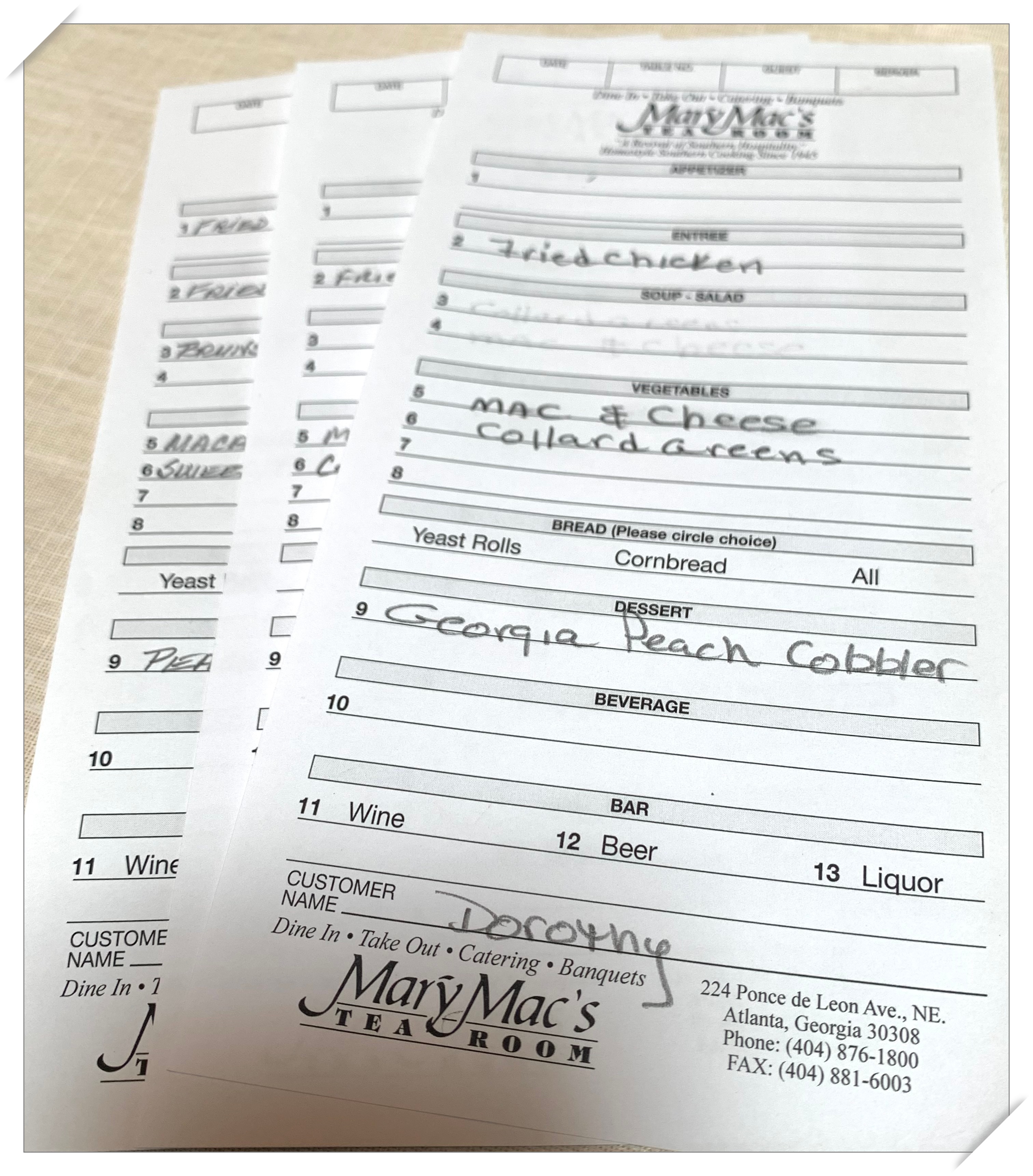
Mary Mac's table order forms
Traditions are important here. Some remain for sentimental reasons, others are kept because they continue to work. Food orders are placed with pencils and order forms at each table. A complimentary cup of pot likker and cracklin' cornbread muffin are served to first-time diners, which we enjoyed. (For non-southerners, pot likker is the salty and porky broth left after cooking collard greens. Cracklin’ cornbread is cornbread with crispy pork skins baked in.)

Much like the food, there's no secret special sauce that makes Mary Mac’s Tea Room such an iconic Atlanta institution. This establishment paints a more vivid picture of Atlanta than any museum or historical site ever could. Once again, if it ain’t broke, don’t fix it.

The walls are covered with pictures of famous visitors over the years, including Dalai Lama, Congressman John Lewis, James Brown, Beyonce, Senator Hillary Clinton, country singer Alan Jackson and President Jimmy Carter.
You don't have to be famous to dine at Mary Mac's tea Room, just come hungry, and be prepared to wait if you're not early enough. Trust us, it was worth the wait.

Full disclosure: Grenville and myself are not soda drinkers, except for an occasional Dr. Pepper (whoops, PepsiCo product). Touring the museum was a one-off, been there, done that experience. As for the best fried chicken, while many folks have favorites, our vote would go to the former Tammy & Johnny's in Melfa, VA.

This is the final post on our February road trip to FL and places in between. Next week is a return to posts about places closer to home and random posts of nonsense.

Tuesday, March 8, 2022

Hollywood of the South

The U.S. state of Georgia is well known for peaches, Coca-Cola and as the home of one of the busiest airports worldwide, the base of Delta Air Lines. Interestingly, in recent years, Georgia's film industry has become the third most popular U.S. filming destination right behind New York and California.

Covington, GA, now calls itself The Hollywood of the South™ and has become a go-to site for TV and films. It easily changes to become a Civil War village, a 1950s town or a modern city. Many locations in the town have been used many ways in multiple films. The city's scenic filming locales, moderate weather, and international airport have become a major draw for location scouts, and directors. 
Neither did I until our recent road trip, which included an afternoon in Covington, GA. That's because my cousin, Kathie, who we were visiting in Atlanta, and myself are fans of the popular Netflix show, Sweet Magnolias
The series premiered in May 2020; the second 10-episode second season premiered in February 2022. Kathie and I had binged finished both seasons.

Heather Headley (Helen), Brooke Elliot (Dana Sue),
JoAnna Garcia Swisher (Maddie) - Netflix
For those not in the loop, the series revolves around three South Carolina women (Maddie, Dana Sue, and Helen), best friends since childhood as they deal with personal issues in family, romance, and career in the small town of Serenity, SC. The stories are based on the novels of author Sheryl Woods which are set in the small town of Serenity, a world created by Woods. 

While on the small screen, Serenity may look and feel like a real Southern town, it's not that, but is completely fictional, like in the books. The book and show setting is SC, actual filming is in the small, picturesque town of Covington, GA (pop. 1,400) a 45 minute drive from Atlanta. The town won out over locations like Baton Rouge, LA and Charleston, SC. Interiors are shot on sound stages too.

Shows filmed in Covington, GA
It's not the first time that Covington, GA, has been a filming location, far from it. The town has been the filming location for
 Dukes of Hazard, The Vampire Diaries, In the Heat of the Night, The Walking Dead, Sweet Home Alabama, Remember the Titans. That’s only a sampling of productions that have featured the town square, neighborhoods, and the iconic downtown courthouse. Covington was known as Mystic Falls, VA, for The Vampire Diaries and the popular teen series was shot there for 9 seasons. 

The day of our visit, we were we met many fans of that show who were also looking some movie magic. 

We recognized many Covington landmarks we had seen in the Sweet Magnolias series. 

The downtown square in Covington is heavily featured in the series. We recognized that we had seen many scenes that had featured characters sitting and talking there. 
The square, which is in the center of town, is a public park with war monuments, benches, and trees near the historic courthouse. The busy downtown has shops, antique stores and restaurants and is very walker-friendly. Other parts of the town feature historic homes with wraparound porches. 
Newton County Courthouse, downtown Covington, GA
The town's most prominent downtown building is the 1884 Newton County Courthouse seen in the show's opening and in the background of scenes. This historic courthouse is listed on the National Register of Historic Places. The tall brick building features a black dome at the top and a prominent clock. It was built in 1884 in the Second Empire architectural style popular between 1865 and 1900. Its 12-month construction cost was nearly $30,000.
Mystic Grill Restaurant, Covington, GA
In the show, a popular Covington eatery, the Mystic Grill Restaurant, is named Sullivan's, a restaurant owned by chef Dana Sue. This location was also featured in The Vampire Diaries. As shown in the photo above, there was a waiting line the Saturday we visited. The bar area is on the lower left and Grenville's lunch is in the lower right. The interior did not look like the restaurant in the show, not unlike when we visited the Cheers location years ago in Boston.
Lee-Porter Mansion, Covington, GA
We located another show location, The Corner Spa, which is a historic Antebellum home at the corner of College Ave and Oak St (The Lee-Porter House) that is a fitness spa for women (it was formerly Miss Frances's mansion in the show). It now houses law offices and exterior shots were filmed here. It's not open to the public with Private Property signs posted, but we took exterior photos from curbside. The show's interiors are filmed on a soundstage. 

Covington was incorporated in 1821 as the seat of the newly organized Newton County. It's named for Leonard Covington, a hero of the War of 1812, U.S. Army Brigadier General and later Congressman. In 1854, it incorporated as a city. In 1864, General Sherman's troops looted the city, destroying many buildings, however, several antebellum homes were spared including one featured in a now classic film.
Twelve Oaks B&B, Covington, GA
Hollywood has been a part of Covington's fame for decades back to 1939 when Gone with the Wind premiered in movie houses. The Twelve Oaks mansion of Ashley Wilkes was based on a stately 1836 antebellum mansion there. It was a private residence when Margaret Mitchell wrote the novel. Reportedly, after seeing it in the Atlanta Journal newspaper, she sent a clipping to the Hollywood set designers with a note, I like this for Ashley’s home. Since then, other films and shows have used the mansion's exterior and interiors for scenes. It is now the Twelve Oaks Bed & Breakfast, a luxury accommodation with antique furnishings and architecture.

If you're wondering (like me) why although Hollywood is considered the heart of the film industry, Georgia has staked a claim as its Southern campus. It's become one of the busiest filming states — it comes down to business and location(s), a wide range of scenery including mountains, forests, cities and beaches. 

The state has been working to attract Hollywood since 2008, when its former governor signed a lucrative tax incentive for film productions, Georgia Entertainment Industry Investment Act (HB 1100). It offers a 20 percent incentive on productions of $500,000 or more in GA, plus 10 percent more if a peach logo is put in the credits. The incentives are similar to those in other states but, unlike those states, there's no end date. Since its signing, the incentive has transformed Georgia’s film industry into a multibillion dollar production. All genres and film types are considered by its film commissioners.

Georgia is producer Typer Perrys base whose Atlanta studios are set on 330 acres on the decommissioned Fort McPherson Army base. Pinewood Atlanta Studios built a campus in Fayette County with 18 soundstages on 700 acres making it the largest multi-purpose  studio built outside Hollywood, CA.
One day, it could be fun to visit Hollywood, CA, but on this recent trip, GA was a lot closer and we spent a wonderful day outing with a family member.

Friday, June 21, 2019

Eats & Treats, TN and GA (Again)

While on a (mostly) southern states road trip traveling from New Hampshire to Florida, we're sampling foods along the way. It's part of the road trip fun for us. Here's some (more) recent dining experiences in Loganville and Norcross, GA.

Cracker Barrel Old Country Store, Inc. on Interstate 24, near Chattanooga, TN was an evening dinner stop. While we've passed a few on this trip, this was our first (and
only) stop at one. Most U.S. highway travelers will recognize this chain of restaurant/gift stores with a Southern country theme. The company was founded in 1969 by a sales rep for Shell Oil, who developed the concept to attract highway travelers. The first store opened in 1969 in Lebanon, TN, close to Interstate 40. Stores were placed near Interstate exits in the Southeastern and Midwestern U.S., but expanded countrywide in the 1990s. As of September 2018, there are 645 stores in 44 states. Despite our extended road trips, this was only our third or fourth stop at one.


The menu is based on Southern cuisine and biscuits, fried chicken  grits, country ham, and turnip greens, are always seen on the menu. We didn't eat the biscuits. I shared some of the chicken with Grenville. Restaurant entry is always though decor designed to look like a country store and everything shown is for sale. Each restaurant has a front porch lined with wooden rocking chairs, also for sale.

A previous post described a lunch met-up with fellow blogger Ludwig at Mojito's in Norcross. This wasn't our only dining experience in town. 
Paizanos in Norcross, GA is on the corners of Jones and Wingo Streets and lists its address as Historic Norcross. The restaurant's name is a variant spelling of the Italian paisano, translated as "brother" and often used by Italians toward their fellow Italians.

Downtown Norcross has a small town appeal. There's an old train depot (now a restaurant) and several historic buildings which have converted to other uses, but with small plaques describing their previous use.

The interior of Paizanos is geared toward an old-school New York restaurant feel according to it owners, Chuck Conrose and Craig Pittman. As noted earlier, we visited my cousin, who lives in nearby Peachtree Corners. She suggested we dine here and it was a great choice. 

The menu is varied from pizza to pasta and other entrees, and salads. Diners are greeted by a wraparound solid wood bar that evokes the feel of an old New York City pub or saloon with a large mirror behind wine racks on the wall behind the bar. There’s also a nod to New York baseball in the form of a framed Wheaties ad with Yankee legend Joe DiMaggio. Seating is at the bar or a table in one of two dining areas. Counter seating includes views out the front window across downtown Norcross. Paizanos is open for lunch and dinner, Monday thru Sunday and it's a casual dining place with customers in jeans, shorts, and T-shirts. 

The menu features 14 different specialty pizzas with New York themed names like Hell’s Kitchen Sink, Bronx Bomber, Greenwich Village, Penn Station, Bensonhurst and Staten Island Ferry, Park Avenue. 

All of those sounded delicious, but we opted for more sensible (?)dinner items. My choice was a Caesar salad (wins out every time for me) and grilled chicken breast over sautéed spinach. Both were very good. We all choose to forgo an Italian speciality dessert, but easily caved when the waitress suggested we could split a cannoli three ways. After all there's far less calories in doing that...right?

Journey’s End Restaurant in Loganville, GA, certainly isn't the place you would easily find unless, of course, you're a "local." And that's exactly HOW we dined there when we visited a former co-worker of mine, Jean. She had relocated to GA a few years after we were both downsized from our last positions in a NJ tech firm in 2011.

Journey's End Restaurant is a mid-priced restaurant that is definitely a no-frills place. It's a buffet-style eatery, but with a smaller and more limited selection than many larger buffets-style places. By comparison, this restaurant has a limited selection of Southern buffet foods. Jean was very insistent that we try the catfish, and I did

There were a lot of local folks here when we dined on a Friday night. It's open 7 days a week for lunch and dinner from 11 am to 9 p.m. Southern comfort food is featured including black eyed peas, cheese grits, hushpuppies, corn on the cob, bbq pork ribs, fried chicken, fried oyster, baked rolls and of course fried catfish - fried whole, bones and all.

We enjoyed suppertime (Southern for "evening meal") with our friend and thanked her for selecting this restaurant which we definitely never have found on our own. Although, admittedly, catfish won't become my favorite seafood.

Monday, June 17, 2019

Largest Painting in GA

We're currently on a "southern" U.S. road trip from NH to FL and posting about sites seen & foods sampled along the way. This post is about a stop in Atlanta, GA.


Previous posts have covered more than one place seen on our current travels. This post deals with only one seen at the Atlanta History Center (AHC), a history museum and research center in Buckhead, a residential district of Atlanta, GA. Founded in 1926, the AHC contains one of the largest U.S. collections of Civil War artifacts, which (admittedly) we didn't fully explore.

That's because the most spectacular exhibit is what we went to see — The Battle of Atlanta cyclorama, a 132-year-old hand-painted oil-on-canvas work. Believe me, this is not only a very impressive work, it's also a very immense work at 49 feet tall, covering an area of 16,000 square feet and weighing almost 10,000 pounds (6 tons and longer than a football field). This is only one of two functioning cycloramas in the U.S. — the other is The Battle of Gettysburg cyclorama at Gettysburg National Military Park in PA. Atlanta's was originally larger, but additions to Gettysburg's, as part of a restoration effort, made it larger(We visited the PA cyclorama a few years ago and were similarly impressed back then.)
A fish-eye view of the exterior of the cyclorama inside the rotunda . The cut-out portion of the canvas is known as the “tunnel entrance.” This feature, common in all cycloramas, avoiding the need to excavate under the building for access (Atlanta History Center)

We entered the painting rotunda through a 7-foot-tall tunnel entry that passes beneath the cyclorama, then took an escalator to the 15-foot high stationary viewing platform for a full 360-degree view of the painting. A 12-minute introductory film projected onto the painting's surface, detailed historical interpretations of the cyclorama over the years. 

What you are about to see — The Battle of Atlanta cyclorama — is not history. It is an artifact of art, entertainment, and messaging. It is about the past. German artists created the panorama 22 years after the battle. It was intended for Northern audiences interested in the Battle of Atlanta, July 22, 1864. Its creators made it for people who could and would pay to see it. (Atlanta History Center)

Back in the 1880s, The Battle of Atlanta cyclorama painting was equivalent to today's virtual reality. Created over five months by 17 German artists at the American Panorama Company in Milwaukee, it debuted in Minneapolis, WI in 1886. While cycloramas could depict any moment in history, for a few years in the 1880s, the timing was right for Civil War battle scenes. Painted 22 years after the Battle of Atlanta, the battle wasn't a Confederate victory and the painting depicted the battle as a heroic Union victory, which appealed to Northern audiences. But, when the painting relocated to Atlanta in 1892, it was modified and advertised as “the only Confederate victory ever painted” to appeal to Southern audiences. (Most of these incorrect changes were reversed in the 1930s.)
Artists of the American Panorama Company pose in front of the nearly finished Battle of Atlanta in their Milwaukee studio in June 1886 (Wisconsin Historical Society)
How they began: British painter Robert Barker patented a cyclorama design in 1780.
Within 20 years cyclorama buildings appeared in Europe and America as a popular form of entertainment. 
Internet source: Early cyclorama building

They were stretched around the interior of specially-built circular buildings. Early scenes depicted cities and landscapes; later ones showed battle scenes, natural disasters, and Biblical scenes. Visitors paid 25-50 cents, climbed two sets of winding stairs, and stood on a central platform. This put them in the center of the large paintings which often included landscaped foregrounds, music and narration for a 3-D effect. Viewers had the sense of being immersed in the scene. (These were the IMAX of their time.) At their peak, up to 40 cycloramas were on tour in the U.S. Only densely populated cities provided enough profits to offset the costs. Most were bankrupt by the 1890s and many either discarded or destroyed. Popularity faded even more in the 1900’s, due largely to the rising popularity of moving pictures. 

Imagine being able to buy the The Battle of Atlanta panoramic painting for only $1,100. That's what GA businessman Ernest Woodruff did in 1893 at public auction after it had travelled a Midwest circuit until its promoters declared bankruptcy. Later, the city of Atlanta offered land to house the painting and its building which were moved to Grant Park. Despite being the site of Confederate reunions and memorials, it continued to lose money and was deteriorating from rips and water leaks.
Original Grant Park cyclorama building (Atlantic History Center)
In 1921, the city built a new brick and steel building to house it in Grant Park and added a recorded tour. Between 1934 to 1936, the painting underwent major restoration. It was reinforced, retouched and converted back to the Northern victory it depicted. Sculptors funded by the Depression-era Works Progress Administration (WPA) included shrubbery, cannons, tracks, and soldiers creating a diorama foreground that fit in perspective with the scale of the painting. Four to five faces are repeated among the 128 figures; artists crafted faces in their likeness. (The clay soldiers were subject to deterioration and later replaced with plastic models.) 


In December 1939, Atlanta hosted the premiere of Gone With the Wind, the film based on Atlanta resident Margaret Mitchell’s bestselling novel of the Old South. (Sadly, back then, attendance was "white only" which excluded the film’s African-American performers; not surprising as among the 6,000 images in the painting, only one black.) 

Actor Clark Gable, who portrayed Rhett Butler, was in town and, after viewing the cyclorama, reportedly said that the only way it could be better would be "If I were in it.” 
Actor Clark Gable at Atlanta cyclorama , December 1939 (Atlanta History Center)
And, so he was added in after then Atlanta Mayor William B. Hartsfield had one of the diorama’s original artists redo a figure of a dying Union soldier, adding a face painted to resemble Gable's film character. Oddly enough, this revised figure which appears to be smiling smirking in death and has become one of the most photographed figures in the diorama (possibly as it's specifically mentioned during the intro talk)

From 1979 to 1982, an $11 million restoration that cleaned the canvas and restored paint colors again saved the painting from deterioration. Between 1986 to 2010, attendance dropped 80%. The 1921 building was too small for the large painting, plus the building's fire and climate systems were unreliable. In 2011, a Task Force of city officials and community leaders recommended a move to the Atlanta History Center. Too years later, a $10 million endowment and a $36 million fundraising effort led to construction of a 25,000-square foot building and another restoration and relocation began. 

In February 2017, engineers and conservators moved the five-ton painting on two custom-made 45-foot steel scrolls. It was split along two major seams and spooled onto the rolls. A team of 200 architects, engineers and conservators restored the painting to its original 1886 appearance. The $35 million renovation also restored the painting's skyline and recreated sections removed to fit it into the 1921 building. 

Two years later, in February 2019, The Battle of Atlanta cyclorama reopened, fully restored and in its new and at last permanent home, 127 years after it first debuted in Atlanta. 

If you're ever in Atlanta, GA, you might also consider a visit to the Atlanta History Center. And, if possible, also visit The Battle of Gettysburg in PA. 

These were two one-of-a-kind experiences which we're very glad to have seen within the past few years. 

BIG thanks to my GA cousin, Kathie, for also wanting to go and see this cyclorama and for also being the designated driver.