Saturday, August 8, 2020

Another Blogger Gone

Yesterday, I received an email message from a fellow blogger with very sad news😢

It said that because of a spouse's declining health, both the blog and personal email address were being removed. Some bloggers may already know the situation as the blogger also sent the email to others as well, providing a bit more detail. Those details will not be shared here. For privacy reasons, the blogger's name, gender and the blog name have been purposefully omitted in this post. 

As soon as the email was received,I sent a reply which came back as recipient unknownThe blog also was no longer online as it had already been removed. It has been removed from my sidebar list.

This is the third fellow blogger in as many months who has bid farewell. Words seem of little comfort when the unforeseen happens and lives change suddenly, as they often do. 

If any of those former bloggers read this post, know that our thoughts, prayers and well wishes go out to you. Now, more than ever, it's important to know that others care. 

(Comments are off. There's nothing more to add.)

Friday, August 7, 2020

Friday Funnies + Duct Tape

At some point, most folks have used duct/duck tape for a repair. It’s become an essential tool in homes and garages to repair leaky water pipes, air ducts, and ↓ especially cars.
All these auto repairs found in Nashua, NH


There's no end to the number of online videos about men and duct tape, but did you know that the mother of two Navy servicemen was behind this invention?
Vesta Stoudt

OK, so maybe it's not her best photo, but Vesta Stoudt is the one to thank. During WW II, she worked at the Green River Ordnance Plant in Dixon, IL, packing ammunition boxes with cartridges used to fire rifle grenades. The cartridges were packed in small waxed, taped boxes to protect against moisture. The tape had a paper tab that a soldier could pull to open it. When wet, the tab was hard to pull off, the box had to be forced, time-consuming in war-time.

Her idea was to seal the boxes with a strong, cloth-based, tearable and waterproof tape, instead of paper tape. Like a good worker, she suggested it to her supervisors, but when nothing changed, she went as high up as possible writing to President Franklin D. Roosevelt in February 1943. Trust a woman to not take No for an answer.

Not only did FDR approve her idea, he fast-tracked it to the War Production Board which wrote Vesta that not only did the Ordnance Department approve her idea, but that it was of exceptional merit. Soon afterwards, the War Production Board selected the Revolite Corporation, a new division of the Johnson & Johnson Company to produce the tape. J&J was chosen because of that company’s experience with surgical adhesive tapes. Wonder what her supervisors thought after that news?

army green
Boston Duck attraction
The color of the original waterproof, cloth-backed tape color was army green for camouflage, of course. It was used to repair jeep fenders, tents, vehicle seats, boots uniforms. The military called it 100-mile-per-hour tape or gun tape. Soldiers named it duck tape since it repelled water, like duck feathers. Not like the Boston Duck in this photo.

Duct & Duck Tapes
After the end of WW II, J&J began selling the tape to the public and returning soldiers helped promote it. Popular across the US, it was called (no surprise) duct tape. In the 1950s, it was first used to repair/seal ducts in home heating and cooling systems in and its color was changed to silver.

Today, silver remains a popular color, and the tape is sold worldwide in many colors, patterns and a Duck® tape brand. Annual sales estimates claim the Earth could be wrapped around over 12 times. That's a whole lot of taping.

Back to Vesta Stoudt, who received a letter from FDR and the Chicago Tribune’s War Worker Award for her idea and persistence. But I never learned if her sons, Clarence and Lowell, returned home safely. Thanks to a good friend, who enjoys online sleuthing as much as I do here's ↓ updated information.

Vesta Stoudt died in 1966 and was the mother of 8 children, 3 of whom died at a young age. Vesta was survived by 4 sons, 4 sisters, 20 grandchildren and 8 great grandchildren. Navy sons Clarence and Lowell both survived WW II. Clarence died at 83 and is buried in the same cemetery as his parents (Vesta and Harry).

What’s your favorite use for duct tape?


Enjoy Your Weekend, Everyone
A nice one forecast for Nashua, NH

Thursday, August 6, 2020

It Happened (Not)

I get it. It's already August 5, so this forewarning that bloggers have seen display at the top of the Theme and New Post pages is overdue.
In comments that bloggers left on my Problem Resolved Now post they said that they had (1) reverted to the new interface, then reverted back to legacy, (2) avowed not to switch until forced, or (3) had switched or (4) were automatically switched.

Several commented that, so far, things were going OK despite working through some issues. Many more voiced their dislike for the new and improved version.

While I wasn't planning to post today, here's what happened. As noted in my earlier post, I could identify with #2 above and had switched, but after finding numerous issues, notably my browser (Safari) not being able to connect to the server found I could revert to Legacy Blogger and presto, not only that issue, but several others were gone. All was right with the world (apologies to Jean Shepherd) OK, briefly it seems.

Today, I can empathize with #4 above as what to my wondering eyes should appear (apologies to Clement Moore) in working on a new post was to find that Blogger had automatically switched  to the new interface. At 8 p.m. last night, I was finishing a post in the legacy version and by 9 a.m. had been booted off.

That's not happening for now, so back to Legacy Blogger, I reverted again, but for how long is uncertain. I just went to the banner area on the Home page selected Design, then clicked on the last choice at the bottom of the left side column, Legacy Blogger. I wasn't able to show it, because after reverting back, the only choice that shows now is Try the new Blogger!
One thing is certain, there are still unresolved issues with the new interface, Hopefully some will be resolved in future weeks. Until then, I'll keep reverting to the past as long as possible. Change isn't bad, but when it's worse than what went before, it's awful.

That's it for now — Rant is over. (Quotes in this text were borrowed from Twas the Night Before Christmas and A Christmas Story.)

As we all know, today there's so many more pressing issues in the worldwide to be annoyed, angered, upset, frustrated about and rightly so. But, every now and then, it's these very little things that can really be upsetting and quite annoying.

OK, it's Your Turn. Feel free to rant on, but please be kind and considerate.

P.S. Many thanks for comments on the recent Nashua This n That post. Despite issues in any city (small or large) we have found it to be an enjoyable place to reside.

Wednesday, August 5, 2020

More Nashua This 'N That

Welcome to a new month. Hasn't spring and summer gone way too fast this year?

Since my late June post about re-openings and events here in Nashua, NH, there's been a lot of activity in downtown businesses. Most are open for business with restrictions. NH is doing better than many other states during the pandemic. In an online report, the NH Department of Health and Human Services reported 6,613 diagnosed cases of COVID-19 statewide; of that number 88% (5,794) have recovered with a death rate of 6% (416). 

As in most cities, large public gatherings are not allowed. Despite cancellation of July 4 events, we watched a number of unofficial fireworks from our favorite riverside seat.
That's one of the two clocktowers for which this mill apartment complex is renamed. A group of neighbors gathered to watch over half a dozen displays from 8 to 10 pm on Independence Day evening.

Some venues have resumed business with necessary changes. These two "fellows" cautioned about proper social distancing outside the entry of a downtown tailor and alterations store. The owner created and outfitted both mannequins.
Downtown restaurants were first open for takeout, then outside dining opened up in late May after Jersey barriers were put in place on the city's main and side streets. Indoor dining opened in July with restrictions on seating capacity and seatings rearranged for distancing. Given a recent run of hot weather, outside dining remains very popular.

A couple of restaurants have attempted to make the on-street dining experience more pleasant by placing full grown trees in vary large enclosures on the street behind the barriers. The city recently installed ramps to allow those with disabilities easier access to outside dining.

The Nashua Public Library also reopened in July, while still offering curbside pickup of books, videos and other items requested from the library website. I stopped into the library last week and it was desolate. The only people I saw inside were librarians; even the parking lot was completely empty.
Despite being open, the library has very limited patron access. There's no access to book stacks, movies or music. The children's room is closed as well as activity rooms and the magazine area. Patrons use self-checkout and can only browse a selected new books themselves. The ongoing book sale area, formerly set aside for the Friends of the Library, and the free magazines rack by the front doors are gone. Patrons are allowed computer time only if pre-scheduled with only 6 users per timeframe. 

I've been downloading e-books since the library closed in March and personally, see no need to return until full access is allowed. I have always enjoyed going to the library to explore the materials inside, and that can't be done now.

The Nashua Farmers’ Market downtown near City Hall has been very super-busy on Sunday mornings. We've been there several times to stock up on fresh veggies. The market also has baked goods, artwork, honey, homemade pasta and other items. Grenville is waiting for some farm-grown tomatoes to be available.

There's also several garden co-operatives within the city where residents can "rent" garden spaces. Grow Nashua has several throughout the city. This one is located across the street from the Nashua Post office.

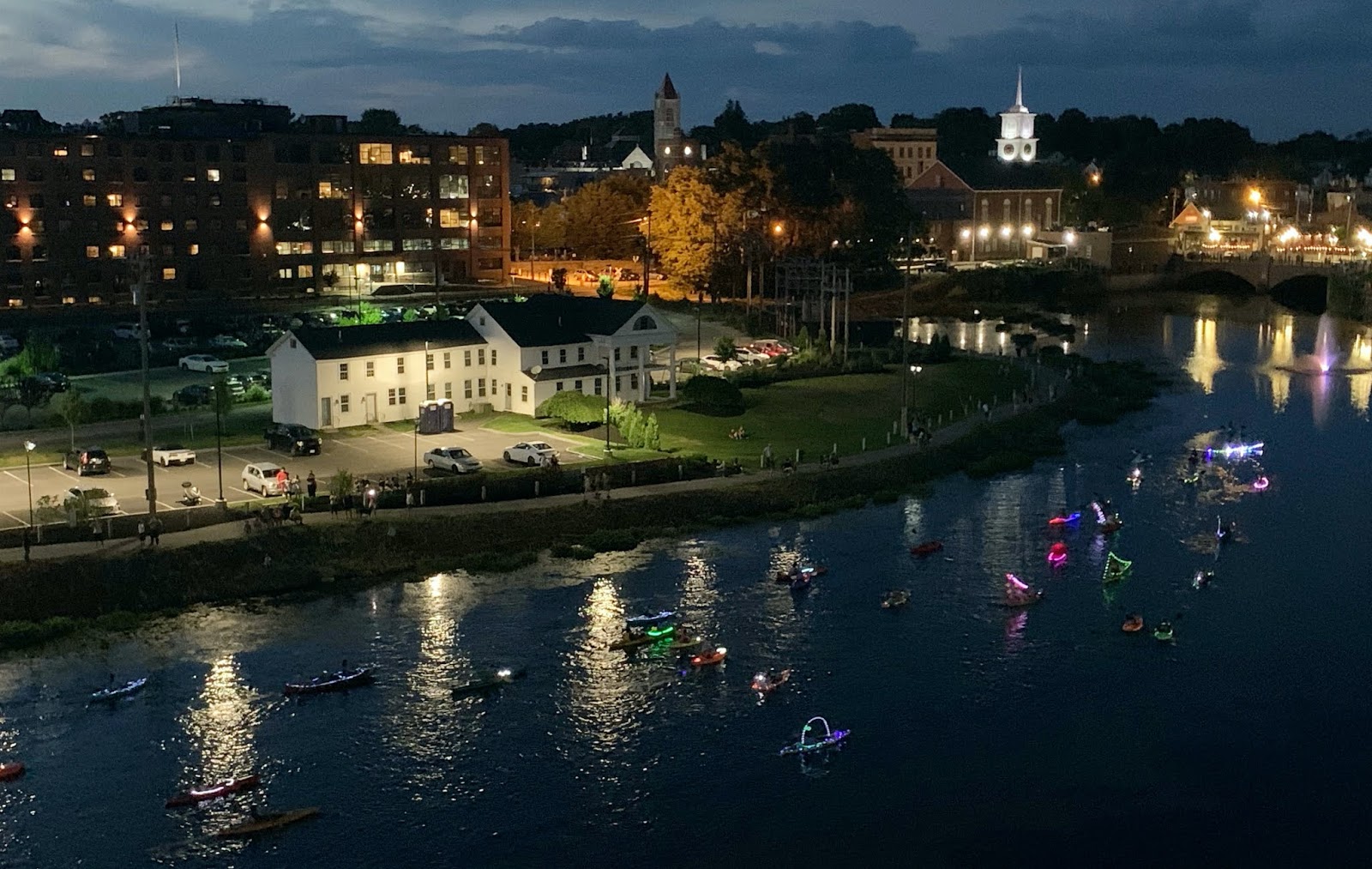
Kayaking continues to be a popular activity on the Nashua River, more so on weekends. A couple of weekends ago, we had a great view of a "Water Light Parade" from our 5th floor window. The event was organized by the Nashua Area Kayak Exploration Destinations group. It was estimated that over 60 water craft were on the river, most decorated with a variety of lights. We were watching a movie and heard a lot of shouting on the river. The flotilla lasted well over 20 minutes. 

Had we known in advance we would have gone down to the riverside. (The event was posted on Facebook which we don't use.) It was a wonderful sight and we hope will be repeated, not a once and done event.

The pocket park near the mill apartments, better known as the French Park  (Le Parc de Notre Renaissance Francaise) has a bountiful display of blooms which are attracting a lot of visitors especially ones with wings — bees and butterflies.


There's a lot of indoor blooms at Clocktower Place mill apts in the form of door decos.
We're doing well and continue to do our own grocery shopping and going out for walks. The most exciting personal update is that we've taken our bikes on a couple of excursions to nearby Mine Falls Park.
We definitely need a few more bike outings as it's been awhile since we've ridden and even small upgrades are tough. Temps have been in the 90s some days the past couple of weeks, but fall is coming fast

THANKS to everyone who left a comment on my last post about resolved Blogger issues and using Legacy Blogger (old) vs. New and Improved Blogger. It seems that many bloggers have the same attitude —  if it ain't broke, don't fix it. After I reverted back, this post was done using the Legacy version with no issues setting it up. Several bloggers have posted about being automatically switched to the new format. If, and when, that happens, I'll have to deal with it, but hoping it won''t happen anytime soon. 

Friday, July 31, 2020

Problem Resolved Now

My last post included a question about a recent Blogger issue. One blogger commented on a similar issue only on an iPad. For myself, this issue was on both an iPad and desktop PC, both using the Apple browser, Safari. Here's a repost of that issue:


Has anyone else using the Safari browser been experiencing problems with Blogger? This post took a longer than usual time today as I kept getting the message: "Safari cannot connect to the server" after selecting Design in the header bar. I found a workaround, but it was cumbersome. I'm not sure why this issue started, but hope it's a temporary glitch and not something that will make future posting and updating difficult. A secondary issue is that when I went to update this post, some parts of the original wording had disappeared, very strange indeed. I apologize, in advance, if you find some incomplete sentences.

What to do?
I checked online and followed many suggestions including resetting the network on the iPad, turning it off and on, shutting down our home modem and turning on, clearing the cache of stored visited websites.

Results
Not one, zero, none of these suggestions worked and I tried all of them. The issue remained. But, it's been resolved and that message no longer displays and I can connect to the server.

What Worked?
Reverting to legacy blogger and ditching the so-called new and improved version which I had switched to a couple of weeks ago, but wasn't completely comfortable using. In comments on this blog and others, a number of many bloggers have voiced their dissatisfaction complained about the new Blogger interface. Some reported issues with inserting photos and other images. 

The same was happening for me. Sometimes text would mysteriously not be there when the post was published, even though it was in the draft version. This happened several times when I was working on the previous post in the new interface. Oddly enough, it was always the same wording. Reworking the affected paragraphs and checking back several times finally resolved that issue.

A few other new Blogger interface issues for me: comments could no longer be marked as spam and then deleted. Preview wasn't always working when a draft was in process. Full-size photo images would not align left easily.

My Plan . . .
Until the bugs (and any/all other glitches) are worked out, I'm staying with the older Legacy Blogger interface as long as possible, no more switching to new and unimproved. That means until I get kicked off and forced to update. Hopefully, the folks behind Blogger will resolve some of these issues, and soon.

How about anyone else?

Thursday, July 30, 2020

Shakers and Movers


This post topic came after a 45-minute weekend road trip from Nashua to the small town of Canterbury, NH, where the major attraction is the Canterbury Shaker Village historic site.

(Spoiler Alert: this is a longish blog post because I found the subject matter very interesting and perhaps you will as well.)


Canterbury Shaker Village was founded in 1792 through land from community members, Benjamin and Mary Whitcher who donated their 100-acre farm. The village began with 43 members. In 1803, there were 159 members and in 1850, the site had 3,000 acres with a community of 300 housed in 100 buildings.

Today, this village is one of the most intact and authentic surviving Shaker community sites with 25 original buildings, 4 reconstructed buildings and nearly 700 acres of gardens, fields and forest. In 1993, it was declared a National Historic Landmark for its architectural integrity. In years past, its been visited by over 50,000 people from the US and 45 countries.


The village is open weekends for free outside only tours. On a warm Saturday, tour guide Ann, led our group, Grenville and myself, on a very informative 45-minute tour. We learned a great deal. Going inside would have enhanced the visit, but like two other New England Shaker villages, buildings are likely to remain closed through 2020 (these are COVID-19 related closures).

In 1905, there were 100 members in the Canterbury Shakers, down to 49 in 1916. The last male member in the village, Brother Irving Greenwood, died in 1939. By 1965 with eight remaining Shaker sisters, leaders voted to close the Shaker Covenant, the document all new members signed to join. In 1969, remaining Canterbury sisters laid plans to preserve the Shaker legacy and property by founding Canterbury Shaker Village Inc.

Whenever we visit a new place, there's always more to learn. This week we watched a 1984 documentary by filmmaker Ken Burns, Hands to Work. Hearts to God, part of The American Experience series. It provided a wealth of information, and if you're interested in learning more, I would highly recommend it.

Who were the Shakers?
They called themselves the United Society of Believers in Christ’s Second Appearing, but the world called them Shaking Quakers (Shakers) because of enthusiastic worship services that included singing, dancing and stomping to shake off sin.

They were admired and derided, imitated for successes and ridiculed for eccentricities. Some of these involved following a precise order when piling bones on plates after a meal; lining up in a prescribed order; entering a room to the sound of a horn and through separate male and female doors; stepping first on the right foot when going upstairs; when hitching a team, harnessing the right-hand horse first.


What did Shakers invent?
This religious group was far from a group of zealous worshippers, they were Movers — inventors and innovators. Shakers created the flat broom, metal nib pen, clothespin, no-kill mousetrap, seed packets, a machine for making tongue-and-groove boards, and the circular saw. 

They've been credited with over 100 patents, 37 of which have been verified, including: an addition to the back of chair legs to allow tilting back without slipping, a commercial oven that had revolving metal shelves pierced to allow even heating and could bake 60 pies or 70 loaves of bread at once. We spotted one of these ovens through a window at the bakery shop. They provided merchants with point-of-sale materials, like posters for store windows, and are thought to be the first to market small, consumer-sized packets of garden seeds. 

Shakers believed that a song, an invention, the inspiration for a building were gifts from God, not individual accomplishments. This explains why they failed to patent some inventions until they realized others were stealing them. Some of their concepts launched industrial careers for less altruistic outsiders who marketed and made fortunes from them.

Shakers are credited with writing 10,000 pieces of music. Between 1842  and 1908, over 10 different Shaker hymnals were published at Canterbury. Simple Gifts, written in 1838 by Shaker Joseph Brackett became famous after Aaron Copland used in Appalachian Springs in the 1940s. 

How widespread were Shakers in the US?
Shakers started in Great Britain in 1750 as a group of English Society of Friends (Quaker) dissidents. Eight followers left England and landed in NY in 1774 under the leadership of “Mother” Ann Lee, a mill worker, who when she died 10 years later, had laid the groundwork to spread the faith based on the principles of communal possessions, celibacy, pacifism, open confession of sins, and equality of the sexes

At its mid-19th century peak, there were nearly 5,000 members living in 18 self-contained communities from Maine to Kentucky. Three of those were in New England: Canterbury Shaker Village in NH, Hancock Shaker Village in the Berkshire Hills of Western, MA, and Sabbathday Lake in ME, the only active Shaker community in the world today which is now shutdown for public visits.
Communities were organized into families of 30 to 90 people. Work was a holy act, a belief reflected in high quality workmanship and design. Members gave up families and property, and were welcomed into “holy families” where men and women lived as brother and sister, with all property held in common. Males and females worked together dividing workloads and decision-making. 

Seventy-five years before the emancipation of the slaves and 150 years before women began voting in America, Shakers practiced social, sexual, economic, and spiritual equality for all members. Although converts devoted themselves and their possessions to the community, they could leave at any time.


If Shakers were celibate, how did they grow?
They relied on conversion. In the early 19th century in America, people were questioning traditional religious beliefs and social order, which led many to embrace the Shakers’ progressive thinking. Shakers were celibate after becoming members and did not marry or have children. They took in orphaned children and raised them; no child was turned away and all were fed, clothed, and educated in academics and trades. At 21, they could leave or sign the covenant to become members.

Formerly, being called a Shaker was considered a derogatory name. It later became an indicator of quality, ingenuity, value and was trademarked as a logo to products. Renowned for their furniture products, especially chairs, they produced tables, cabinets and other household pieces.

Unlike what's commonly seen in Shaker antiques and most museum pieces Shakers embraced color. Nearly all original furniture, built-ins, household objects, even floors were painted with colors dictated by their sect, blue, red, yellow or green. Shakers also dyed cloth they wove in colors of salmon, pink, red, Prussian blue, yellow, orange and purple. 

Canterbury Shaker Village resembles other similar villages with main buildings serving a utilitarian communal society: dwelling houses, shops, stables, a laundry, school, ministry, and an infirmary. 

The Meeting House ↓ played a primary role in the daily functioning of the community. Worshippers listened to community elders offering relevant lessons.
The village prospered through farming, livestock breeding, mills, the production of seeds and herbal medicines, printing and inventions. Its print shop which became the site of published materials for all NE Shaker communities, also accepted jobs from outside the community. Village members patented a commercial sized washing machine that won a gold medal at the 1876 Centennial Exposition in Philadelphia (PA) and models were later sold to hotels. 

In 1834, eldress Dorothy Durgin designed a hooded cloak that fit over bonnets to keep sisters warm. This fostered a fashion trend when Grover Cleveland’s wife wore one to his inauguration. The clothing line expanded during to The Hart and Shepard Company in 1891, founded by Sister Emeline Hart and Shaker Deaconess and Trustee Lucy Ann Shepard, who went on the road traveling to resort hotels as far as Florida with trunk-loads of cloaks and other handmade goods.

Shakers embraced technology and useful inventions 
Soon after the availability of modern household appliances, Canterbury sisters purchased a KitchenAid mixer, followed by an electric refrigerator and a Maytag washer.

In 1901 the New England Telephone Company installed telephones at Canterbury Village. The village had one of the first cars in the state, a 1907 REO, replacing the horse and carriage and removing long distance travel between Shaker communities

In 1910, the NH village built a powerhouse at a cost of $8,000, which powered electric lights in 16 buildings. The powerhouse contained a gasoline-powered, direct-current generator and storage batteries. This was before the NH state building in Concord was still burning gas.  In 1925, they purchased power from the local utility, but kept the powerhouse as a backup.

Shakers were not ascetics and had plenty of food and clothing. They believed cleanliness, neatness, and order led to serenity, but did not believe in drudgery. Tasks rotated with free time for entertainment like community plays and concerts.

They understood the value of “curb appeal,” positioning the most impressive, lightest colored buildings close to public roads or on high elevations to serve as advertisements. This former barn is now the museum store, closed during our visit.
At Canterbury, a range of ventures developed over the years and included selling patented medicines, clothing, cookbooks, and furniture. They also sold farm products of milk, cream, butter; lemon syrup for lemonade and medicinal use, canned vegetables, baked beans, pickles, honey, tins of culinary herbs, candy. Edward D. Pettengill of Portland, ME, partnered with the Shakers to bottle and sell Shaker-made ↓ products.

The wood shed ↓ stored large quantities of wood to cook and provide heat in winter. This is the last remaining wood shed at Canterbury. A nearby identical one was destroyed when the 1858 cow barn burned in 1973. 
The foundation stones for the cow barn can be seen here ↓. This was a huge barn, 200 feet x 45 feet, and it housed 100 dairy cattle. A 25-foot ramp provided access at either end. Sadly, only these stone foundations remained after the barn was destroyed by fire. 
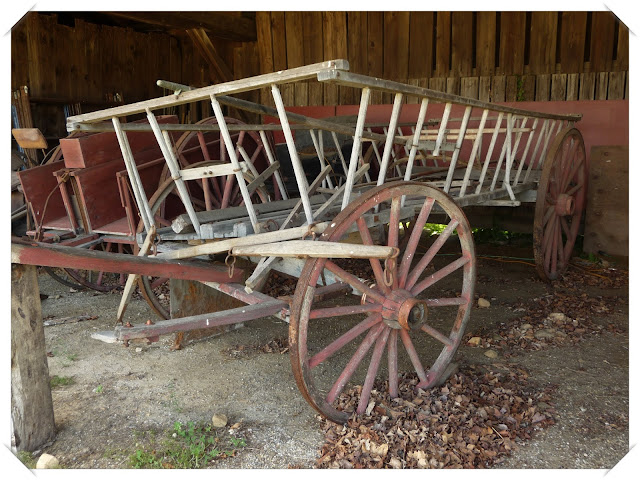
The horse barn and an equipment barn ↓ with several old carriages remain standing.
The 1785 Syrup Shop ↓ may have been first used as a lodging. Later, it was used it to make medicinal syrups, most famously Thomas Corbett's Compound Concentrated Syrup of Sarsaparilla, known as The Great Purifier of the Blood and other Fluids of the Body.
The Canterbury Dwelling House ↓ was built in 1793. Men and women entered through different doors and stairways, and slept in separate quarters. Sisters and brothers never touched.
The creamery ↓ was where milk products from the large herd of dairy cows were processed and later sold.
The village had its own firehouse complete with a bell tower.
There was also an on-site infirmary ↓ for ill or injured members. When traditional cures failed to work, medical practitioners were consulted from the surrounding area.

And, because I didn't know the differences between these religious sects, here's some information.

How do Shakers differ from Amish and Quakers?
The Shakers, Amish, and Quakers differ theologically and in the way they live. Unlike Shakers and Amish, Quakers do not live in their own communities. Unlike Amish and Quakers, Shakers were celibate and did not marry. Unlike Amish, Shakers believed in full gender equality. And while the Amish reject most technology, the Shakers embraced technological advances.

? Has anyone else using the Safari browser been experiencing problems with Blogger? This post took a longer than usual time today as I kept getting the message: "Safari cannot connect to the server" after selecting Design in the header bar. I found a workaround, but it was cumbersome. I'm not sure why this issue started, but hope it's a temporary glitch and not something that will make future posting and updating difficult. A secondary issue is that when I went to update this post, some parts of the original wording had disappeared, very strange indeed. I apologize, in advance, if you find some incomplete sentences.

Monday, July 27, 2020

Calling It Quits (Not Me)


No, I'm not talking about myself, at least not right now. There's far too many ideas in the to blog about someday stockpile of mine. More ideas than time to post, but better to have them, then not.

That said, I have read several recent posts in which the blogger has "talked" about giving up his.her blog for a myriad of reasons: for some it has become a time issue with other demands (such as family, medical) others have said they've run out of topics (really?) and still others have claimed it's no longer fun for them. And, as we all know, when the fun stops, it's really no fun at all.

We blog for many reasons — to share our life, home, family, travel and personal viewpoints. Granted, sometimes a blog post (or many) may be annoying, irritating, and even contrary to our personal and fast-held beliefs, but they are that individual's. There's no need for vehement comments unless. of course, the blog thrives on that activity, which some do. It remains your right to read, comment or not, and the level at which you choose to do so — nicely or not  it's your choice. You could also choose not to read certain posts and maybe not raise your BP. (Mine is already a bit elevated these days.)

Which brings me in a very roundabout way to the topic of this post  a blogger who is signing off from blog-land and one who I will miss reading. Of course, quitting isn't unusual and others have done so before. Some return after an absence; others have quit without a final post.

This week, I read a final post from Valerie, a blogger from the UK, on her blog, A Mixed Bag. In her words: I am quitting. Yes, you read that right. Thing is, I am  too old for this game or any other game and it is all down to age and degeneration. 

Valerie wrote that she's blogged for many years, enjoyed it and the friends made. Rather than repeat her brief farewell post, you can follow the above ↑ blog link.

It was disappointing to read that Valerie not would be putting her books away and forgetting that she wrote stories and books (her words).  That's unfortunate as her stories were a joy to read. She's is a talented and creative writer who created visual imagery through words. If her blog remains online, you may be still be able to read some of her stories.

This isn't the first time, a blogger that I and others have enjoyed has decided to quit blogging. And, most likely, it won't be the last. As stated above, lives change as do people's needs.

Backtracking a bit to this date in late February, I wrote about fellow blogger Laurie, a talented artist, who posted that she was quitting her blog, Where the Spruce Trees Grow, for medically related issues. Laurie was always open in sharing her blogging 
difficulties after a brain injury and failing eyesight. She left blogging, returned briefly, but eventually announced that she was quitting permanently (failed eyesight was her reason). Sadly you won't be able to see her artwork. While her blog title remains, all posts have been removed.

So once again, another blogger is leaving the blog world. I wish Valerie all good things in her blog "retirement." Admittedly, I will also miss hearing about the antics of her cat, Charlie.

Thanks, Valerie, for sharing such wonderful stories and unfailing good humor on your blog. I, and others, will miss reading them. And, if you ever want a guest blog post, just let me know. Please stop in for a visit, every now and then. I (and others) would like to know how and what you're doing.

OK, your turn, any other bloggers thinking about quitting? Do comment on why or why not.

Speaking for myself, Blogging is a wonderful outlet and I appreciate that others share a similar opinion. Like some, it's my only form of social media. My regret is that it's difficult to comment on everyone's posts in a timely manner as some blog often. I try to visit everyone's blog at least weekly, more often if possible. My own posting has been cut back to 3X a week and there's still a stockpile of ideas. Thanks, as always, for your comments, ALL are much appreciated.