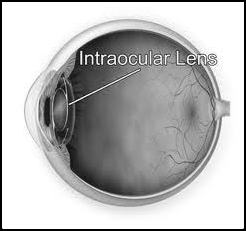
Everything went well with both surgeries. People have asked me about the surgery and recovery. Some have admitted they were squeamish about an eye procedure. This post contains my own reactions, which may differ for others.
First, there was absolutely no pain and no sedation required (it's can be needed). I was awake during both very short procedures done at a same-day surgical center. Several rounds of eyedrops were administered for 30 minutes prior to surgery, including ones to numb the eye and dilate it. I opted out of anxiety-reducing medication or I would have had to forgo a celebratory glass of wine after surgery. I'll take wine over valium any day.
 |
| Internet source |
The implanted artificial intraocular lens (IOL) isn't seen or felt and is now a permanent part of my eyes. IOLs have different features; cost is a factor. Medicare and some insurance plans don't cover all types. My ophthalmologist recommended a fixed-focus monofocal lens with a single focus strength for distance vision; reading glasses would be needed afterwards.
Here's very good news — the reading glasses don't require a prescription and are widely available in popular $ or on-line. My ophthalmologist said these would work. I'm buying several pairs. But, what to do with frames that formerly held prescription lenses?
Restrictions? A few the first week after surgery to ensure that soap or water doesn't splash in the eye. No heavy lifting, high impact exercise, contact sports and swimming. By week 2, only swimming is restricted 1 more week.
Personally, the worst part wasn't the surgery, the restrictions, putting eye drops in 4X daily, or post-op visits, but the required eye dilation. Yes, it's absolutely needed for a complete eye exam or procedure; after-effects, specifically light sensitivity, last from 4 to 6 hours. It averages closer to 5 hours for me, hence my dislike.
The
 If anyone is considering his surgery is needed, my suggestion is to discuss thoroughly with your eye doctor. If you're declared "ready" you also might want to go for it.
If you're Medicare-eligible, like me, this procedure is covered; there may be certain exclusions. If you do need a prescription for glasses after the surgery, that first one may be covered as well.
Speaking for myself, the end result was well worth any non-covered expenses that won't be covered by insurance.
Seeing clearly and without glasses is really good.