Sunday, October 24, 2010

Twin Cities: Biddeford & Saco

town sign welcome Saco The Saco River connects the Maine towns of Biddeford and Saco, which were originally considered a single town. Today the towns refer to themselves as the “Twin Cities.”

lite (2)Biddeford is a the largest city in York County, Maine and the 6th largest city in the state. It is the most southerly incorporated city in the state and the principal commercial center of York. It is the site of one of the earliest U.S. European settlements – first settled by in 1616. 

In 1653, Roger Spencer was granted the right to build the first sawmill. Lumber and fish became the chief exports. In 1659, a garrison and mill were built at the falls. During King Philip's War in 1675, the town was attacked by Indians. Settlers withdrew to  safety, and their homes and mills upriver at the falls were burned. In 1693, a stone fort was built a short distance below the falls, but was captured by Indians in 1703. The town was reorganized in 1718 as Biddeford – after Bideford, a town in Devon, England, from which some settlers had emigrated. saco city collage2 In 1762, the land NE of the river was set off as Pepperellborough, named after Sir William Pepperrell, who in 1761 purchased 5000 acres and timber rights to 4500 acres on the east side of the Saco River. Pepperrell donated land to the town for use as a village common, burial ground and site for a new meetinghouse.

The first bridge on the Saco River connecting Biddeford and Saco was built in 1767. The river divides into two falls that drop 40 feet providing water power for mills. Boot and shoe factories were established. The developing mill town also had granite quarries and brickyards and lumber and grain mills. Major textile manufacturing facilities were constructed along the riverbanks, including the Laconia Company in 1845, and the Pepperell Company in 1850. This was the town’s last remaining mill and is also now closed.

pepperill mill collage

Biddeford incorporated as a city in 1855 and built a city hall.

biddeford city hallThe mills attracted immigrants from the province of Quebec. At one time, textile mills employed up to 12,000 people. Today all are closed down and in serious need of repair as shown by these photos of a mill downtown Biddeford that lost its steeple. Time is really at standstill for this once proud clock

old mill-clock (1)

biddeford mill collage old mill-clock (5)

The McArthur Public Library, housed in the former Pavilion Congregational Church on Main Street, anchors Biddeford's historic downtown. Biddeford was one of the first cities in Maine with public library service. Robert McArthur, an Irish immigrant, who started working as a bobbin boy in a mill, gave the funds to purchase the building and monies to provide for its maintenance.

library 

biddeford collage

Directly across the river from Biddeford is Saco, formerly known as Pepperrellborough after Sir William Pepperrell, who in 1761 purchased 5,000 acres and timber rights to 4,500 acres on the east side of the Saco River. Pepperrell donated several acreage to the town for use as a village common, burial ground and site for a new meetinghouse.

By 1805, the town was renamed Saco since the name was too cumbersome. It was incorporated as a city in 1867. Saco became a lumber center with log drives down the river. At Saco Falls, timber was cut by 17 sawmills. In 1827, the community produced 21 million feet of sawn lumber, some of which was used for shipbuilding. The last log was driven down the Saco River in 1943.

City Hall dates from 1856 and has undergone several renovations, including an attempt to remove the bell and clock in 1880 and surviving a fire in 1895.Saco city hall

main street Saco The Saco Manufacturing Company established a cotton mill in 1826, with a canal dug through rock to provide water power. The mill burned in 1830; replaced in 1831 by the York Manufacturing Company. For well over 100 years, it was the city’s largest employer and taxpayer; however, York closed in 1958 as the New England textile industry faded in the 20th-century and the building sits empty.old mill Saco

With the arrival of the Portland, Saco and Portsmouth Railroad in 1842, the area developed into a major textile manufacturing center; brick mills dominated the Saco and Biddeford waterfronts. Other businesses included foundries and machine shops.  saco city collage2

Saturday, October 23, 2010

Lobster Capital – Let’s EAT

eats farnsworth musmRockland is one of the biggest shipping centers of lobsters in the world and today calls itself the lobster capital of the world. The  city hosts an annual Lobster Festival in August and at in December erects a Christmas tree built of lobster traps decorated with evergreens and lobster trap buoys.

Rockland is a city in Knox County, Maine. Abenaki Indians called it Catawamteak, meaning “great landing place.” In 1767, John Lermond built a camp to produce pine lumber, and it was called Lermond's Cove and later Shore village. Renamed Rockland in 1850, it was chartered as a city in 1854. The new name came from the granite and limestone that has been quarried and shipped to major cities from Maine. Rockland’s principal businesses were shipbuilding and lime production. In 1854, the city built 11 ships, 3 barks, 6 brigs and 4 schooners.

Today, the city is the commercial center of the midcoast Maine region with historic inns, shops, restaurants, and art galleries, including the Farnsworth Art Museum and Wyeth Center.

street view (1) street view (3) street view (5)It’s also home to the 20x20 foot EAT sculpture – 5 six-foot diameter disks weighing 300-pound discs, each 6 feet in diameter – that is showcased 50 feet above ground level. It sits on special base built to withstand winds of up to 100 mph. The original light bulbs have been replaced with modern light-emitting diode bulbs.

NO, it’s not signaling a restaurant, but sits on top of the Farnsworth Art Museum. It is on a special base built to withstand winds of up to 100 mph.The original light bulbs have been replaced with modern light-emitting diode bulbs.

farnsworth museum

The electrified metal sculpture was designed by American pop artist Robert Indiana for the 1964 World’s Fair in Flushing, NY – and was an instant hit.

NOT because people appreciated the artwork sitting in front of the New York State Pavilion – instead long lines formed because people thought there was a restaurant inside the exhibition.robert-indiana-love The confusion led to fair administrators turning off the illuminated display shortly afterwards. When the World's Fair ended, the sign was kept in a storage shed behind Indiana's home in Maine. Think you never heard of Indiana? His best known piece worldwide is LOVE – two letters on 2 lines with the "O'' tilted sideways.

A few more pieces from the Farnsworth Museum sculpture garden.

art collage

Friday, October 22, 2010

A Peak at Peaks

YES, this was our last day in Maine, so we took a trip to a place that is special to one of our followers and a good friend. Also $4.10 round trip was cheaper than a harbor tour cruise.
P1030752Peaks Island is actually part of the City of Portland, but once here you would never know it. After a very cold ferry ride we stopped for coffee at the Peaks Cafe, a place where you felt right at home when you walked in. So at home that if you sat in someone’s favorite chair they would tell you about it. Today was chilly, windy, and full of dramatic clouds again.
P1030759 


P1030747


P1030768


P1030818


We didn’t walk the whole island due to the chill and a 25 mph breeze. Here is a sample of the cottages we saw.
Peak's Is 
ThP1030788is one is for you Possum. We put a bid in on this lot for you. Only problem is I can’t remember what street it was on.
AND YES…. we have your rocks.
 
 
The strangest pic of the day was this one. Notice thP1030756e California plates  and the cord to plug it in. So the question for me would be, if they drove it here where did they plug in and recharge crossing the desert, plains, mountains????

The Sweetest Moose

One way you can be sure to see a moose on your trip to Maine is tolenny moose (5) visit Lenny. But, can’t pet or take him home. Lenny is a real sweetheart, or more correctly a really sweet moose. He can’t help it, cause it’s in his makeup – all 1,700 pounds of milk chocolate. He’s a big fellow too at 8 feet tall and measuring over 9 feet from front to back.

lenny moose (3)

And when going to Scarborough (not the fair) but the town in Maine, a visit to see Lenny is well worth the trip. You can find Lenny hanging out at Len Libby Candies, a store that sells handcrafted chocolate and ice cream, on Route 1in Scarborough.

It’s the only home Lenny’s known since being created in 4 weeks back in 1997. His first public appearance was on July 1 of that year. He hangs out in one sweet place – the store’s ice cream parlor. His surroundings include a mural of a log cabin and pine trees and he  stands in a pond of white chocolate tinted blue. Not a bad way to spend one’s days.

Lenny’s not alone either – keeping him company, besides store visitors, are Libby, a 380 lb black bear of solid dark chocolate, and her cubs, Cocoa and Chip, each weighing in at 80 lbs of solid dark chocolate.

lenny moose (1)

Lenny’s Start

Maureen Hemond, co-owner of Len Libby, with her husband Fern, came up with the idea of a chocolate moose. Zdeno Mayercak, a sculptor from the Maine College of Art had traveled to Freeport to study the stuffed moose on display in the lobby of L. L. Bean.

Mayercak created Lenny with tools normally used on wood and clay – hammers, chisel, hatchet. Lenny has a metal frame; his dimensions ruled out the use of a mold. Chocolate blocks each weighing 10 pounds were put on the frame. The jagged wire was worked into the chocolate to give it a finished look.

Lenny is solid chocolate. The mortar used to hold the blocks together was melted chocolate. More chocolate was molded inside of the frame. Chocolatier Fern Hemond tempered the chocolate to develop the shiny coat of the moose and instructed Mayercak and his assistants on its application.

lenny moose (4)Lenny maintains his dark good looks with the help of professionals  who paint brush his coat with confectionary glaze to lock in the oils from the chocolate, preventing evaporation and melting. The temperature stays under 68 degrees because a moose meltdown would not be a pretty sight. Lenny’s “birth” is documented in a video that loops endlessly on a TV monitor near his rustic setting. Here’s where you can see an online video about how Lenny was made.

Len Libby Candies

There’s no longer a Len Libby behind the company, but the tradition of hand making sweet confections continues with owners Fernand and Maureen Hemond.

The confectionary opened for business in 1926. Owner Len Libby had apprenticed with several candy-makers, and later worked as master candy-maker in the Portland area. After retiring, he opened a shop near Higgins Beach in Scarborough. At a time when much of the world's goods were handmade, the art of candy-making was enjoyed by everyone and Libby's candy selections became widely popular.

In 1949, Libby sold his business to Hemond who had begun his apprenticeship in the Higgins Beach shop while still in college. Hemond has continued with the shop's original candy-making recipes. The company has only the single Scarborough location and remains a family owned and operated business.

lenny moose (4)

You can’t pet or take him home, but the store sells miniature versions of Lenny and other handmade chocolates and candies. And, if you can’t visit in person, there’s always mail order.

DSCN7933

Thursday, October 21, 2010

Day 27 (can you believe it???)

WOW!!!!! I had to recount those calendar days to make sure i had it right. Twenty seven days on the road. We are still in Portland Maine. Today was a cloudy, damp, drizzley, misty, rainy, sunny, really rainy and windy, and finally sunny with a spectacular finish.
 P1030729 P1030730 P1030727
This was the finish of a storm with driving rain and 30 mph winds while we were in Wells. We sat the storm out in a parking lot at the beachfront and watched the storm roll over us and out to sea.
Our actual route was through Scarbrough, Saco, Kennebunk, Ogunquit, and Wells. Along the way we ran into some interesting things.
P1030717
This is a solid chocolate Bear. I tried to take a bite of his ear but they caught me. Beatrice will have more on him and his friend.
P1030722


The Saco River separates the towns of Saco and Beddeford. In the 1800’s it was dammed in numerous locations to provide power to run the many mills along the river. Today water from the dams spin turbines that generate electrical power. The structure to the right is a wind turbine that has P1030723been erected near the Saco generating   station. I guess that it will be put into service to either replace the water turbines or produce additional electricity eventually. There is a program in  Maine to remove the older dams on rivers and restore the historic fish runs. This turbine was about 60 feet tall. So how do you get something that big and tall to stand????? Lots of concrete and a whole lot of really huge bolts anold train stnd nuts.
We found this old railroad station in among a flea market. After pulling into the parking we spotted a sign that parking was $5.00. I guess he had more lookers than buyers so he decided to charge for parking. At least he would make a few bucks, but not from us.
Tomorrow Peaks Island, and Portland Head Light. (Yes Possum, I'll bring a rock home for you.)

Lighting the Way (Back When)

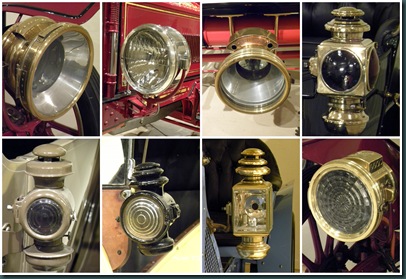
DSCN6908The antique autos we saw during our visit to the Owls Head Transportation Museum were really amazing. I was fascinated by the beauty of these antique automobile headlamps.

headlamp collage1

headlamp collage2

DSCN6815

Other car parts were just as interesting. Imagine seeing these beautiful vehicles on today’s roads – NOT.

car parts collage It’s really so true that “they just don’t build them like they used to.”

Wheels and Wings

Owls Head, a small town located just a few miles south of Rockland, museum logoMaine, is home to the Owls Head Light and also to the Owls Head Transportation Museum, a collection of over 200 restored DSCN6799antique cars, planes, bicycles, carriages, and motorcycles. Some of these vehicles date to the early 1800's and all are operational. The displays are presented In a open and very spacious environment that resembles an airline hanger. The design lets you move around without feeling confined in tight spaces. The museum is very well lit, which is good for available light photos, but also creates glare issues from highly polished vehicles. 
DSCN6932
DSCN6881 DSCN6730  The Owls Head Transportation Museum was founded in 1974 and DSCN6783 encompasses over 100,000 square feet for exhibitions. What makes the Owls Head museum so unique compared to other transportation museums is that all the vehicles on display really run. Many are used on exhibition days during the summer months.
DSCN6767DSCN6746 DSCN6739 DSCN6758 DSCN6791 DSCN6801  DSCN6845DSCN6780  DSCN6781
There are motorcycles – many early Harley Davidsons.
cycle collage
The Duesenberg (nicknamed "Duesy") was an American luxury automobile built entirely by hand around 1913.
dusenberg collage And who can resist the appeal of a Rolls Royce – or maybe two?.
DSCN6817
DSCN6875If you thought the MG only came in small sizes, check out these MGs.
MG Collage  Some examples of working cars.
work cars collage  Some very colorful cars . . .
red car collage DSCN6861 DSCN6900 DSCN6901 
A favorite aircraft is the 1917 Fokker Dr. I Tri-plane. The same type of plane that Manfred Von Richthofen, better known as the Red Baron, flew in World War I. There’s also a full-scale replica of the Kitty Hawk, the flyer that the Wright Brothers flew for the first  successful manned flight  in North Carolina in 1903.
planes (9) planes (3) plane collage
This was our second transportation museum stop in Maine after touring the Cole Transportation Museum in Bangor. Both museums are well worth the trip if you visit Maine. (And both offer free admission to those under 18 years old.)