Showing posts with label VT. Show all posts

Thursday, May 4, 2023

If We Don't Have It

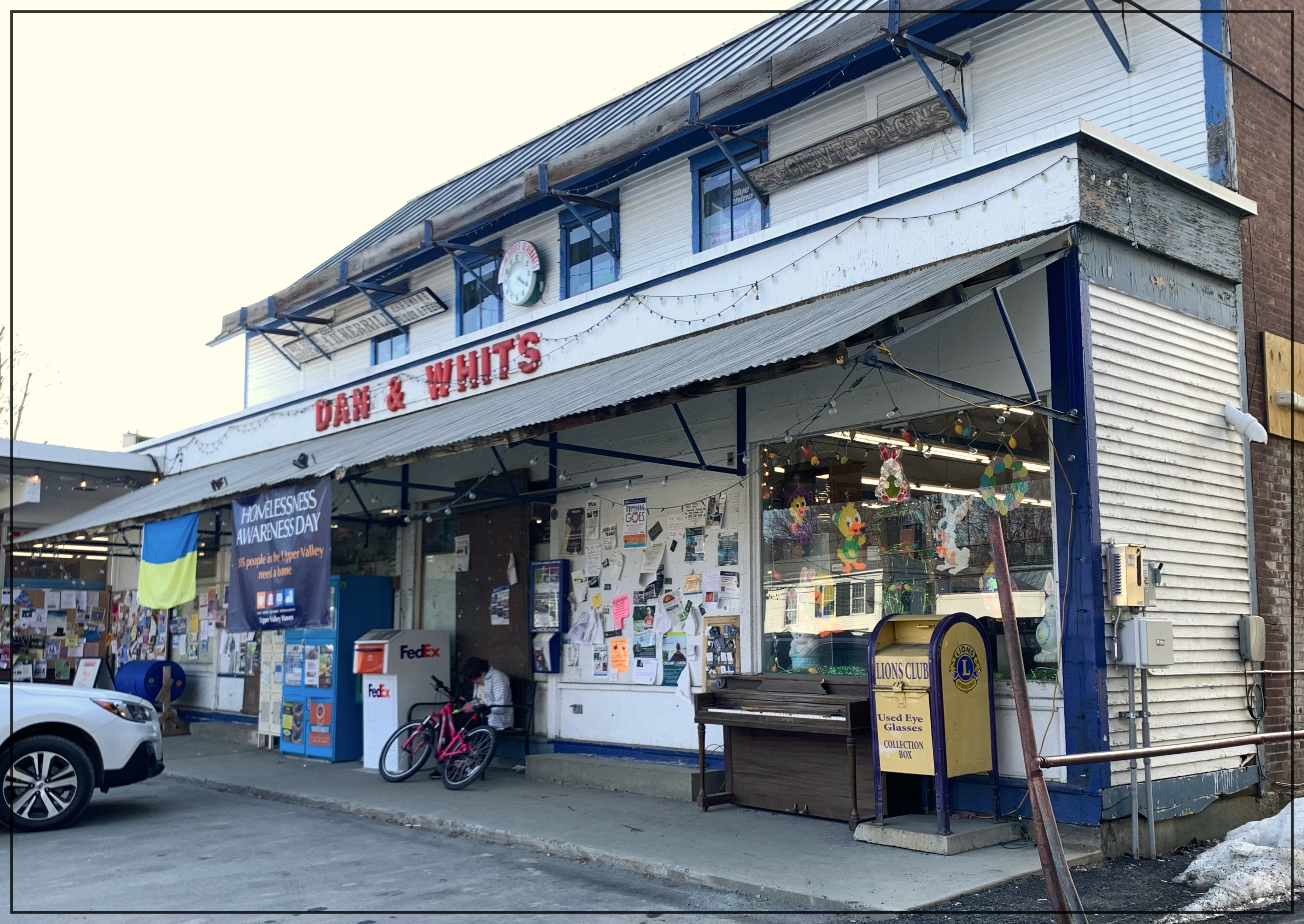
Store motto at Dan & Whit's, VT
. . .You Don't Need It !

That's the motto posted at Dan & Whit's general store in Norwich, VT. It can be found on items throughout the store, from clothing to shopping totes.

For over 100 years, this store has been as much of a fixture as an iconic New England church steeple.

Norwich, VT, was settled by land grantees from Norwich, CT in 1761 which explains its name. This small New England town (pop. under 4,000) is one of the wealthiest towns in Vermont. It's home to many professors who teach at Dartmouth College, just across the Connecticut River in Hanover, NH. 

Dan & Whit's store is an integral part of the town and it's located in the center of town, as downtowns go, this one is small. There's the Norwich Post Office, the Norwich Bookstore, the Norwich Fire Department, and the Norwich Inn where we stayed (more on the inn later)
Dan & Whit's General Store, Norwich, VT
Everyone who lives or visits Norwich most likely has shopped here. Years ago there were up to five general stores in town, today just Dan & Whit's remains in the same Main Street location since 1891. It's served many purposes in that time—a bank, town hall, and the local post office. The Merrill family, its previous owners, ran it for three generations. In the 1930s, Dan Fraser & Whit Hicks began working there; 20 years later when the Merrills decided to sell, Fraser and Hicks purchased it in 1955. 

Both men ran the business until the 1970s, when Whit sold his half of the business to Dan. The name stayed and Dan's sons, George and Jack, took over in the 1970s. They're still the principal owners and visit often, now the third generation of the Frasers runs the day-to-day operation. 

Like other independent country stores in New England (there's still others) shopping at Dan & Whit's is a unique experience, like going back in time. 
Housewares, dairy products, canning goods and canned foods
Inside, there's groceries, produce, local dairy products, canning items, housewares, clothing, toys and even flowers or firewood. If you're hungry, there's also a deli and meat counter, pre-made salads and sandwiches, pizza, and even take-out sushi.
Sandwiches, groceries, and produce
The exterior isn't fancy with gas pumps out front. Self-service pumps became a gas station standard years ago, but until 2012 gas pumps here were maintained by a service attendant When an underground tank needed replacement, it was time to replace the pumps, but the store's gas provider could only provide ones with credit card slots. One good thing is the changeover helps prevent non-paying drive-offs to the tune of up to $100 a day. Before, some motorists would fill up and leave while the attendant was inside running a customer's card.
Bulletin boards in front of store
There's no eye-catching window displays. Several bulletin boards hold postings from various community groups in no specific order. If it's posted, someone might read it.
Directory on back door 
The real experience is where the general market ends and you go through an unmarked door behind the meat counter to enter the real general store. 
Some of the thousands of items found in Dan & Whit's 
Here's where you'll find thousands of items, some of which are listed on the Hardware Department door. There's hunting and fishing gear, dog treats, livestock grain, gardening tools, snow shovels, work gloves, socks seasonal items, flower pots and soil, hoses, grill supplies, baskets, canning supplies camping gear, fencing, screens, axes, sledge hammers and firewood.
Vintage screw cabinet and scale at Dan 7 Whit's
This store is such a community staple that when the pandemic hit and help was hard to find, residents came to help out. Local professionals including a business man, doctor, teacher, professor, therapist, and nurse helped the store stay open for business.
A general store can't match a big box store where things will cost less. But, there won't be as much genuine affection, and some fun too, in the shopping experience. That's what a store like Dan and Whit's still has to offer everyone who comes in.
The Norwich Inn on Main Street, Norwich, VT
Our road trip to Norwich, VT, was a 90 minute drive from Nashua, NHWe stayed here at the Victorian-style Norwich Inn on downtown Main Street. Set back from the street, the inn has three buildings that accommodate 40 guest rooms; 17 are housed in the Victorian mansion, which has a lounge, dining room and pub. The large covered porch has rocking chairs that have been used by many visitors over 226 years.

Moose head at Norwich Inn
Entering the inn's back door, we were greeted by this guy with a bird friend. According to a small plaque, this moose met his demise in September 1924. He's been at the inn many years.

The Norwich Inn was built in 1797 by Colonel Jasper Murdock as a private residence considered one of the state's finest. Colonel Murdock ran his home as the Norwich Inn, a stagecoach tavern that hosted travelers on the coach road heading north from Boston to the White Mountains. In 1801, it  became the Curtis Hotel owned by Eleazer Curtis. 

In July 1817, the fifth U.S. President James Monroe took a summer trip through New England and stopped at the inn. According to the inn's history, he had dinner and spent time meeting town citizens before leaving. While Monroe had a short visit, the hotel gained bragging rights as the first Vermont lodging establishment to have hosted an American president.
The Newton Inn, Norwich, VT

Its next owner, local resident Lewis S. Partridge, a member of the Vermont Militia, named it the Union House. 

After his 1886 death, Dr. W.S. Bowles became the next owner and it became the Newton Inn. It was destroyed in a December 1889 fire that began in a neighboring store, consuming it, the town post office, and several structures. Innkeeper Bowles, rebuilt in 1890 on the foundation of the original structure. The new Newton Inn resembled a Victorian structure with a wraparound porch and central turret.

In 1920, Dr. Bowles sold the inn to Charles and Mary Walker, who restored its original name. Although Prohibition had just started, the Walkers ran a tavern and, according to local legend, “Ma” Walker, served bootleg whiskey in the inn's cellar. A hotel register from the time features cartoons of Dartmouth students with mugs held high. A famous Dartmouth graduate, Theodor Seuss Geisel (Dr. Seuss) was a frequent patron. When Charles died, Mary ran the inn until the mid-1930s when health issues forced her to sell. Guests have reported seeing her spirit in the dining room, dressed in a black formal gown. 

During its years of various ownership, structural changes were made to reflect trends of the day. Porches were enclosed and towers were removed. In 1991, new innkeepers began restoring the building to its earlier splendor as a landmark in the center of Norwich. Renovations included the reappearance of the central cupola and reconstruction of the front porch.
Jasper Murdock's Alehouse at the Norwich Inn
The inn's brewing traditions returned when a microbrewery was opened in a former livery building. In 1993, Jasper Murdock's Alehouse began producing English-style ale and a flagship ale, Whistling Pig Red Ale. About 200 barrels of beer are crafted annually and sold exclusively at the pub and it's one of the smallest U.S. breweries.
Dining room, back entry and staircase at the Norwich Inn
In 2006, the inn changed owners again and was bought by a Potomac, MD, couple who stayed there while visiting their Dartmouth College son and considered buying the property. There was just one hitch, it wasn't up for sale. That said, discussions were held and the inn once again had new owners. They were on-site during our visit, we were told, by the full-time innkeeper, Dave.

As you'll find in most historic hotels, the bathroom is much smaller than those in a modern lodging. If you choose a room in the historic Main Inn, it is not handicap-accessible. There is no elevator. You'll get exercise using the stairs, which are carpeted and nice to look at and Dave will help out with luggage.
Seating areas at the Norwich Inn
Just off of the dining areas is a Victorian-style living room complete with overhead chandeliers and a fireplace that was lit every evening during our visit. The room has comfortable seating to sit and enjoy a good book, chat or play a board game.
King Arthur Baking Company headquarters, Norwich, VT
No visit to Norwich, VT, would be complete without stopping at King Arthur headquarters, the flagship campus for all things about baking. We watched artisan bakers in the company bakery, browsed the extensive store, and had lunch at the onsite cafĂ©. We also spoke to folks who had travelled from PA and WI to attend some of the baking classes.
King Arthur store and bakery products
The company was founded in 1790 in Boston, MA, by Henry Wood who was an importer and distributor, originally of English-milled flour. Over the following years, it changed owners from Wood to Benjamin Sands and in 1895 was organized as a joint-stock company, named Sands, Taylor & Wood Company after the owners: Orin Sands, Mark Taylor, and George Wood (no relation to Henry Wood).

In 1896, the company introduced a new brand of premium flour that was called King Arthur Flour. It was so named after George Wood attended a performance of a musical, King Arthur and the Knights of the Round Table. The new flour was introduced at the Boston Food Fair in September 1896 to commercial success which has continued to this day.

The company became an employee-owned business in 1996 and has been 100% employee-owned since 2004. It's been named one of the Best Places to Work in Vermont annually since 2006. 

In July 2020, King Arthur Flour changed its name to The King Arthur Baking Company Inc. to reflect products and services other than flour, which include baking equipment, baking mixes, and cookbooks through its catalog, website, and at its flagship store. The logo was changed from a medieval knight riding a charger to a wheat-themed crown.

The re-branding was launched several months into the Covid pandemic, as retail flour sales exploded and people started home baking. King Arthur's flour sales in March 2020 were nearly 20 times above that of the previous year. That's a lot of dough (flour and dollars)!

Yes, I was one of those home bakers who used King Arthur brand exclusively, and still do.

Monday, September 27, 2021

Final Anniversary Adventures

This is the last post (promise) on our August anniversary road trip in NH and VT. We've been to other places since then, including a roadside attraction in MA and a balloon festival in PA, details in future posts. 

There's a region in Northern CA widely known as Silicon Valley. Perhaps less well known is that in the mid-19th century in New England, Windsor, VT, and surrounding regions became known as Precision Valley.

Precision Valley ran along the Connecticut River, from Springfield, VT, to Hartford, CT. In the 1850s, electricity didn't exist and water power was what enabled precision machinery to operate
The village of Windsor, VT, became an anchor in the Precision Valley due to a gun factory on the banks of the Mill Brook that became a forerunner in the field of interchangeable precision manufacturing. 
Today, the former Robbins & Lawrence Company gun factory is home to the American Precision Museum, and its unique collection of machine tools spanning the first 100 years of precision manufacturing. Declared a National Historic Landmark in 2001, the building is significant for its architectural integrity reflecting the size, scale, and operation of a 19th century New England factory.

Richard Lawrence had moved to VT in 1838 at age 21 and later formed a gun-making shop with Nicanor Kendall. In 1846, local businessman Samuel Robbins urged them to bid on a United States army order for 10,000 rifles for the Mexican-American War. They got the bid because their bid of $11.90 was ten cents per gun lower than competing bids. And, convinced the government parts interchangeability could be used in building the rifle.
Lawrence and Robbins bought Kendall out and formed a partnership, buying land and building a factory and machine shop, hiring workers and mechanics, inventing new machines, adapting old ones, and creating the new technology of producing precise interchangeable parts to fill the order. The system of mass production introduced at the factory was so efficient that the order was done 18 months early; the company was awarded a second contract for 15,000 more rifles. 
The four-story factory had high ceilings and wood construction. Its wood floors accommodated heavy equipment for a large workforce. The narrow width and expansive windows provided plenty of natural light. An 18-foot iron and wooden water wheel in the basement powered a network of belts and shafting to operate the factory's machine tools. These could cut rifle wood and metal parts with accuracy and consistency speeding up the production process.
F. Howe & R. Lawrence

Robbins & Lawrence was one of the first companies to use custom metal lathing machines to create parts so precise they could be interchanged. This was a major advance in weapon making and manufacturing in general. Shop superintendent Frederick W. Howe was responsible for many of the company’s innovations in machine-tool design and along with Lawrence developed a milling machine that was later commercialized for use by other firms.

When the war ended in 1848, R&L found that machine tools could be used to produce other items. These tools created precise custom parts for machinery that became standard throughout the U.S. The concept of interchangeable parts was applied to mass production of consumer goods like shoes, watches, sewing machines, typewriters and later bicycles and automobiles producing them faster and in greater quantities.

Revolving hammer pistol
R&L produced in mid-1850s 
In 1851, American contractors and manufacturing firms including Robbins & Lawrence exhibited at the Crystal Palace Exposition in London, a worldwide celebration of arts and technology. The Windsor-made rifles won a metal and the British Parliament sent a group to the VT factory to study the American System of interchangeable machine-made parts.

Afterwards, Britain placed an order for 25,000 Enfield rifles to be made in Windsor, also ordering 141 machine tools to equip an armory being built near Enfield. Robbins & Lawrence became one of the first American companies to export new technology from America to Europe reversing the previous direction.

Ironically, the awarding of this major contract also led to the company’s downfall. In 1857, the Robbins & Lawrence Company went bankrupt and closed. The company, which had bought machinery to produce the rifles, was left with 12,000 undeliverable muskets when the Crimean War ended suddenly in 1856.

The Robbins & Lawrence Company employed over 150 men at its peak. These machinists and engineers were able to apply their skills to tool companies in the area and beyond. Even in its decline, the company’s technical innovations guaranteed Windsor, VT, a chapter in the history of the American Industrial Revolution. It also played a role in fostering the careers of those who implemented Vermont’s machine tool industry in the late 19th and 20th centuries.
After it closed, the plant and equipment were bought in 1858 by Ebenezer Lamson operating as Lamson, Goodnow & Yale which made sewing machines. When the Civil War erupted in 1861, he secured a government contract for 50,000 long-arm rifles and re-tooled to produce rifles and machinery for gun makers like Colt, Remington, Sharps Rifle, and the Springfield Armory.
The most common firearm for Union soldiers was the Special Model 1861 rifle-musket based on the British Enfield rifle made by Robbins & Lawrence in the 1850s. 
During the fall and winter of 1861-62, production soared. Lamson recruited skilled machinists and gun makers from around New England. Gas lighting was installed; more than 300 men worked in shifts around the clock. By spring 1862, orders for gun-making machines slowed. Machinists in the Windsor factory began receiving orders for lathes, drill presses, barrel turning machines, and various types of milling machines. 
By 1870, Lamson sold the arms making tools and machinery to Winchester and Smith & 
Wesson and continued as a manufacturer of machine tools for a number of years changing the firm’s name to the Windsor Manufacturing Company. 

The heritage of the former Robbins & Lawrence Company continued with several companies using the old buildings and tools. The property was sold to the Windsor Electric Light Company and, in 1926, was sold again to the Central Vermont Public Service Company which proposed razing it in 1964 and prompting Windsor resident, Edwin Battison to form plans for a museum. 
Battison ↑, curator of Mechanical Engineering at the National Museum of American History at the Smithsonian Institution in Washington, DC, secured the building in 1966 to house not only the American Precision Museum in 1966, but his collection of historic machine tools, related books, and archival materials. He served as its director until 1991.
The American System of Manufacturing had its roots in firearms production. Notable features included the extensive use of interchangeable parts and production mechanization. The system was first fully developed in armories and known as armory practice. 
The Robbins & Lawrence Company and its successors played a crucial role in this process.
Folks, this was yet a(nother) long-ish post about a subject that may not appeal to all. Many of our recent road trips have included visits to new-to-us museums. I enjoy reading about them and sharing this information. Hopefully, some of you, will enjoy reading about them here. If you did, there's more recent museum visit posts to come, but later (promise).

Wednesday, September 8, 2021

Anniversary Adventures

We’ve been doing staycations (traveling in the U.S. and mainly New England) for day trips and overnight lodgings. Our recent anniversary getaway was less than a 2-hour drive from Nashua, NH, to White River Junction, VT, and Cornish, NH. (This post is a long one and highlights several stops as separate posts weren't needed for each one.)
Downtown White River Junction, VT (year unknown)
Ironically, we were in VT, 9 years ago when Hurricane Sandy battered the East coast in 2012. In 2021, Hurricane Henri threatened the Northeast and New England. Both times, the area we stayed was spared any repercussions. 
S. Main St, White River Junction, VT (circa 1940s)
The village of White River Junction derives its name from where the White River joins the Connecticut River on the borders of VT and NH. It was once a bustling railroad hub that contained over 14 railroad tracks in its boundaries. Today, the White River Junction Historic District consists of galleries and studios reflecting architecture from the late 19th and early 20th centuries. The district was listed on the National Register of Historic Places in 1980.
Rail lines in White River Junction, VT, circa mid-1850s
In 1847, the Vermont Central Railway and Connecticut River Railroad began building rail lines through White River Junction. This led to a thriving village revolved around the depot where the rail lines met. Five different railroad lines were laid through the village from 1847 to 1875 to create an eight-track crossing served by 50 passenger trains a day. 
In 1849, the first passenger station opened, a union station meaning that was used by every railroad. It was the first of three stations to be destroyed by fire in 1861, 1881, and 1911. Rail service declined in the 1960s due to the Interstate Highway System. The current railroad station is still in use, but passenger service is down to two daily trains on Amtrak’s Vermonter route.
Hotel Coolidge, S. Main St, White River Junction, VT
This trip, we stayed in the Hotel Coolidge on South Main Street. The 1926 Italianate-style hotel is one of the larger structures in the historic district as well as being the only lodging within the village of White River Junction today. Just like the train stations, it has a history of endurance after fires destroyed two earlier buildings in that location in 1878 and 1925.
Junction House, White River Junction, VT (year unknown)
In 1849, Samuel Nutt, a farmer, who owned land near the first railroad depot, sought to capitalize on the success of the Vermont Central Railroad. He purchased the Grafton House in Enfield, NH, and moved the clapboard structure to land he owned on the other side of the tracks from the depot. Renamed the Junction House, it provided meals and shelter for rail travelers and served as a local meeting place. In 1878, it suffered the fate of many wood-frame hotels of that era and burnt down after a kitchen fire spread throughout the building. 
Junction House & other buildings, White River Junction, VT
In 1879, it was replaced with a 200-guest room facility and continued operating as an important railroad hotel. Sold in 1901 for $50,000, the new owners expanded to 340 guest rooms. In 1919 the building again caught fire when an oil heater exploded on the second floor. All guests were evacuated, but the wood-frame hotel was a total loss. Rebuilding began within weeks. 
Hotel Coolidge circa 1925, White River Junction, VT
In 1924, owner Nathaniel Wheeler renamed the Junction House to the Hotel Coolidge in honor of his friend, John C. Coolidge, father of U.S. President Calvin Coolidge, and a VT resident. That structure, also destroyed by fire, was replaced by the current structure in 1925. Through the years, the building continued as a hotel with storefronts. Renovated in 1997, it remains the Hotel Coolidge nearly a century after its completion, standing for longer than its two predecessors combined, but with far fewer rooms. It's now a 30-room hotel and 26-bed youth hostel. 

When White River Junction was an active railroad center, the rebuilt Hotel Coolidge was the leading hotel. In 1927, room rates were $2.50 per night, $3 for a room with a bath. In May 1929,  two months after his second term ended, former President Coolidge spent a few nights at the hotel while on a fishing trip.
Current Hotel Coolidge exterior & lobby, White River Junction, VT
A stay at the Hotel Coolidge is quite different from staying in a modern hotel chain. It has some unusual quirks, like slanting floors, a sink in a sitting room, and rooms with a bathroom between the bedroom and sitting room. That's because, years ago, these may have been separate bedrooms with a shared bathroom.
Hallway, stairs, 2nd floor sitting area, Hotel Coolidge, White River Junction, VT
But these differences are what make it so unique with hallway tables, chairs and lamps and sitting areas at the end of the hallway directly near the stairs. Currently, hotel rooms are all on the second floor, compared to years ago. All rooms have a small fridge, no microwave or coffee maker, unlike many current hotel/motels. However, free hot coffee was available in the lobby in the early morning and throughout the day.
The smallish Hotel Coolidge elevator
The hotel's elevator is very small and definitely not anyone feeling claustrophobic. That's because it accommodates 2 people with luggage. It was also very quiet, and very slow exactly as the posted sign indicated. 
Boston & Maine Locomotive #494, circa 1892
Remnants of the village's railroad history remain. In a pavilion in front of the RR depot, Boston & Maine R.R. locomotive #494 and a caboose are on display. Both have NH connections. The coal-fired engine was built in 1892 by the Manchester Locomotive Works. The 33-feet long caboose was built in 1921 by the Laconia Car Company. The engine remained in use until 1938 and was displayed at the 1939 World’s Fair in Queens, NY. In 1957, after it was donated to the town of Hartford, VT, it was restored and placed on display in White River Junction with the caboose.
Former Post Office is the Center for Cartoon Studies, White River Junction, VT
A prominent building directly across from the hotel is the U.S. Post Office built in 1934 as a Works Progress Administration (WPA) project and succeeding earlier ones in 1849 and 1890This Neo-Classical Revival-style brick building retains the inscription United States Post Office on the front and was at various times, a post office, Vermont District Court and a privately owned office building. Today, it's home to the Center for Cartoon Studies, a 2-year art school focusing on sequential art, such as found in comic books and comic strips.
Gates Hotel Annex, White River Junction, VT
Sometime after 1950, the above lettering was painted on the walls of this building, which may have been a hotel earlier, but no information was located. One sign states Room with Bath with an arrow. The other sign advertises Gates Hotel Annex, Newly Furnished, Hot and Cold Water, $1.00. The building is considered a landmark in the village and houses a bar on the lower level.
Former J.J. Newberry's now  houses Tuckerbox Restaurant
By 1938, the building at the intersection of North and South Main Streets was renovated for J.J. Newberry Stores. Renamed Newberry Market, today, the site is occupied by Tuckerbox. This 
popular village eatery features Turkish and Mediterranean cuisine and is the only one of three downtown eateries open daily for breakfast, lunch and dinner. We dined here several times as the other two restaurants were open limited hours, mainly due to being short-staffed.
1890 Gates Block, White River Junction, VT
It's not only the Hotel Coolidge, but many other buildings in the center of White River Junction that have survived over the years. One prominent structure is the large 1890 Gates Block named after George W. Gates, who not only owned most of the land now in the historic district, but was prominent in the early development and growth of the village
Vermont Salvage Company, White River Junction, VT
A visit to White River Junction always should include a stop at the Vermont Salvage Exchange on Gates Street. This was our second stop in nine years (since 2012) and the building has remained the same as then. We even suspected some of the same items were inside. 

The business is housed in an Italianate Revival structure built on land formerly leased from the Vermont Central Railroad. The building was formerly home to the Cross-Abbott Company, a wholesale grocery business founded by Charles Cross and Charles Abbott in 1894. By 1903, it was one 13 prosperous wholesale businesses. When Cross-Abbott moved out in the mid-1950s, another wholesale distribution company, White River Paper Company occupied the building until 1989 when Vermont Salvage started in business there.
All that's sold here is architectural salvage which makes Vermont Salvage is a very unique place to visit. There's no knick-knacks, yard sale or flea-market items, just lots and lots of stuff taken from old homes and buildings.
Vermont Salvage is a haven for architectural salvage of all types
Today, this location is considered by many as New England's premier architectural salvage company. Within its two floors, it features everything from antique and historic pieces, wrought iron fencing, sinks and tubs, columns, mantelpieces, doors and even stained glass windows.

While we stayed in VT, we spent time in nearby Cornish, NH, where a highlight of our visit was a first-time meetup with fellow NH blogger, Marcia, and her husband, Dan. We enjoyed a get together with wonderful food and good conversation. Marcia and Dan graciously provided a tour of their home and barn. (Whoops, no photos taken.)
Our anniversary day started with Saturday morning breakfast at the Four Aces Diner in West Lebanon, NH, which bills itself as Home of the All American Retro Brunch 50's Diner. This is a very popular eatery as witnessed by the packed parking lot, luckily we did not wait long for a booth, counter seating was also an option.  The blueberry pancakes were delicious, according to Grenville, and I agreed this choice was better that mine, a Cinnabon® roll pancake. While tasty, they didn't compare to one of those decadent cinnamon rolls. 
Transportation from parking area to Cornish, NH, fair grounds
After breakfast, we spent nearly the entire day at the Cornish Fair. Billed as 
Family-Friendly, Country, Agricultural Fair, it reminded us of the similar ones we had attended when living on the VA eastern shore, which was largely an agricultural area.
The heat took its toll on these cows, including this exhausted young'un
There was an abundance of local participants and fair goers despite the very warm and humid Saturday we attended. Last year's fair had been cancelled due to the pandemic. It was evident that this year's event was more early attended because of that fact.
Vintage tractors displayed at Cornish, NH, Fair
Anyone who has ever been to an agricultural fair knows that it's not be complete without displays of tractors. There's always plenty of all makes, models and ages and always a lot of green John Deere models.
Cornish, NH, Fair indoor exhibits
Indoor exhibits included home grown veggies and canned goods, along with crafts, photography, quilts, and baked goods (no sampling here).
Rides and stage performances at Cornish Fair
One thing we do not enjoy at fairs are the rides, so we were content to watch others enjoying these high flying ones. But, we did enjoy these performers at an outdoors pavilion.
Our anniversary ended with cheesecake and white wine enjoyed in our VT hotel room. The wine was brought along on the trip and the dessert was purchased at a supermarket. It had been a long and very warm hot day outdoors and after dinner on the way back from the fair, we opted for an intimate dessert celebration.

WAIT, this isn't the end of our anniversary adventures as there's more to come, but not in this post (thankfully). A future post will detail our visit to the only National Historic Park in NH.