Friday, June 14, 2024

Friday Flag Day 🇺🇸

Annual flag display in Hudson, NH, from Memorial Day to Independence Day
The usual Friday Funnies have been given today off to commemorate Flag Day, today, June 14. It's not a national holiday and government offices like courthouses and United States Post Offices are open as are public offices and schools. While many Americans may be unaware of this day, others will have flags on display.

The U.S. flag that often is referred to as the Stars and Stripes was adopted on June 14, 1777 by the Continental Congress as the official American flag during the Revolutionary War. Until that time, Colonial troops fought under different flags with various symbols including rattlesnakes, pine trees, and eagles with slogans like "Don’t Tread on Me," "Liberty or Death" and "Conquer or Die" to name some.

The Flag Resolution of 1777 stated: "Resolved: that the flag of the United States be made of thirteen stripes, alternate red and white; that the union be thirteen stars, white in a blue field, representing a new Constellation."

Interestingly, it wasn't an American who labelled the U.S. as the Stars and Stripes. That credit was given to a French nobleman and military officer, the marquis de Lafayette, who volunteered his aid to the Continental Army led by General George Washington.

Did you know that . . .
There's an entire vocabulary of terms associated with flags?

Vexillology is the study of the history, symbolism and usage of flags or, by extension, any interest in flags in general. Someone who studies flags is a vexillologist, one who designs flags is a vexillographer, and the art of designing flags is called vexillography. A hobbyist or general admirer of flags is known as a vexillophile.

Dr. Whitney Smith
That terminology is due to a New Englander fascinated by flags from his childhood. The term, vexillology, was coined by a Massachusetts teenager in 1957. Whitney Smith, Jr combined the Latin word vexillum (a kind of square flag that was carried by Roman cavalry) with the Greek suffix logia (the study of) and coined vexillology. In 1961, he co-wrote The Flag Bulletin, the world's first journal about flags. The following year, he established The Flag Research Center at his home serving as its director.

Dr. Smith, a Harvard graduate, who later taught political science at Boston University, credited his interest in flags to youthful memories of Massachusetts Patriots' Day celebrations (unique to his home state). Later, turning his childhood passion with flags into a scholarly discipline. Dr. Smith became the preeminent scholar on the history, symbolism, and significance of flags amassing newspaper articles, flag-related publications and flags. Over time, this collection of documents and tens of thousands of books, pamphlets, engravings, electronic files, and flag-related artifacts was the largest in the world. 

Dr Smith died in 1976 from complications of Alzheimer's disease. The Whitney Smith Flag Research Center Collection is now housed at The Dolph Briscoe Center for American History at The University of Texas at Austin. It is now the world’s oldest institution dedicated to interdisciplinary research initiatives on all aspects of flags, flag histories and flag usage.

When asked why flags should be taken seriously, Dr. Smith’s standard reply was: "People kill for flags. People die for flags. It is incumbent on us to try to understand how a piece of cloth can incarnate that power."

So, today on Flag Day in memory of a New Englander who felt so strongly about all flags, this post has many facts that apply specifically to the U.S. flag.
Street art mural in Nashua, NH
The U.S. Flag Code
On June 22, 1942, Congress passed a joint resolution amended in December 1942, that has come to be known as the U.S. Flag Code, a federal law that sets forth guidelines for the appearance and display of the U.S. flag by private citizens. These guidelines specify times and conditions for display of the flag, manners and methods of display, and buildings where such display should occur.

What's seen as the most important guideline involves how U.S. citizens should behave around the flag. For example, members of the armed services and veterans are asked to stand at attention and salute when the flag is passing in a parade or being hoisted or lowered; civilians should place their right hand over their hearts.

The flag should never touch anything beneath it, like the ground, floor, water or merchandise. The flag should never be carried flat or horizontally, but always aloft and free. It should never be used as wearing apparel, bedding or drapery, too often it has been used for these purposes.

Violating the flag code isn't illegal even though the U.S. Flag Code is a federal law. Guidelines are only stated within the voluntary and non-binding language such as, "should" and "custom," meaning there is no penalty for violating any of its provisions.
General Guidelines for Displaying the Flag
  • When the flag is hung vertically on a wall, window, or door, the union (blue section) should be to the observer’s left. When the flag is hung horizontally or vertically against a wall, the Union should be to the observer’s left.
  • In a procession, the American flag should be to the right (the flag’s own right) of any other flag or, if in a line of other flags, in front of the center of that line.
  • When displayed from a staff from a building, the union should be at the peak of the staff.
  • When the flag is displayed otherwise than by being flown from a staff, it should be displayed flat, whether indoors or out; or so suspended that its folds fall as freely as though the flag were staffed.
  • When displayed over a street, the flag should be suspended vertically with the union to the north in an east and west street or to the east in a north and south street.
  • On a platform, the flag should be above and behind the speaker, with the union uppermost and to the observer’s left.
  • When displayed from a staff in a church or auditorium, the flag should occupy the position of honor and be placed at the speaker’s right as he/she faces the audience.
  • When the flag covers a casket, the union should be at the head and over the left shoulder.
When to Display the Flag
As a symbol of respect, honor, and patriotism, the flag can be displayed any day of the year according to the following guidelines. The custom is to display the flag only from sunrise to sunset on flagstaffs in the open; however, if illuminated, it can be displayed at night. It should not be displayed in inclement weather. The flag should be displayed every day, especially:
  • New Year’s Day, January 1; Inauguration Day; Martin Luther King Jr.’s birthday
  • Lincoln and Washington's birthdays; National Vietnam War Veterans Day, March 29
  • Thanksgiving, Christmas and Easter Sunday; Mother’s Day and Father's Day
  • Armed Forces Day, Memorial Day (half-staff until noon)
  • Flag Day, June 14; Independence Day, July 4
  • National Korean War Veterans Armistice Day, July 27
  • Labor Day, first Monday in September; Constitution Day, September 17
  • Indigenous Peoples’ Day/Columbus Day, second Monday in October
  • Navy Day, October 27; Veterans Day, November 11
  • Birthdays of states (date of admission); state holidays
  • Other days as proclaimed by the President of the United States
Also, the flag should be displayed at every public institution, in or near every polling place on election days, and at schoolhouses during school days.
“America’s Tall Ship” the USCGC Eagle is the largest tall ship flying the Stars and Stripes 

Displaying the U.S. Flag Alongside Other Flags
  • In the U.S., no other flag should be placed above the American flag or, if placed on the same level, to the right of the American flag.
  • The United Nations flag may not be displayed above or in a position of superior prominence to the U.S. flag, except at the United Nations Headquarters.
  • The flag, when displayed with another against a wall should be on the right (the flag’s own right), and its staff should be in front of the other staff.
  • The American flag should be at the center and the highest point when displayed with a group of state flags.
  • When flags of states, cities, etc., are flown on the same halyard, the American flag should be at its peak.
  • When flags of two or more nations are displayed, they are to be flown from separate staffs of the same height, and the American flag should be hoisted first and lowered last.
Some U.S. Flag No-Nos
  • The flag should not be dipped to anyone, including government officials or the President.
  • The flag should never be displayed with union (stars) down, unless as a signal of dire distress.
  • The flag should never touch anything beneath it: the ground, floor, water or merchandise.
  • The flag should never be carried flat or horizontally, always aloft and free.
  • The flag should never be fastened, displayed, used, or stored so that it might be easily torn, soiled, or damaged in any way.
  • The flag should never be used as a covering for a ceiling.
  • The flag should never have anything placed on it.
  • The flag should never be used for any advertising purpose, nor embroidered on cushions or handkerchiefs, printed on paper napkins or boxes or used as any portion of a costume.

How to Properly Dispose of an American Flag
  • If the U.S. flag does touch the ground, it does not need to be disposed of (this is a myth) just ensure the flag is washed or dry-cleaned.
  • When the flag is in torn or in a condition no longer fitting its status, it should be destroyed in a dignified and ceremonious fashion, preferably by burning.
  • Most American Legion posts will conduct an annual ceremony, often on Flag Day to retire old or worn flags. Contact your local chapter if unable to dispose of the flag yourself. Boy Scout or Girl Scout groups also might have information about retiring a flag.
Admittedly, I didn't know a lot about flag etiquette (very little) before doing this post. Even though I am not a native of New England, it was that connection with Dr. Smith that led to this post. 
Enjoy Your Weekend, Everyone
Happy Father's Day to fathers stepfather, grandfathers and others
and in memory of our fathers as well


Wednesday, June 12, 2024

Good Gosh Geese 😧

Canada geese are famously among the most well-known and widespread birds — despite this fact, they don't have many human fans. 

That's because anyone who has lived near or visited an area these geese frequent knows WHY.

Wherever the geese gather, they leave behind messy and abundant evidence of their presence, it's on the grass, walkways, in short — everywhere. 

Even though geese these are migratory birds, many will remain in the same place year long. 

Why? 
Because they have everything they need: water, grassy areas, few natural predators in these spots and most often a number of humans willing to feed them. 

There's a burgeoning population here in Nashua, NH.

The mill apartments we live in are along the Nashua River, and this area has become a year-round home for the Canada geese. At this time of year, their numbers have been going up because it's time to raise a family. 
Most geese begin breeding at 2 or 3 years of age and nest every year for the rest of their lives, which is a very long time considering that the average life span of a Canada goose is between 10 to 25 years.

Canada goose is the common name for the species Branta canadensis. This name comes from the species being mainly distributed in Canada and the northern U.S. Branta was a Latinized form of Old Norse Brandgás, translated to burnt (black) goose and canadensis is a thought to be a Neo-Latin word meaning from Canada.
It's correct to call this bird Canada goose, just don't call it a Canadian goose, which could be any goose from Canada. Now, that it's adapted to live all across the U.S. even Mexico, calling it a North American or Mexican goose would be just as incorrect.

As with any bird, the official name is its Latin name which is the same worldwide. The species name for this goose is Branta canadensis which became known as a Canada goose. 
Some species are named after people, in this case it's an urban legend that this goose was named for John Canada, an ornithologist and taxidermist, who's said to have separated the species from other geese. No record of anyone by that name exists in either profession, so this legend, while popular, remains unproven.
A mated pair will raise one brood each year. The female will lay five to six eggs and incubate for up to 4 weeks in late spring, while the male keeps watch on the nest. Eggs hatch in late April to June, depending on location. The largest family size we've seen here is six young goslings. 

Adult geese are fearless parents who can be mean when there's a threat, actions like stretching their neck hissing and honking loudly serve as a warning, sometimes biting and slapping their wings; attack is also possible. Not surprisingly, they're protecting their territory and family. 

Geese aren't necessarily any more aggressive than other birds. Humans have more encounters with them because we live alongside them. When that happens, the best policy to avoid an encounter with an angry male goose is to steer clear, walk slowly and give them a wide berth.

The goose in this photo was hissing at another group of geese that it perceived as being too close.

Goslings get flying lessons at two to three months and stay with their parents for the first year, and can even migrate with them. As they mature and become more independent, they go with other juveniles in groups, known as gang broods, which can consist of up to 100 goslings, just like teenagers ? 

Within 2 to 3 years, most will seek a partner, a search called assortative mating, which means they look for a mate similar to themselves in size. Humans similarly mate with those resembling themselves in many ways, a process known as positive assortative mating (PAM).
Unlike many species, geese are monogamous and bond for life. If a partner dies, the remaining goose will try to find a new one within the same breeding season and often in the location.
Canada goslings are very captivating when young
And change very quickly as they grow up
There's a continuously large presence here  — w
ith food, water and safe places, not to mention a river view, there's no need to leave — life is very good in Nashua, NH.


How about where you live — are Canada Geese very populous ?

Monday, June 10, 2024

Maine Lighthouse Museum

One of the best things we've discovered about a road trip is that many times we don't know what we'll come across, and when unplanned or unexpected, all the better.
That's what happened in Rockland, Maine, on our recent anniversary road trip when we visited the Maine Lighthouse Museum. This museum houses the largest collections of lighthouse lenses, lighthouse artifacts and United States Coast Guard memorabilia (USCG) in the nation. The goal of the museum is to educate and promote not only the lighthouse but lifesaving as well.
Who knew?
Certainly not us and this museum is right here in New England, almost in our backyard so to speak. Along New England's 6,000 miles of coastline there are 200 lighthouses remaining and every state has at least one. 

Lighthouses were made from a variety of materials: wood, rough-hewn stone, brick, reinforced concrete, iron, steel, even aluminum and fiberglass. They were built on land, in the water, on islands, on top of ledges and cliffs, on breakwaters and piers and on caissons; at least five are on fort walls. Some are squat, others are tall and dignified. No matter their size, lighthouse are always impressive, even more so were lighthouse keepers who are included in the museum exhibits.. 

As we were driving through Rockland, we saw a sign for the museum and made a detour from our planned route to find the museum. Luckily, it was open on a weekday as the switch to summer hours came the week before after Memorial Day. Maybe, because it was a weekday with schools not yet out and limited vacationeers, but the day (Monday) and time of our visit (afternoon), we were the only visitors..

What's to See?
Everything to do with New England lighthouses. Museum exhibits include vintage Fresnel lenses, foghorns, marine instruments, life saving equipment, photographs, flags, buoys, fog horns and bells, lighthouse and ship models and Coast Guard memorabilia. There’s an exhibit dedicated to the fascinating and largely untold history of female lighthouse keepers. Many items on display are one of a kind and not found elsewhere. For anyone interested in lighthouses or American maritime history, it's a must-see stop. Patrick is a Navy veteran, so we couldn't bypass this chance to visit.

CWO4 Kenneth Black, USCG 
How Did It Begin?
The Maine Lighthouse Museum was founded by the late CWO4, Kenneth Black, who is recognized as one of the leading lighthouse preservationists in the U.S. A WW II Coast Guard veteran, Black saw action at the invasion of Okinawa. After the war, he served throughout New England and the Great Lakes in various capacities. He ended his Coast Guard career as Commander of the Rockland Coast Guard Station.

As the Officer in Charge of Coast Guard Station Rockland, Black gradually assembled the beginnings of the museum collection as he visited Coast Guard stations and bases in New England. He realized that while Maine doesn't have the most lighthouses (65 compared to over 150 in Michigan), it has some of the most historic and oldest ones. 

Black was Mr Lighthouse
When he retired from the Coast Guard, Black was the official curator of the First Coast Guard District. As a Coast Guard Commander, he had overseen the operation of many of the nation’s lighthouses. His interest is saving lighthouse artifacts began after he learned that many were being discarded as automation changed the way lighthouses had been operating since the late 1700s. 

He coined the phrase, Lighthouses are like people, they come in many different sizes, shapes and colors, and used it to promote the importance of lighthouse preservation.

USCG Station, Rockland, ME
After gathering countless maritime artifacts, Black received Coast Guard permission to set up a display at the Coast Guard Station in Rockland, ME, which evolved into the largest collection of lighthouses lenses and equipment in the country. When the exhibits overflowed this space, Black arranged for them to be loaned to the Shore Village Museum, 
which housed Civil War artifacts and some lighthouse memorabilia, now, working foghorns, ship models, flashing lights, search and rescue gear, bells, buoys and boats were added to the museum. For many, this was the first time, they were able to see so much maritime memorabilia. Black took on a new role as curator of the Shore Village Museum. 

Internet source
Black wasn't done collecting as he traveled throughout New England searching out more artifacts. His goal was not only to preserve the nation’s heritage, but to promote the study and appreciation of maritime history for future generations. The public responded as people stepped forward with donations. Some were easy to transport, others, like priceless Fresnel lenses, fog bells and foghorns weighing thousands of pounds took more effort. 

In 2005, when the collection, once again, outgrew its exhibit space, it was relocated to its present location, the restored Courier Newspaper building on Rockland's waterfront and renamed the Maine Lighthouse Museum. (The Shore Village Museum later closed.) The new museum now featured the largest collection of rare lighthouse lenses (especially Fresnel) of any U.S. museum. In 2007, the Museum of Lighthouse History in Wells, ME, merged its collection with the Maine Lighthouse Museum. This merger created the largest lighthouse museum in the U.S.

What are Fresnel Lenses?
Augustin-Jean Fresnel
The Fresnel lens was named after its inventor Augustin-Jean Fresnel, a French civil engineer and physicist. His research in optics in the 1820s led to the acceptance of the wave theory of light. The catadioptric (reflective/refractive) lens he invented was specifically for use in lighthouses and replaced metal reflectors with revolutionary stepped lenses of his design. This extended the visibility of lighthouses, saving countless lives.

Compared to other lenses of the time, Fresnel lens were thinner and lighter in design, which allowed more light to pass through them. Lighthouse lights became more visible at longer distances serving as guides to mariners and lessening shipwrecks. Fresnel lenses became the standard optical system for lighthouse lighting for years, many are still in use today. Sadly, Fresnel died at age 39 after a lifelong battle with tuberculosis. His name is forever associated with his invention.
Nearly all U.S. National Park lighthouses originally had a Fresnel lens. Many have been removed or replaced with more modern lighting mechanisms through advancements in technology. 
Fresnel lenses on display in the museum were amazingly beautiful to see up close.
Fresnel lens from Bakers Island Light, Salem, MA
The above lens was made by Chance Brothers Co. of England, a principal manufacturer or lenses and other lighting equipment and competitor to France in the production of Fresnel lenses. An innovation from Chance Brothers was the introduction of rotating optics, allowing adjacent lighthouses to be distinguished from each other by the number of times per revolution that the light flashed. Noted English physicist and engineer John Hopkinson invented this system while employed at Chance.
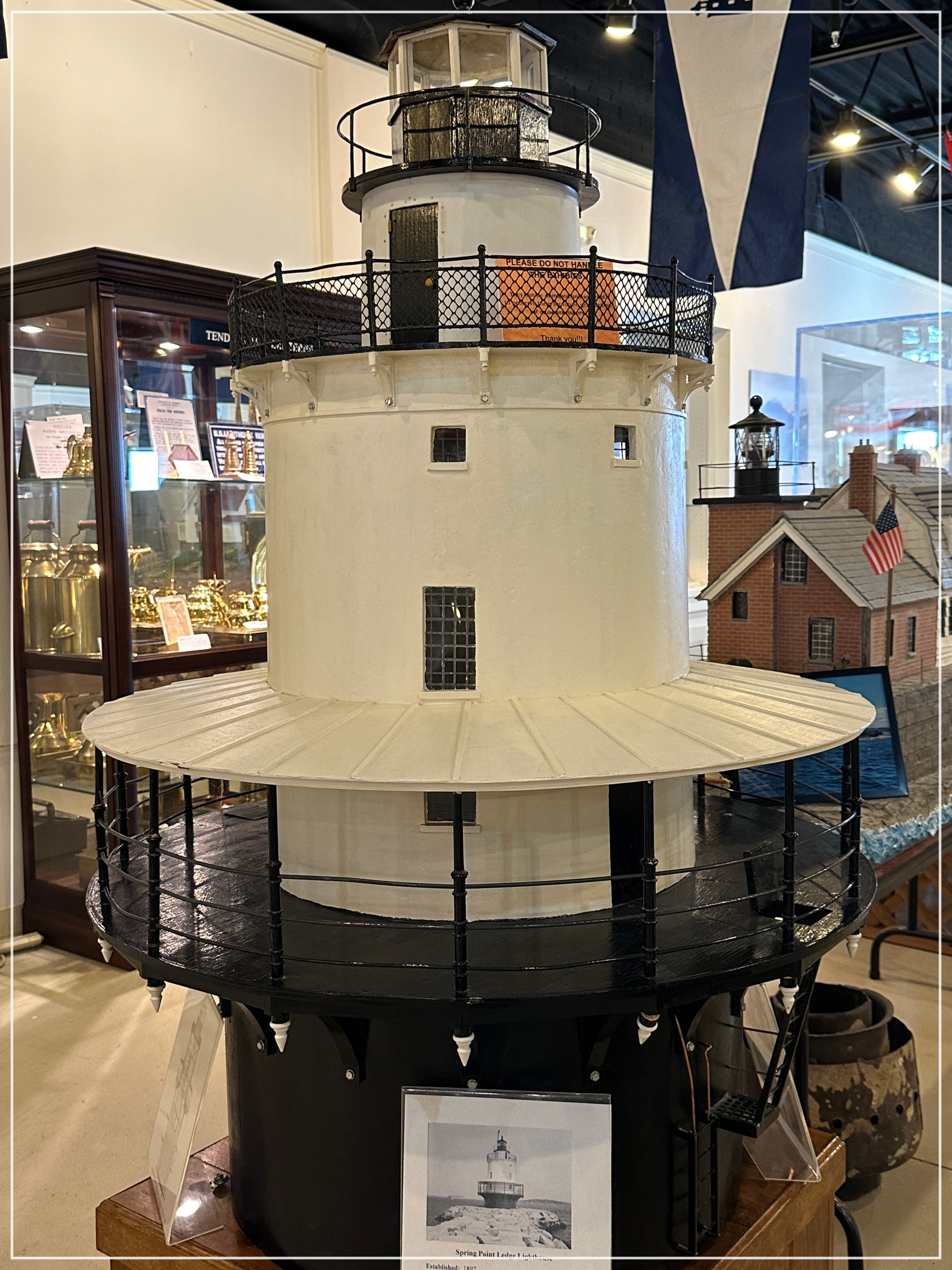
There are several dioramas and detailed lighthouse models on display. All of these were made to exacting detail to display the lighthouses and harbor scenes.
Spring Point Ledge Lighthouse, South Portland, ME
The above model is the Spring Point Ledge Lighthouse in South Portland, ME. It's the only caisson-style (sparkplug or bug light) style light station in the U.S. that visitors can walk to on the breakwater. The superstructure of this type of lighthouse type is built on concrete or metal. This lighthouse has been an integral part of the history of Portland harbor and Casco Bay since 1897; it was listed on the National Historic Register in 1988.
Fog bell formerly on Matinicus Rock Light
This 2000-pound bell was cast in Philadelphia, PA, in 1855 and installed on a wooden frame at the Matinicus Rock Light in Maine. Fog bells were crucial when dense fog interfered with the light's visibility. This one was in use during most of the tenure of Abbie Burgess as assistant light keeper from 1654 to 1875. She became well known for her bravery in tending the Matinicus Rock Light during an 1856 winter storm. She did so for a month when her father, the head light keeper, was away from the island. 
Many vintage photos and personal items of famous lighthouse keepers can be seen in display cases, including Robert Sterling, Fanny Mae Salter, Abbie Burgess, Ida Lewis and others. These individuals are as important to Maine’s lighthouse history as their artifacts. The museum ensures their extraordinary contributions to maritime history are not forgotten.
Early lifeboat, breeches buoy, foghorn displays
What looks like a round personal flotation device with a leg harness attached and works like a zip line is called a breeches buoy. This rope-based rescue device was used to extract people from wrecked vessels, or to transfer people from one place to another in situations of danger. Foghorns provide audible warnings of dangers to shipping like rocky coastlines, shoals, of the presence of other vessels when visual navigation aids are obscured in foggy conditions. 
Exhibits in the museum display different stories of bravery and dedication to the service of the men and women in the United States Coast Guard and United States Life-Saving Services. 
Display cases featured light house lamps and other memorabilia and artifacts.
As stated earlier, our stop at this museum wasn't planned, but was definitely an informative experience. The best part of a road trip is finding and learning about special places along the route and sharing, so now you know as well.
The Maine Lighthouse Museum is at 1 Park Drive in Rockland, ME, the heart of the Midcoast. The museum has summer hours after Memorial Day, Monday through Friday 10:00 am to 5:00 pm. Saturday and Sunday 10:00 am to 4:00 pm. After Columbus Day, hours are limited so it's best to call ahead. The museum closes January and February and in spring operates Thursday, Friday and Saturday.

Friday, June 7, 2024

Friday Funnies

It's easy to have fun with photos. Sometimes, even the simplest ones can lead to some amusing thoughts for an appropriate caption. 

Here's a few recent ones along with my thoughts for a caption. As always, feel free to add your own ideas in the comments. You may have some even funnier and clever ones! 
Drive-in
The Route 66 Restaurant  has become famously recognizable by a taxi protruding from the front of the building. It's not located in CA, but on Cottage Street in Bar Harbor, ME.
Scooped
While I can't recall the exact location where this photo was taken, it may have been in an antiques or collectibles store or possibly a flea market as I frequent all of these.
Mugged
This collection of mugs from various U.S. states was seen in a collectibles store in NH, not sure of the exact location.
In the Bag
This collection of bags was in a Nashua, NH, storefront a few months ago and interestingly enough it wasn't a luggage store, but a print shop preparing for a charity event.
Duck in
This female Mallard perhaps doesn't know that duck in a supermarket is usually found inside a shopping cart, not sitting on top. This image was taken from the bank of the Nashua River where the duck belongs and the cart does not.
Big Wheel
The term big wheel is usually applied to a person with a great deal of power or influence, such as a high-ranking person or official. However, this image taken at a NH flea market, shows a true big wheel — two of them.
Tanked
My first thought for a caption was over a barrel or even rolling along. The photo was taken on a highway and while I can't recall the location, it's a sight that could be seen on any road.
We didn't see any tulip farms on our recent road trip to Canada. But a couple weeks before we left, two large planters at Nashua City Hall displayed these colorful blooms.

Enjoy Your Weekend, Everyone
No definite weekend plans it depends on the weather forecast

Wednesday, June 5, 2024

Revisiting Earth Day

Earth Day was celebrated once again in April and the 2024 campaign, Planet vs. Plastics, advocates reducing plastic dependence which most everyone agrees is a very good thing.

My post for this date focused on ways to personally reduce the use of consumable plastics. At the time, I listed some alternatives, a few of which we were already doing plus several others that were being considered. 

I asked fellow bloggers for their suggestions and the comments were informative especially on the topic of dryer balls. The majority had never used them, some had never heard of them, others said they did nothing for static, a couple of folks said they'd been using them for years.

At the time, we were still using dryer sheets and planning to switch to dryer balls which was done shortly after that post. That decision included avoiding any that were manufactured in China, which took some doing, as so many things come from that country. It's a personal decision to avoid China-made products when possible, knowing it's not always possible 

This brand, Smart Sheep, was purchased online (Amazon). According to the website, the company is the result of a partnership between two women, Kalpena in Nepal and Christine in the U.S. 
Kalpana manages the felting process of the dryer balls in Nepal. Christine imports, inspects, and packages them in the U.S. These dryer balls use New Zealand wool.

According to online information this product is manufactured through ethical fair-trade practices and provides good job opportunities for women in Kathamandu, Nepal. I sincerely hope that is the case. Just in case, you're considering a switch to dryer balls, Smart Sheep offers these fun options, which cost from $5 to $10 more than white wool ones. Guess which ones I'm buying the next time.

Staying on laundry, a couple of months ago we were using bottled liquid detergent; while considering a switch to detergent laundry sheets as there were a lot of pluses including the fact of no liquid measuring, so no chance of spillage. Also, less space needed to store plastic containers as detergent sheets usually come in cardboard packaging, less storage space is a plus for apartment dwellers like us. Plus, several bloggers recommended them.

For those not familiar with detergent sheets, these come in pre-measured, dissolvable sheets. Some cons were that they might not dissolve in all water temps or not remove stains and odors. I've used them in cold and warm water temps with no issues. Of course, our laundry doesn't get heavily soiled since we're not working outdoors and there's no children in our home. Others may have different results.

Once again, there was a decision on which product to buy. Again, I wanted a U.S. made product and, on a friend's recommendation, tried a brand made in Canada (close enough). In the future, I may search out other brands, but so far these have been working well for us.

Just so you know, detergent sheets definitely are more costly than liquid detergents. While for us, the extra expense is worth the expense, this may not be true for everyone.

Last, but not least, is that we've stopped using plastic grocery shopping bags, unlike in 12 other states, NH has not banned these in grocery stores. (If you plan to travel, know that single use plastic bags are banned in California, Colorado, Connecticut, Delaware, Hawaii, Maine, New Jersey, New York, Oregon, Rhode Island, Vermont, Washington.)

Yes, we were a bit late in returning to using tote bags which oddly enough we were using all the time, pre-pandemic. When we couldn't use them we lazily fell into the practice of using grocery store plastic bags. An upside is that these were then used for trash disposal and that, in turn, meant we didn't buy plastic trash bags. Once the supply runs out, we'll look for alternatives.

Staying on the subject of grocery shopping, we stopped using single-use plastic bags for vegetables and fruit. Instead, this set of mesh bags, also bought online, is brought to the supermarket along with the tote bags, 
better late than never

These are easily washed, air tried, and ready for reuse unlike plastic bags which were always discarded. 

According to the product information, the contents will easily scan at the register; however, that doesn't seem to be true. In the time we've been using them, the cashier has always had to open the bag to scan the item(s).

Finally, this last item has nothing to do with laundry or grocery shopping — it's a change in a bathroom item, switching to a fabric shower curtain liner instead of a plastic one. The plastic one was able to be laundered regularly, but it was still plastic. 

This polyester fabric (non-plastic) one can also be laundered and it dries quickly, also it's more attractive, so I bought it in two different colors, blue and cream

These are some measures we've been taking to lessen our use of plastics and other items harmful to the environment. There are, of course, many others. 

Once again, I invite your comments and/or suggestions on things that work for you. 

Monday, June 3, 2024

Kindness and Caring

Comments are off for this post as it is not about anything I've said, seen or done. It's about the unselfish action of a fellow blogger as told in her recent post and a link is provided below.

Today, I was going to present a different post. However, in catching up on blog reading from the past few days, a recent post by another blogger led to a decision for this post instead. 

Kindness and caring are universal issues as most will agree. From my experience in reading posts from fellow bloggers for well over a decade of blogging, many folks are concerned with these issues. And, many have undertaken and continue to do good deeds each in their own ways without fanfare of any type. 

It's just what they do.
Now to the point of this post.

The blogging community is special and many bloggers may be familiar with MadSnapper aka Sandra, who posts about a range of topics from learning about new things to what's happening in her FL neighborhood. Her comments posts of other bloggers are always kind. It's obvious that she has read the post without leaving just a "nice post" comment.

Sandra's caring was shown in her recent post which I will not paraphrase here as you can read it firsthand. It made me stop and think about homeless persons that I see here in Nashua, NH, quite often. Apparently, other bloggers reacted the same as evidenced by their comments.
In her post, Sandra said she hoped that everyone who read the post would become aware of others in similar situations.

We can all spread kindness in so many ways. Sometimes, it's with a financial assist, other times with a kind word.

Thanks, Sandra, for sharing your kindness experience and for the reminder. It's one that bears repeating.