Today’s day tripping destination was Dover, NH, the oldest  permanent settlement in the state, and the 7th oldest in the U.S. Dover’s population of almost 30,000 (as of the 2010 census) ranks it behind the cities of Manchester and Nashua and ahead of Portsmouth.
Dover is nicknamed “The Garrison City". after the style of log houses that early settlers built using felled trees. The garrison style typically has two stories; the second story overhangs in the front.
Settled in 1623 on the banks of the Piscataqua River, Dover was first called Hilton’s Point, after Edward Hilton. The town was also known by the Indian names of Newichwannock (place of wigwams) and Cocheco (the rapid foaming water) and briefly called Bristol and Northam. It became Dover permanently in 1637 possibly to honor Robert Dover, an English lawyer who resisted Puritanism.
 Dover's location on the Piscataqua and Cocheco Rivers made it a thriving center of trading and manufacturing.
 The city’s earliest days as a colonial seaport led to a successful shipbuilding industry in the 1700s. Incorporated as a city in 1855, Dover flourished as the nation's leading manufacturer of cotton goods. The development of a brick industry spanned decades of successful mill operations through the middle of the 20th century.
  However, during the Great Depression, textile mills no longer dependent on New England water power either moved to southern states for cheaper operating conditions, or simply went out of business. Dover's mill yard shut down in 1937, and was bought at auction in 1940 by the city for a sole bid of $54,000. The Cocheco Falls Millworks now has tenants including technology and government services companies, and a restaurant.
 The Cocheco Manufacturing Company founded in 1827 was named after the Cohecho River flows alongside downtown Dover (the misspelling was a clerical error at incorporation).
Our exploration downtown included a lunch stop for a slice of basil pesto pizza and then a cup of pumpkin coffee and pumpkin muffin.
The Cocheco Manufacturing Company founded in 1827 was named after the Cohecho River flows alongside downtown Dover (the misspelling was a clerical error at incorporation).
Our exploration downtown included a lunch stop for a slice of basil pesto pizza and then a cup of pumpkin coffee and pumpkin muffin.

 The drive back to our Nashua accommodations, produced another display of nature’s beauty – in addition to the fall colors . . .


 Temps in the high 70s made Monday a great day to “sandwich in a fair” – blame Grenville for that line.
The annual Sandwich Fair has been held traditionally on Columbus Day weekend for the past 101 years. It’s one of New Hampshire’s oldest agricultural fairs and includes a parade, horse and oxen competition pulls, stage shows, tractor races, farm animals, local New Hampshire food sampling, and 4H exhibits.
Getting to Sandwich, NH was about a 2-hour road trip from where we’re staying in Nashua. The fair is held in the center of Sandwich in very large fields behind the town library.
 The Sandwich Fair began as an agricultural event that local farmers hoped would turn into an annual market day where they could trade and sell their cattle. In 1886, area farmers exhibited 184 yoke of oxen at the fair. In August 1887, the fair was held on October 11. Judges were appointed for the various categories and a prize list was announced. An estimated 3,000 people attended the 1-day event.
 During the summer of 1888, planning started for another October fair. Fancy work, curiosities,
  antiques, flowers and plants were again shown in the grange hall. A first was a printed program of events. That year the weather was miserable with an early snow and a small number of people attended the fair.
A local newspaper, the “Sandwich Reporter,” reported in 1893 that fair traffic was heavy with an estimated 3,000 attendees. The report noted there was very little drunkenness and that all of those intoxicated were “out-of-towners.”
A 1924 fair update announced that one of the main attractions of the upcoming fair would be a coon hunt. That event has not been held since then. In October 1986, a new midway was built and stage shows featured bluegrass and music from the 1950’s and 60’s. Poultry from local breeders was shown, but out of state poultry was banned. Due to a poor growing season and early frosts there was a scarcity of fresh flowers at the flower show.
The 1987 fair parade was held despite snow, sleet and mist. There was less canned foods than in previous years attributed to the popularity of freezing fresh vegetables.  In 1988, the fair expanded to 3 days – Saturday thru Monday making it the first three-day fair, a tradition that has continued.
This was a popular event today in the professional lumberjacks competition. Can you figure out what it is?
In 1988, the fair expanded to 3 days – Saturday thru Monday making it the first three-day fair, a tradition that has continued.
This was a popular event today in the professional lumberjacks competition. Can you figure out what it is?
 If axe throwing was your answer, then you’re absolutely right!
 Over the years, the number of food vendors has increased.
 The number has grown, but not the variety of choices with a lot of the same “foods” being offered and typically called “fair” food.
 And, of course, lots of sweet treats.
 Lunch today – what’s left of the bloomin’ onion and a sausage sandwich.

 Fairs like this one are becoming events of the past in many areas, so it was fun to find and attend this 100+ year old event. We may never attend another Sandwich Fair, but are glad we made it to this one on our NH road trip.
 This apple is the one you can eat and it was celebrated at the 4th Annual Apple Fest which benefits The Salvation Army of Nashua.
 Sullivan Farm is not just the only operating apple orchard located in Nashua, NH, its also Nashua’s last remaining farm. Next year Sullivan Farm marks its 100th anniversary.
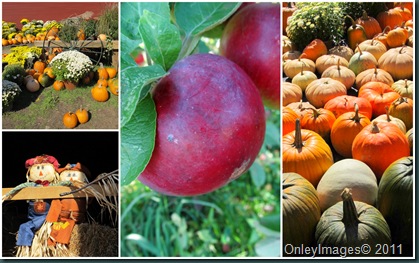 This celebration was not just about apples, but a fall celebration that included pony rides, hay rides, train rides, pumpkin painting, face painting, scarecrow making, emergency vehicle demonstrations, live musical entertainment.
 Sometimes, children was as colorful as the painted pumpkins.
 Scarecrow making was a family event.
 There were hayrides, cow train rides and pony rides. Grenville heard there were train rides too.

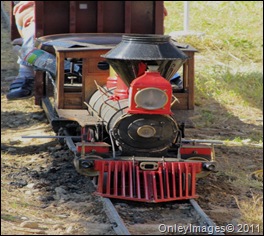 But this train was a little smaller than he expected.
This was a fun outing on a very warm fall day with temperatures in the high 80s. More of the same weather is expected for Monday on yet another adventure.
But this train was a little smaller than he expected.
This was a fun outing on a very warm fall day with temperatures in the high 80s. More of the same weather is expected for Monday on yet another adventure.

Unseasonably warm weather made a walking tour of Portsmouth, NH enjoyable. After visits to Manchester and Nashua, the 1st and 2nd largest cities in NH, this visit was to one of the state’s smaller cities (pop. 21,250).
Once a village, it was settled by English immigrants in 1630 and named Piscataqua, after the Abenaki name for the river, and later renamed Strawberry Banke, after the many wild strawberries growing beside the Piscataqua River. Strategically located for trade between upstream industries and mercantile interests abroad, the port prospered. Fishing, lumber and shipbuilding were principal trades in the region. Slaves were imported as early as 1645 and formed an integral part of building the city's prosperity. Portsmouth was part of the Triangle Trade* and reaped significant profits from slavery.
 When incorporated in 1653, it was named Portsmouth in honor of the colony's founder, John Mason. Mason was the former captain of the port of Portsmouth, England, in the county of Hampshire, for which New Hampshire is named. Portsmouth was named the colonial capital in 1679. Portsmouth boasts a historic seaport and is a popular summer tourist destination especially in summer months.
 Market Square in the heart of Portsmouth’s dining and shopping district with many brick buildings built after devastating early 19th century fires. The worst was in 1813 when 244 buildings burned.A fire district was created that required all new buildings within its boundaries to be built of brick with slate roofs; this created the downtown's distinctive appearance.
 With the protection of a Historic District Commission, much of the city's irreplaceable architectural legacy survives. It draws tourists and artists, who each summer throng the cafes, restaurants and shops around Market Square. In 2008, Portsmouth was named one of the “Dozen Distinctive Destinations” by the National Trust for Historic Preservation.
* The Triangular Trade refers to a slave route. Its name is from the three routes that formed a triangle. The first route carried fish, lumber, and other goods from New England to the West Indies. In the West Indies, ships picked up sugar and molasses which is a dark brown syrup product made from sugar cane. This was used to make rum. From the West Indies, merchants carried the rum, along with guns, gunpowder, and tools to West Africa. Here, they traded these items for slaves, then took the slaves to the West Indies where they were sold. Traders would take the profits and buy more molasses.
Portsmouth offers a wide choice of restaurants, bakeries, and shops, many with distinctive hanging signs. Here are a few . . .
 Easy to see what’s offered in these places . . .
 Some signs were round . . .
 Some were square or rectangular . . .
 Still overs were oval-shaped . . .

Today, the weather turned unseasonably warm along most of the east coast, and New Hampshire was no exception. The high was 79 degrees – even warmer than at our home on the VA eastern shore.
After a morning in Portsmouth, we followed Route 1A, which is an alternate to Route 1 and runs along the beach areas. New Hampshire lays claim to 18 miles of coastline, compared to 35 miles of Virginia Beach coastline and 130 miles in our home state of NJ.
Wallis Sands State Beach, about 15 minutes south of Portsmouth, is a beautiful, sandy curving beach that is on Route 1A. It has a large parking lot, showers and restrooms, and an admission charge in summer months. We saw many sailboats . . . Hampton Beach, the most popular beach in the region is also off Route 1A in Hampton. It has attracted thousands of beach goers since the turn of the century. The beach is wide with bath house and lifeguards in season.
Lots of folks were taking in the warm temps, which are expected to continue through the weekend and into early next week.
 This little guy was enjoying the beach . . .
 Today, was a beautiful day with possibly even warmer temps on Sunday.
Whatever happened to fall?
There hasn’t been any fall leaf colors to post about – yet. Maybe next week, hopefully.
Today was a GRAND experience in more ways than one – 20 grands – in downtown Nashua, NH.
 A GRAND isn’t worth $1,000 when it’s referring to a baby grand, which is like $10,000 and up depending on the maker.
 Darrell’s Music Hall on Main Street features 20 baby grand pianos on display in its showroom. Adam Darrell, grandson of the store’s founder, told me that the cost of a grand piano depends on the maker. Averaging $10,000 per piano (although many cost more) brings the total of the storefront display closer to $250,000 – lots of GRANDS indeed.
 These are beautifully crafted instruments, whose workmanship shows throughout, from interior strings, to pedals and keyboards .
 Darrell’s Music Hall is a family-owned and operated business. Adam’s grandfather, Kenneth Darrell, was a singer who decided that instead of venturing into that part of the music industry, to approach music another way. He founded the music hall to establish a solid foundation for his growing family.
 The business that Darrell started has been a fixture in downtown Nashua, NH since 1969. It’s all about pianos with a large selection of new and used baby grand pianos, and other styles, including player pianos and digital models. Services include maintenance, repairs, accessories, music lessons, studio rentals.
Where there’s pianos, there’s sheet music – classics to show tunes.


 permanent settlement in the state, and the 7th oldest in the U.S. Dover’s population of almost 30,000 (as of the 2010 census) ranks it behind the cities of Manchester and Nashua and ahead of Portsmouth.
 Dover's location on the Piscataqua and Cocheco Rivers made it a thriving center of trading and manufacturing.
  The city’s earliest days as a colonial seaport led to a successful shipbuilding industry in the 1700s. Incorporated as a city in 1855, Dover flourished as the nation's leading manufacturer of cotton goods. The development of a brick industry spanned decades of successful mill operations through the middle of the 20th century.
  However, during the Great Depression, textile mills no longer dependent on New England water power either moved to southern states for cheaper operating conditions, or simply went out of business. Dover's mill yard shut down in 1937, and was bought at auction in 1940 by the city for a sole bid of $54,000. The Cocheco Falls Millworks now has tenants including technology and government services companies, and a restaurant.
 The Cocheco Manufacturing Company founded in 1827 was named after the Cohecho River flows alongside downtown Dover (the misspelling was a clerical error at incorporation).


