Wednesday, June 19, 2019

Something Smokey in TN

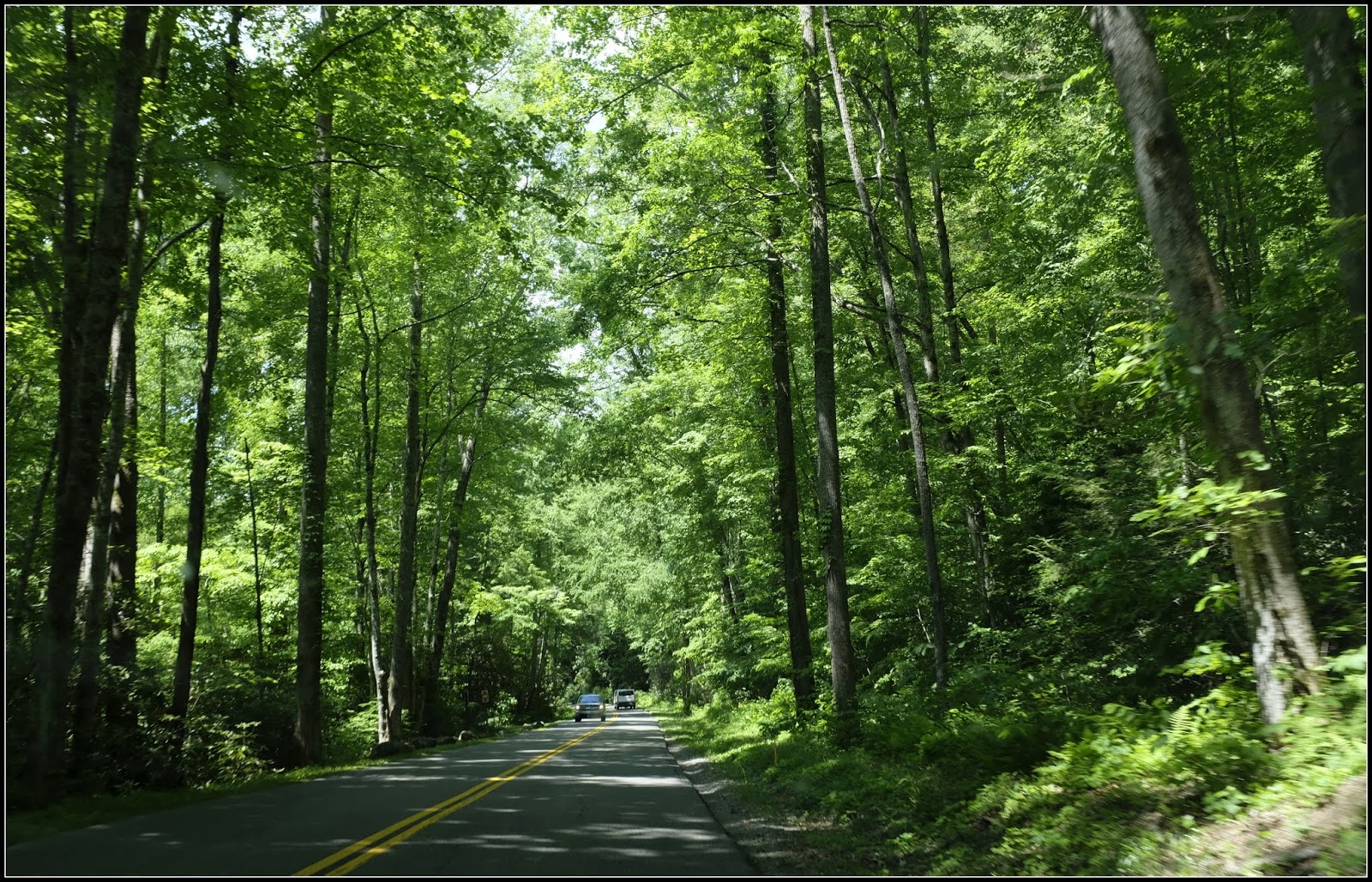
We're currently on a "southern" U.S. road trip from NH to FL and posting about sites seen & foods sampled along the way. This post shows scenics as we traveled to Chattanooga, TN from Knoxville, KY.

The Great Smoky Mountains are a mountain range rising along the TN-NC border in the southeastern U.S. They are a subrange of the Appalachian Mountains. The range is commonly called the Smoky Mountains. The name is often shortened to the Great Smokies due to the ever-present morning fog, which was still there at mid-day on our travels.

The Great Smokies are home to the Great Smoky Mountains National Park, which protects most of the range and covers 522,427 acres of endless ridges of never-ending forests.

The park was established in 1934, and, with over 11 million visits per year, it is the most visited national park in the U.S out of 59 national parks. It’s open all day, every day of the year; however, some facilities and roads shut down in winter. (The second most heavily visited national park is Grand Canyon, third is Yosemite, and fourth is Yellowstone.)


Natural fog often hangs over the range and gives the mountains their distinctive bluish tint which looks like smoke. The fog results when vapor is released from the area's vegetation and molecules that make up the gas scatter blue light from the sky. The Cherokees called this “blue smoke.”

While we didn't get the chance to spend extended time in the park, just driving through a portion and seeing some views was awe-inspiring. Thankfully, the weather was great too. An extended drive is definitely on our "to do" list for a future road trip.

Monday, June 17, 2019

Largest Painting in GA

We're currently on a "southern" U.S. road trip from NH to FL and posting about sites seen & foods sampled along the way. This post is about a stop in Atlanta, GA.


Previous posts have covered more than one place seen on our current travels. This post deals with only one seen at the Atlanta History Center (AHC), a history museum and research center in Buckhead, a residential district of Atlanta, GA. Founded in 1926, the AHC contains one of the largest U.S. collections of Civil War artifacts, which (admittedly) we didn't fully explore.

That's because the most spectacular exhibit is what we went to see — The Battle of Atlanta cyclorama, a 132-year-old hand-painted oil-on-canvas work. Believe me, this is not only a very impressive work, it's also a very immense work at 49 feet tall, covering an area of 16,000 square feet and weighing almost 10,000 pounds (6 tons and longer than a football field). This is only one of two functioning cycloramas in the U.S. — the other is The Battle of Gettysburg cyclorama at Gettysburg National Military Park in PA. Atlanta's was originally larger, but additions to Gettysburg's, as part of a restoration effort, made it larger(We visited the PA cyclorama a few years ago and were similarly impressed back then.)
A fish-eye view of the exterior of the cyclorama inside the rotunda . The cut-out portion of the canvas is known as the “tunnel entrance.” This feature, common in all cycloramas, avoiding the need to excavate under the building for access (Atlanta History Center)

We entered the painting rotunda through a 7-foot-tall tunnel entry that passes beneath the cyclorama, then took an escalator to the 15-foot high stationary viewing platform for a full 360-degree view of the painting. A 12-minute introductory film projected onto the painting's surface, detailed historical interpretations of the cyclorama over the years. 

What you are about to see — The Battle of Atlanta cyclorama — is not history. It is an artifact of art, entertainment, and messaging. It is about the past. German artists created the panorama 22 years after the battle. It was intended for Northern audiences interested in the Battle of Atlanta, July 22, 1864. Its creators made it for people who could and would pay to see it. (Atlanta History Center)

Back in the 1880s, The Battle of Atlanta cyclorama painting was equivalent to today's virtual reality. Created over five months by 17 German artists at the American Panorama Company in Milwaukee, it debuted in Minneapolis, WI in 1886. While cycloramas could depict any moment in history, for a few years in the 1880s, the timing was right for Civil War battle scenes. Painted 22 years after the Battle of Atlanta, the battle wasn't a Confederate victory and the painting depicted the battle as a heroic Union victory, which appealed to Northern audiences. But, when the painting relocated to Atlanta in 1892, it was modified and advertised as “the only Confederate victory ever painted” to appeal to Southern audiences. (Most of these incorrect changes were reversed in the 1930s.)
Artists of the American Panorama Company pose in front of the nearly finished Battle of Atlanta in their Milwaukee studio in June 1886 (Wisconsin Historical Society)
How they began: British painter Robert Barker patented a cyclorama design in 1780.
Within 20 years cyclorama buildings appeared in Europe and America as a popular form of entertainment. 
Internet source: Early cyclorama building

They were stretched around the interior of specially-built circular buildings. Early scenes depicted cities and landscapes; later ones showed battle scenes, natural disasters, and Biblical scenes. Visitors paid 25-50 cents, climbed two sets of winding stairs, and stood on a central platform. This put them in the center of the large paintings which often included landscaped foregrounds, music and narration for a 3-D effect. Viewers had the sense of being immersed in the scene. (These were the IMAX of their time.) At their peak, up to 40 cycloramas were on tour in the U.S. Only densely populated cities provided enough profits to offset the costs. Most were bankrupt by the 1890s and many either discarded or destroyed. Popularity faded even more in the 1900’s, due largely to the rising popularity of moving pictures. 

Imagine being able to buy the The Battle of Atlanta panoramic painting for only $1,100. That's what GA businessman Ernest Woodruff did in 1893 at public auction after it had travelled a Midwest circuit until its promoters declared bankruptcy. Later, the city of Atlanta offered land to house the painting and its building which were moved to Grant Park. Despite being the site of Confederate reunions and memorials, it continued to lose money and was deteriorating from rips and water leaks.
Original Grant Park cyclorama building (Atlantic History Center)
In 1921, the city built a new brick and steel building to house it in Grant Park and added a recorded tour. Between 1934 to 1936, the painting underwent major restoration. It was reinforced, retouched and converted back to the Northern victory it depicted. Sculptors funded by the Depression-era Works Progress Administration (WPA) included shrubbery, cannons, tracks, and soldiers creating a diorama foreground that fit in perspective with the scale of the painting. Four to five faces are repeated among the 128 figures; artists crafted faces in their likeness. (The clay soldiers were subject to deterioration and later replaced with plastic models.) 


In December 1939, Atlanta hosted the premiere of Gone With the Wind, the film based on Atlanta resident Margaret Mitchell’s bestselling novel of the Old South. (Sadly, back then, attendance was "white only" which excluded the film’s African-American performers; not surprising as among the 6,000 images in the painting, only one black.) 

Actor Clark Gable, who portrayed Rhett Butler, was in town and, after viewing the cyclorama, reportedly said that the only way it could be better would be "If I were in it.” 
Actor Clark Gable at Atlanta cyclorama , December 1939 (Atlanta History Center)
And, so he was added in after then Atlanta Mayor William B. Hartsfield had one of the diorama’s original artists redo a figure of a dying Union soldier, adding a face painted to resemble Gable's film character. Oddly enough, this revised figure which appears to be smiling smirking in death and has become one of the most photographed figures in the diorama (possibly as it's specifically mentioned during the intro talk)

From 1979 to 1982, an $11 million restoration that cleaned the canvas and restored paint colors again saved the painting from deterioration. Between 1986 to 2010, attendance dropped 80%. The 1921 building was too small for the large painting, plus the building's fire and climate systems were unreliable. In 2011, a Task Force of city officials and community leaders recommended a move to the Atlanta History Center. Too years later, a $10 million endowment and a $36 million fundraising effort led to construction of a 25,000-square foot building and another restoration and relocation began. 

In February 2017, engineers and conservators moved the five-ton painting on two custom-made 45-foot steel scrolls. It was split along two major seams and spooled onto the rolls. A team of 200 architects, engineers and conservators restored the painting to its original 1886 appearance. The $35 million renovation also restored the painting's skyline and recreated sections removed to fit it into the 1921 building. 

Two years later, in February 2019, The Battle of Atlanta cyclorama reopened, fully restored and in its new and at last permanent home, 127 years after it first debuted in Atlanta. 

If you're ever in Atlanta, GA, you might also consider a visit to the Atlanta History Center. And, if possible, also visit The Battle of Gettysburg in PA. 

These were two one-of-a-kind experiences which we're very glad to have seen within the past few years. 

BIG thanks to my GA cousin, Kathie, for also wanting to go and see this cyclorama and for also being the designated driver.

Friday, June 14, 2019

Eats & Treats in GA

While on a (mostly) southern states road trip traveling from New Hampshire to Florida, we're sampling foods along the way. It's part of the road trip fun for us. Here's some recent dining experiences in Norcross and Dahlongea, GA.
Pappadeaux Seafood Kitchen in Norcross, GA was a welcome place for dinner after a  long day’s drive from neighboring TN, more so because it was directly across the parking lot from our hotel. We learned just how popular the restaurant is as gates were installed at the entry to the hotel’s parking. Apparently, diners would use the lot which left guests with no spaces, definitely not good business for the hotel.

From the hotel front desk we learned that the eatery was a very popular place, not only on weekends, but many weeknights after the work day is over. So, of course, we had to dine there and try it out as it was a first-time for us.

Luckily, we were early and the dining room was uncrowded. Service was slow considering the sparseness. However, in this case, it was a welcome relief as we were in no hurry. Accommodations were next door. We were parked for the night, and more than willing to linger and enjoy our meal with our rush. However, our dining parter (above) was in a hurry and scampered off even before appetizers were served.
The menu featured, of course, seafood, mostly done cajun style. Appetizers included gumbo, oysters, octopus, crawfish, lobster bisque and crispy alligator, which Grenville enjoyed and I tried — it tasted (sort of) like chicken to me, but not a favorite. 

Dinner items included Shrimp Creole and Grits, Crawfish or Shrimp Ã‰touffée,  Blackened Mississippi Catfish, Redfish Pontchartrain, If none of these choices (or others) were appealing, dinners with steak, lobster and crab were also available. Our dinners were rainbow trout with shrimp (Grenville) and grilled salmon and salad (my choice).

Pappas Restaurants, Inc. or Pappas Restaurants is a private, family-owned and operated restaurant chain, founded by Greek-American brothers Pete and Jim Pappas and headquartered in Houston, TX. The first restaurant was a greek grill opened in 1967. The company is currently run by fourth-generation brothers Chris and Harris Pappas. There are 10 unique restaurants in more than 80 locations in the U.S. including; TX, CO, AZ, IL, OH, NM, GA, and AL. Pappadeaux Seafood Kitchen is the largest "concept" restaurant in the company's restaurant business. 

We told our server, John, that we had recently celebrated our 22nd anniversary, in fact it was on the day we started this current road trip. The anniversary marked the day of our 1st date, but John didn't ask and delivered key lime pie for dessert which was "complimentary." (Thanks, John, we shared and it was delicious.)


Mojito's is a Cuban-American bistro that opened last year in Norcross, GA, in the downtown shopping district. The family-owned and operated restaurant offers homemade dishes and desserts and live Salsa and Latin Jazz music in the evenings. We were there for lunch and unfortunately missed the music, which we learned was often provided by the owners, Luis and Yanin Fernandez.

The restaurant lunch and dinner menus include several sandwich choices including a traditional Cuban sandwich (sandwich Cubano), roast pork or a barbecue sandwich, plus chicken, seafood and pork choices of salads and entrees.


The small, casual eatery has indoor seating, but on a beautiful and not-too-hot GA afternoon our first choice was outside dining. 

Luckily, our dining companion readily agreed to our choice. We had the pleasure or dining with Ludwig, a fellow blogger, who coincidentally also lives in nearby Peachtree Corners and had recommended Mojito’s as a meet-up for lunch. 

This was a wonderful first-time meeting for all of us. We not only enjoyed a delicious lunch, but spent time afterwards exploring a bit of the Norcross shopping district, which was small but charming.

Ludwig and I had previously corresponded after I told him that my cousin also lives in Peachtree Corners and the we hoped to visit her (which we did on this trip). If you get a chance, do visit his blog site, Cafè Ludwig, it provides a wealth of information on photography and computer tips and tricks. (Thanks, Ludwig for a wonderful few hours together. we look forward to seeing you the next time we're in GA.)
A few views of the charming downtown Norcross, GA chopping district that we explored before and after lunch during our visit.

Monteluce Winery & Estates in Dahlongea, GA provides the beauty of Tuscany, the experience of Sonoma and the hospitality of the South. This is a winery-based estate community in Dahlongea,about 40 miles north of Atlanta, GA. It was founded in 2007 by a partnership between Atlanta-based Beecham Builders, Greenway Development, and Harrison Design Associates and features Tuscan-styled architecture. Montaluce's first grapes were crushed in the fall of 2008. The facility is on 400 acres with 35 acres dedicated to the vineyard which produces Sangiovese, Cabernet Sauvignon, Cabernet Franc, Malbec, Pinot Grigio, Chardonnay and Merlot wines. 

If you’re are looking for a new home and can afford living here, a lot is priced from $70,000 to $600,000 and homes from $370,000 to $1.35 million. It’s expected that the project, which will include a hotel and 300 homes, will be completed in five or six years. (No thanks, we're staying in NH.)

Lucky for us, there's also a full-service restaurant on site which serves lunch, dinner and brunch. We went for lunch with my cousin, Kathie who lives in Peachtree Corners. We were also visiting her on this trip. (It was a great visit and more to come on our GA experiences.)

For lunch, Pat and I both selected the "Chef's Delight" which was Havarti grilled cheese, house-made truffle honey, and Tuscan tomato soup (photo top left). Kathie selected a" Local Salad Greens" with a chef's choice of cheese, roasted nuts, heirloom tomatoes, house croutes, house vinaigrette (no photo taken). We enjoyed our selections, even though Grenville and I usually prefer grilled and/or smoked gouda for our grilled cheese sandwiches.

The restaurant, as expected, serves wines produced in the winery. There's a separate tasting room and wine samples can also be tried in the restaurant, which we all did. Prices ranged from $7 to $35 for white wines (glass or bottle), $14 to $78 for red wines and $8 to $36 for sparking wines (Prosecco). We opted to enjoy glasses of wine vs. a bottle as we were heading out for more fun after lunch and Kathie was the designated driver.

Wednesday, June 12, 2019

Three & Done in Chattanooga, TN

We're currently on a "southern" U.S. road trip from NH to FL and posting about sites seen & foods sampled along the way. This post is about a stop in Chattanooga, TN.

On our travels, we look for local attractions. Sometimes, we find off-the-beaten path ones and (better-yet) free as in the last post. And sometimes not, as when we visited 3 of "most popular" tourist traps destinations here. It was a package deal and definitely a been there and done that oronce thrice and done experience.

Imagine seeing an underground 145-foot high underground waterfall after walking a half-mile underground in a cave estimated to be 30 million years old. That describes Ruby Falls in Lookout Mountain outside Chattanooga, TN. This National Historic Landmark is the tallest and deepest underground U.S. waterfall open to the public (yes, it has lights).


The Ruby Falls tour takes slightly over an hour, and is all underground. Visitors descend 1,120 feet by elevator in timed tours, be warned it's a very well-packed trip down. In terms of comparison, you go as about as far down as the Empire State Building is high. (FYI, there's no rest rooms in the cave, but they're in the gift store which, of course, comes before the elevator line-up.)  

When the elevator stops (and it does), a guide meets the group and leads a ½-hour paced walk through the cave noting many of the formations along the way. (It was difficult to capture many. We were moving along since other groups were also down below.)
The passageways narrow in some spots and they can be slippery. Caves drip because of water seepage in the ground above. Walking is OK, but there’s no room for wheelchairs or strollers in the cave.

Stalactite and stalagmite are mineral deposits found in caves. A stalactite (from Greek stalasso "to drip” meaning “that which drips”) is a type of formation that hangs from the ceiling of caves; stalactite has a letter c, like ceiling, where it forms. A corresponding formation on the cave floor is called a stalagmite.


We really had to watch our heads as some overhangs are quite painfully low as a woman in our group learned. It's not dark in the cave as over 500 lights illuminate the pathways to Ruby Falls. (It's still not like being outdoors, can you tell caves are not my thing?)

On the plus side, no air conditioning is needed in a cave and we learned that the year-round temperature in the Ruby Falls cave is 60 degrees. Add some humidity, and the cave temperature is like 70 degrees. (Definitely cooler than outside when we visited.)  
The Falls has built-in crowd control as each tour group enters. (Your group is one of several in the cave at one time). Here's how —  when the light show starts (this is definitely a tourist sight) — lights illuminating the falls change from blue to red to white with music — when the lights go down, it's time  to go. Of course, there's time to see the falls and take pictures first. The guide says that after the falls experience, you’re a “survivor.”  

WAIT, there's more because now, there’s no need to wait to share your experience. As of 2018, Ruby Falls has high-speed Wi-Fi installed within its cave. You can use social media to share your experience immediately while there. (Doesn't everyone want to do that?)

Ruby & Leo Lambert
How it came about: In 1905, the natural entrance to Lookout Mountain Cave was closed during the construction of a railway tunnel. In the 1920s, Leo Lambert, a chemist and cave fan (spelunker) who thought he could re-open the cave as a tourist attraction, formed a company, and purchased land on the side of Lookout Mountain above Lookout Mountain Cave. In 1928, drilling began through the limestone when a small passageway (how small— 18 in. high x 4 ft wide). Lambert crawled 17 hours to explore the opening finding a formerly hidden cave and waterfall. On a return trip to the cave, he took his wife Ruby, and named the falls after her. Tours began in December 1929. A year later, the Ruby Falls cave was expanded and opened and the two caves were shown on separate tours. The falls cave was more popular and the lower cave trip ended in 1935. 

The entrance building, Cavern Castle, was built to resemble a 15th century Irish castle. Constructed from limestone excavated from the elevator shaft, it  was dubbed the “World’s Most Magnificent Cave Entrance” when completed.

Ruby Falls has over a half million visitors worldwide each year. It's a very unique experience, but once down was quite enough for me; I prefer above ground.

If you like rocks — BIG ones than Rock City on Lookout Mountain in Chattanooga, TN, is the place to visit, just don't try to move any while there. You might hurt yourself.

Besides rocks, you should also like gnomes because there are a lot of them (over 50) in Rock City. The history of Rock City as a world-famous tourist attraction dates back after the U.S. Great Depression. There are gnomes in the photo below...can you see them?


The trail leads through a variety of unique and bizarre rock formations, including the 1,000 short tons Balanced Rock and Fat Man's Squeeze. 

One of the strangest attractions  here is Fairyland Caverns — it’s a cave and the oddest one you may never want to see. Visitors pass through natural and man-made tunnels decorated with sculptures of children's' characters. There are even more strange little gnomes interspersed with weirdly back-lit scenes from fairy tales, nursery rhymes, and children’s books. These are set into blacklist recesses along a dimly lit pathway and really seem more scary than amusing. Seriously, this path was so dark in places, that I was not only thankful Grenville had his small flashlight along, but very happy to see the exit.

Since its start, Rock City has claimed that it's possible to “See 7 States” — TN, KY. VA, SC, NC, GA, and AL from an outcrop called Lover’s Leap, from which no one has jumped. Some scientist have disputed this claim noting that visitors can only see a few states. Rock City has ignored this and provides arrows pointing out the sight lines toward the states. 


Frieda & Garnet Carter and gnome
How it came about: In 1932, Garnet Carter, Lookout Mountain real estate developer (also inventor of miniature golf which he called Tom Thumb Golf) hit on the idea of developing a residential neighborhood on the top of Lookout Mountain. The community was to be called Fairyland, after his wife Frieda’s long-time interest in European folklore. 

The 700 acres of Fairyland encompassed Rock City as Frieda set out to develop the property into a huge rock garden. She marked a trail that went around the giant rock formations, collected wildflowers and other plants and transplanted them along the trail. This gardening was supplemented by imported German statues of gnomes and famous fairytale characters along points on the trail. Carter realized his wife had made something that people might pay to see. And, yet another Lookout Mountain tourist attraction was created.

Rock City officially opened in May 1932 but business was slow as advertising was difficult after the Depression and the mountain-top attraction wasn’t exactly where visitors would stop and look. In 1935, Carter hired Clark Byers, to travel the highways and offer to paint a farmer’s barn if Byers could paint — SEE ROCK CITY on its roof. Soon painted barn signs were seen through the Southeast and Midwest U.S.  

Advertising worked and by the end of the 1930s, travelers started visiting Rock City Gardens. Many barn signs are disappearing now, but these bird house replicas are sold in the Rock City gift shop. 

The Incline Railway on Lookout Mountain is often called America’s Most Amazing Mile and, while it's a short ride at 15 minutes each way, it's a fun trip 9 (no standing on this train)There's an observation deck on Lookout Mountain with food and gift shops, as expected. Plan an hour for the whole experience. 

This funicular (see below) rail system, which has been operating since 1895, is powered by two 100-horsepower winches developed by the Otis Elevator Company. The railway runs on a 1-mile long single track system, except for the passing loop at the midway point  which allows two counter-balanced trains to operate at the same time. It’s both a National Historic site and Mechanical Engineering Landmark sight as of 1991.


A funicular is a mode of transportation which uses a cable traction for movement on steep inclined slopes. A funicular railway employs a pair of passenger vehicles which are pulled on a slope by the same cable which loops over a pulley wheel at the upper end of a track.

The trolley-style cars climb through the area near Lookout Mountain at a 72.7% grade, straight up making it one of the world's steepest passenger railways. (If you want to ride a steeper passenger railway, Scenic World in Switzerland takes the rails as having the world’s steepest —at 52 degrees it has a mind-boggling 128 per cent incline.) We had great views from the observation windows on our ride as well as panoramic views from the observation tower at the Incline’s top station at Lookout Mountain.


The Incline Railway opened in November 1895 and is the second of two incline railways constructed on Lookout Mountain. The first was the Chattanooga and Lookout Mountain Railway, which ran from 1886 to 1898. The current railway is operated by the Chattanooga Area Regional Transportation Authority. 

As stated at the start of this lengthy post, these 3 attractions are tourist stops and, as travelers, we're tourists too. We bought a combo ticket and were able to get to all the same day; they're within a short drive of one another on Lookout Mountain. We've seen them once and that was enough for us (even if we return to the area another time).