Sunday, October 14, 2012

Roanoke Roaming

Continuing on our trip through the VA Blue Ridge area, we spent a day in Roanoke. Our city stops included a visit to the city's centerpiece hotel, lunch at a 1930s "tavern" and a tour of an unusual downtown art museum.

Roanoke was first called "Big Lick" in 1852 because it was near a large outcropping of salt near the Roanoke River that drew wildlife. It became the town of Roanoke in 1882 and two years later was chartered as the City of Roanoke. The name Roanoke is thought to originate from an Algonquian word for shell "money." This was also the name of the river that bisected it, presumably the source of the shells. Roanoke's location in the Blue Ridge Mountains, in the middle of the Roanoke Valley between Maryland and Tennessee, made it the transportation hub of western Virginia. 

1012 Roanoke downtown

The Norfolk and Western (N&W) Railway manufactured steam locomotives in-house and N&W's Roanoke Shops made the company known industry-wide for its excellence in steam power. The Roanoke Shops employed thousands and designed, built and maintained the famed classes A, J, and Y6 steam locomotives. The shops built new locomotives until 1953, long after diesel-electric had emerged as the locomotive choice for most North American railroads. N&W was the last major railroad in the United States to convert from steam to diesel power about 1960.

The Roanoke Hotel was listed on the Virginia Landmarks Register in 1995 and the National Register of Historic Places in 1996.

1012 Hotel Roanoke2

The hotel was built in 1882 by the N&W Railway (now part of the Norfolk Southern Railway) which had recently built its administrative offices in Roanoke, bringing in over a thousand railroad workers. Roanoke's landmark former passenger rail station was built across the street from the hotel. The hotel opened on Christmas Day 1882. In July 1898, a fire started in the kitchen and shut down the hotel for several months. The restored hotel reopened early in 1899 and in 1938 was remodeled to give it a more Tudor look; additional wings were added in 1947 and 1955. Despite fire and depression, it served as the city's social hub for more than a century.

1012 Hotel Roanoke

Its original 34 rooms had grown to 384 rooms by 1989 when N&W deeded it to Virginia Polytechnic Institute and State University (Virginia Tech) for $65,000. After the flag lowering ceremony on November 30, the hotel was closed; a sale of its contents continued for 17 days.

1012 Hotel Roanoke1

In 1992, the "Renew Roanoke" campaign was launched to raise money to reopen the hotel. Virginia Tech had set a deadline of December 31,1992 for the needed funding. By late fall, the campaign was short $1,000,000. In an unprecedented Christmas-time fundraiser, the campaign succeeded in raising over $5,000,000. Norfolk Southern donated an additional $2,000,000. The Hotel Roanoke reopened in 1995 with a conference center built adjacent to the hotel. A pedestrian bridge constructed over Norfolk Southern's railroad tracks links the hotel and conference center to downtown Roanoke.

Lunch was at the Texas Tavern which is still run by the family of the original owner. The Texas Tavern was founded by Isaac N. (Nick) Bullington and opened in February 13, 1930. Bullington was the advance man for the Ringling Brothers circus who travelled a year ahead of the circus booking shows. His plan was to open a small short-order restaurant and on his travels, he collected recipes, ideas and plans on where to locate his business. The original recipe for the Tavern's “Famous Chile” came from a hotel in San Antonio, Texas. 

1012 Texas Tavern

Roanoke, Virginia was one of 10 cities that Bullington considered. He chose it because it as a railroad city it was growing fast. Ownership of the Texas Tavern changed hands over the years, all within the Bullington family. Nick died in 1942 and his son, James, became the sole owner. In the mid 60s, Nick Bullington's grandson became General Manager, purchasing the business. Its current owner is the great grandson of the original founder and took it over in 2005 — 73 years to the day the Tavern originally opened. 

1012 Texas Tavern1

Hamburgers were 5 cents in 1930 and hot dogs were not on the menu. Then in 1960, hot dogs and hamburgers were 15 cents each, jumping to 85 cents each in 1989. It's now $1.30 for either one and chile is $1.70 a bowl. 

After lunch, we headed to the Taubaum Museum of Art on the corner of Norfolk and Salem Aves in downtown Roanoke, VA, described as "the wreck of the flying nun" by critics. Formerly The Art Museum of Western Virginia, it started in 1947 as an offshoot of the Virginia Museum of Fine Arts, with an exhibition in the Hotel Roanoke. In 1951, this "Roanoke Fine Arts Center" was incorporated as an independent organization and renamed the "Roanoke Museum of Fine Arts." It moved to downtown Roanoke's Center in the Square in 1989. 

1012 Taubaum Museum

In 2005, a new design for the museum was unveiled showing the unusual design that led to much debate in the local media. Unexpected increases in the cost of materials escalated building costs from $46 million to $66 million. The museum was renamed the Taubman Museum of Art after a donation of $12.5 million from Nicholas Taubman, former chairman and CEO of Advance Auto Parts. Taubman, a Roanoke native, formerly served as the U.S. Ambassador to Romania. On November 8, 2008, the Taubman Museum of Art opened in the newly completed building. The museum now has a free general admission policy largely due to continuing contributions from the Taubman family and Advance Auto parts. 

1012 Taubaum Museum1

Roanoke was not the most attractive city we toured; its long history with the former Norfolk and Western Railway is its major claim to fame. Grenville will post about the city's railway ties and the other museums we toured during our visit.

Friday, October 12, 2012

Friday Funnies

The sign says it ALL . . .

No work signNO kidding

Thursday, October 11, 2012

Natural and Swinging Bridges

In the past two days we've crossed our bridges when we came to them in two different locations, but in the same state — Virginia.

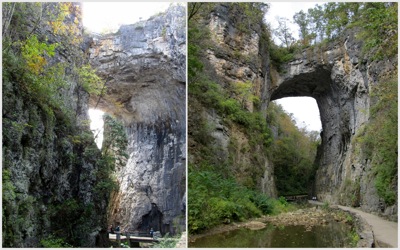
This first bridge is a real natural . . .

IMG 5648

Natural Bridge is a geological formation in which Cedar Creek (a small tributary of the James River) has carved out a gorge in the mountainous limestone terrain, forming a natural arch that is 215 feet high with a span of 90 ft. It consists of horizontal limestone strata, and is the remains of the roof of a cave or tunnel through which the creek once flowed. Natural Bridge has been designated a Virginia Historic Landmark and a national Historic Landmark. The Natural Bridge was a sacred site of the Native American Monacan tribe, who believed it to be the site of a major victory over pursuing Powhatans centuries before the arrival of whites in Virginia. Natural Bridge is also the name of the town in which the bridge is located.

1010 Natural Bridge

Thomas Jefferson purchased 157 acres of land, including the Natural Bridge, in 1774 from England's King George III for 20 shillings. (There are about 20 shillings to a pound, so by current standards, Jefferson got quite a bargain at well under $5.) Jefferson built a two-room log cabin, with one room reserved for guests, beginning its use as a retreat. In 1802, while President, he personally surveyed the area. Unfounded legends claim that Jefferson could throw a stone from the ground below the bridge to the top or that George Washington surveyed the bridge — neither have any factual basis. 

1010 Natural Bridge1

Natural Bridge was one of the wonders of the new world that Europeans visited during the 18th and 19th centuries, Vacationing guests took day trips from the town of Natural
Bridge on horseback or used horse drawn carriages to explore the countryside.
 American poet William Cullen Bryant said that the Natural Bridge and Niagara Falls were "the two most remarkable features of North America." During the 1880s, Natural Bridge was a resort owned by Colonel Henry Parsons, a Civil War captain, who purchased it and 200 more acres. Parsons
 formed a company to build the Richmond-Alleghany (R&A) Railroad and envisioned the colonial equivalent of today's Disneyland for his bridge. Two railroads operated excursion trains, bringing hundreds of people who stayed for dinner, for vacation, and for the summer. The Colonel charged for seeing the bridge and for transport to and from the railway, some 2 miles away. In 1894, he was murdered in Clifton Forge, Virginia.

Today, the top of the bridge can be seen for free, as part of US Highway 11, which runs on top of it; however, since the road runs across the naturally created bridge, little besides the roadway can actually be seen from the top as protective fences block any potentially scenic view. Most who travel across that section of US Highway 11, including ourselves, are unaware of the stunning beauty below.

Now for a bridge that really swings . . .

For over 150 years, portions of the Buchanan Swinging Bridge have played an important role in the town's history while providing a scenic pedestrian crossing. The bridge has become the symbol of the Town of Buchanan (pronounced Buck-hanan), Virginia and is featured on the town seal. Buchanan is about 30 miles north of Roanoke on US Route 11. 

IMG 3214

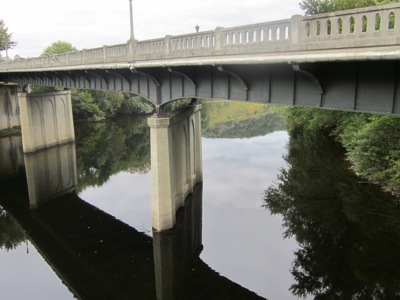
The Swinging Bridge is one of Virginia's most recognized and unusual architectural structures. The bridge is 366 feet long, 57.5 feet tall and the only one of its type to cross the James River. In 1999, the Swinging Bridge was recognized as a National Register Historic Landmark.

1009 Swinging Bridge

Portions of the large stone piers supporting the bridge above the James River were constructed in 1851 as part of the Buchanan Turnpike Company’s Toll Bridge. Toll for every person to pass through this wood covered bridge was five cents, plus an added five cents for each horse, mule or oxen, and five cents for each wagon. On June 13, 1864 the covered bridge was burned by Confederate General John McCausland in an effort to prevent Union troops from crossing the James River on their way to Lynchburg. The bridge was rebuilt following the war but washed away in 1877 during a flood. At this time, the R&A Railroad Company rebuilt a toll-free covered bridge. In 1897, this wood covered bridge was replaced with a steel bridge that remained in use until 1938. 

IMG 3204

In July of 1937, construction of the current concrete James River Bridge, shown above, was started with an agreement with the town to maintain pedestrian access to Pattonsburg, VA by way of the swinging bridge. On July 4, 1938, the two new bridges were dedicated by then Governor E. Lee Trinkle. 

IMG 3202

Yes, we walked across the Swinging Bridge and back again, which is really NOT as unsafe as it might look from the above photo. At the bridge entrance, a sign cautions that there's no running on the bridge and that no more than 3 people cross at a time. In late afternoon, we were the only ones crossing, but heard that the "rules" were not always followed by locals or visitors.

Tuesday, October 9, 2012

Southern Hospitality

Southern hospitality comes in many forms from a hello to a chat or an invite. In the past couple of days we were very fortunate to experience a little of both from fellow VA bloggers. Grenville and I are on a short road trip exploring parts of the VA Blue Ridge. In addition to seeing wonderful new sights, we have also met fellow bloggers, who, like ourselves, are also non-native Virginians.

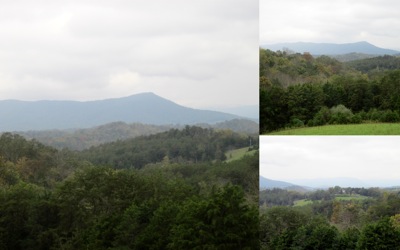
Yesterday, we spent a very delightful several hours with Grace and Joe, formerly from Louisiana. They are building a wonderful new home which overlooks the Shenandoah Valley and graciously took time to show us around. Even in its unfinished state, it's obvious that this home is stunning and they are putting a lot of their own sweat equity into its completion. Imagine looking out on vistas like this from your deck. It was a drab and overcast day, so these photos do NOT do justice to the views.

1008 southern hospitality

Grace has been chronicling the house's progress on her News from the Hill blog, where you can see the evolution of this home. Stop in and visit because the welcome mat is always out online. (Thanks, Grace for the wonderful coffee at Lexington Coffee House.)

Today, we were treated to more hospitality, visiting Rebecca and Lee, formerly from California. This visit included not only conversation but also tasty treats prepared by Rebecca. We visited their home and received the grand tour inside and around the grounds. Their home is also located high on a hill with equally breath-taking vistas. Today's weather was a bit more cooperative for these photos.

1009 southern hospitality2

Rebecca enjoys trying new recipes; we were more than happy to oblige as taste testers for the ham and mango chutney bites and blueberry lemon shortbread. These recipes and more interesting reading can be found on her Shenandoah Gateway Farm blog. Even if you don't enjoy cooking, you may find a few new recipes to capture your interest.

You just can't beat good old Southern-style hospitality. Thanks Grace and Joe, Rebecca and Lee for taking the time to share good talk and food. We had a great time! Let us know if you are ever visiting our part of VA on the eastern shore; that goes for other fellow bloggers too — the Welcome mat is always out at The Frog & PenguINN (when we're home).

Ridge Trip

Yes, we are on another road trip, but this time we are staying "at home" well sort of since our travel is confined to parts of Virginia we haven't visited during our 7 years of living here. We're traveling through sites within the Blue Ridge Mountains (named because of their bluish color when seen from a distance).

1006 Staunton VA5

Staunton, VA is known for being the birthplace of the 28th U.S. President Woodrew Wilson. It is also the home of Mary Baldwin College, a private four-year women's liberal arts college founded in 1842 whose graduates include actress Tallulah Bankhead and Anna Jarvis, founder of Mother's Day in the U.S. The city is also home to the Statler Brothers, country music legends, who grew up and still reside there. Once the city boasted 10 hotels, while most are no longer in operation, one of the largest, the Stonewall Jackson Hotel, was extensively renovated in recent years and is now a popular hotel and conference center. 

IMG 2986

Sunspots, a glass blowing factory and showroom, is housed in the former 1899 Klotz Brothers building, where for a fee you can create your own holiday ornament of blown glass. We declined this $40 "opportunity" but explored the showroom and watched a (free) demonstration.

1006 Staunton VA1006 Staunton VA1

1006 Staunton VA3

And, we had to include a visit to the Woodrow Wilson Museum in Staunton.

IMG 30471006 Staunton VA4

Here, we learned a lot of historical and curious facts about this 28th U.S. president, including:

  • Born on December 28, 1856, elected the 28th president; these 2 numbers add up to 56, his birth year and age when elected President; Wilson served two terms: 1912-1916 and 1916-1920.
  • First name was Thomas; called "Tommy" into his high school years, later dropped his first name as he felt it was not "strong enough."
  • Born in Staunton VA but only lived there a year before the family moved to GA and later SC when his father, a minister, received a new assignment.
  • Did not learn to read until he was over 10 years of age, attributed to dyslexia. He became a college professor and president, governor, and one of the best educated presidents, well known as a scholar, orator and author of many books on government.
  • Graduated from Princeton University in New Jersey, and later served as its president.
  • Elected Governor of New Jersey.
  • Only president to hold a PhD (received from Johns Hopkins University in political science)
  • Credited with starting the Federal Reserve System in 1913.
  • Received the Nobel Prize in 1920 for his work on behalf of the League of Nations)
  • Only president buried in Washington, DC (at the National Cathedral).
  • Second wife died on the 105th anniversary of his birth.
  • Chef Ettore "Hector" Boiardi, later popularly called "Chef Boy-Ar-Dee" directed the catering for the reception of President Wilson's second wedding. 

Our next stop was Lexington, VA. First settled in 1777, it is home to the 9th largest U.S. college, Washington & Lee University, and Virginia Military Institute (VMI) referred to as "the West Point of the South." It is also the nation's oldest state supported military school. Robert E. Lee, commander of the Confederate Army in the Civil War, and "Stonewall" Jackson, one the Confederacy's most famous generals, are buried in Lexington. It is also the site of the only house Jackson ever owned, now open as a museum. 

1008 Lexington2

Another of Lexington's unusual claims to fame is that is connected to 5 generals: George Washington, Robert E. Lee, Thomas Jonathan "Stonewall" Jackson, George Marshall, and George Patton.

Washington saved what was then Liberty Hall Academy from financial ruin through a $50,000 bequest. The schools's board of trustees renamed the school, Washington College in his honor.

Lee became President of Washington collage after the Civil War and is credited with broadening and expanding the liberal arts curriculum. After his death, the trustees renamed the school, Washington & Lee University. Lee Chapel on the grounds of the university houses a centerpiece recumbent statue of Lee, which portrays him, not dead, on the field of battle. Lee and his father, Revolutionary patriot Henry "Light Horse" Harry Lee and other family members are interred in a crypt beneath the chapel. Lee's famous horse, Traveller, is buried outside the chapel. 

IMG 3117

Jackson, a West Point graduate, taught at VMI, but was not a popular professor there and sucked on lemons. This explains why we found half a dozen lemon on the site of his grave at the Stonewall Jackson cemetery in Lexington. You might be able to see them in the photo on the right.

Patton was the third generation in his family to attend VMI. He was a cadet in 1903, but left in 1904 after being appointed to West Point.  Patton later went gained fame in WWII as leader of the U.S. Third Army which liberated more territory in less time than any other army in history.

Marshall studied at VMI and received a diploma in civil engineering. He fought in both WWI and WWII and was named Army Chief of Staff in 1939 on the day war erupted in Europe. The 1948 Marshall Plan rebuilt Europe after WWII laying the foundation for U.S. foreign policy. Marshall was awarded the Nobel Peace Prize in 1953.

Our short rainy day stop in Lexington included a visit to the VMI Museum which features a history of noted VMI alumni and the Henry Stewart antique firearms collection. You can also see Stonewall Jackson's (preserved) horse, Trotter; sorry, but the old boy is not very photogenic for his age.

1008 Lexington11008 Lexington

Friday, October 5, 2012

Lemon Chicken, Spinach & Wild Rice

What’s NOT to like about ingredients like that?

YES, it’s been awhile between recipe posts, not because we haven’t been cooking and eating too, just forgettinglemon chicken (3) to post some new recipes we’ve been trying We’re focused on weight loss (who isn’t?) and have been planning meals that are healthful, delicious AND easy too.

This recent meal easily fit  those guidelines. A BIG plus is that the recipe used ingredients we already had in the fridge or pantry. Just  start the wild rice early as most need 45-50 minutes cooking time.

Lemon Chicken with Spinach & Wild Rice

  • 10 ounces fresh spinach
  • 1/4 cup onion, minced
  • 1 tablespoon olive oil
  • 1/2 cup all-purpose flour
  • salt & pepper
  • 4 boneless skinless chicken breasts *
  • 2 tablespoons butter
  • 1/2 cup chicken broth
  • 1/4 cup dry white wine
  • 2 tablespoons fresh lemon juice
  • 2 tablespoons garlic, minced

* Only 2 chicken breasts were used for us; Grenville cut them in half which not only was MUCH easier then pounding them, but thinner pieces cooked much quicker.

  1. Preheat oil in skillet. Cook spinach and onion over medium heat until just wilted. Remove from skillet and set aside.
  2. Combine flour, salt and pepper. Dredge chicken in flour. lemon chicken (4)
  3. Melt butter in skillet. Add chicken. Cook about 4-5 minutes per side, just until golden brown. Remove chicken to heated dish.
  4. Add broth, wine, lemon juice and garlic. Deglaze pan and cook sauce about 2 minutes, until reduced by half. Add spinach.
  5. Plate chicken over rice, potatoes or pasta. Pour spinach and sauce over all to serve. lemon chicken (9)Our meal was served over wild rice with an addition of  sautéed Portobello mushrooms.

Grenville declared this recipe a keeper, which means it will be served often at the F&P.

Friday Funnies

Be vewy vewy quiet . . .pat hats1012 (2)

Do you know which Loony Tunes character said this and wore a hat like this one? (Extra points for knowing who voiced him and who he was after.)

(Hints: He carried a shotgun and was always looking for that Wacky Wabbit, which he never caught.)

Grenville was a great model for this shot and he doesn’t hunt (or eat) wabbits.

NO PRIZES for the correct answer, just a trip down Merrie Melodies lane for some of us who can admit to seeing the original (or having been told about it).

Wednesday, October 3, 2012

What’s (Still) in the Garden?

Yes, the calendar reads October here too, but the weather here on the VA tractor gnome (7)eastern shore resembles more like summer. This week several days have been VERY warm with daytime temps in the mid-80s and a humidity index that’s even higher.
This heat wave has kept veggies producing in the Frog & PenguINN garden.

The garden caretaker gnome and frog keep watch over the garden for Grenville.

So, what’s STILL producing?
Tomatoes which are still green, but Grenville is hoping these will redden soon for his favorite ‘mater sandwich . . .

tomato collage1012Meanwhile, the green peppers are still producing too. They have been delicious in salads and omelets.

pepper collage1012Grenville has already put in winter crops of broccoli and cauliflower which he’s tried in the past but not with great success. These plants have been looking good with lots of care and watering.

broccoli collage1cauliflower collageThere’s still lots of fresh rosemary and some basil.herbs collageMeanwhile the surprise volunteer butternut squash continues to grow.

butternut squash1012marigolds1012

And there was another unexpected surprise on the patio in the past week — marigolds reseeded and re-bloomed with perfect fall colors.

Tuesday, October 2, 2012

Alpacas & Anniversary

Some folks, such as friends and family who live in more populated areas, tell us we lead “an exciting life.”  We think they’re saying that tongue in cheek or could it be they envy us?
YES, weekend events are different in rural areas. WHERE else could we celebrate a bridge anniversary one day and visit an alpaca farm — all in two days ?
Are we having fun yet? Actually, yes.
Take Sunday, when we visited one of Virginia’s 108 registered alpaca breeders, By the Bay Alpacas farm (Pungoteague, VA) which held an open house.IMG_2922 This event was for National Alpaca Farm Days held annually on the last weekend in Sept when alpaca farms across the U.S. invite visitors. The event is sponsored by the Alpaca Owners and Breeders Association — and it’s FREE.
The farm is about a 20-minute drive from our home along back roads; even without much fall color here, it was a beautiful fall afternoon to be out. Lots of other folks though so too as there was a small crowd visiting with us.alpaca collage2
The farm is owned and operated by Tara and Andrew who said the gentle nature of alpacas IMG_2924and the fact that they are easier to raise than most other livestock attracted them. Alpacas are suited for small or semi-rural farming and require little land for their upkeep. From 4 to 8 alpacas can be raised on an acre of pasture and because of their padded feet are easy on the land. Their diet consists of grass and leafy hay . They do not needIMG_2936 fancy barns, are rarely sick, and don’t challenge fences. The fencing at the farm we visited was mainly to keep other animals out. An added benefit is the mild climate provided on the Virginia Eastern Shore.
We met Nandua, Sam and Bristol, a 2-year old male  (top left) who has won several national championships in halter and fleece classes.alpacas collage1
Alpacas are native to the South American altiplano, the high plain including parts of Peru, Bolivia, and Chile. They were domesticated from vicuñas thousands of years ago by the native Quechua population; their fiber was prized by the Incan rulers. Alpacas were first exported from South America to the U.S. for farming use in 1984. In 1998, the Alpaca Registry Inc. (ARI) voted to close the ARI registry to further imports. All ARI-registered alpacas descend from stock registered prior to the closure.IMG_2914
They are fiber-producing animals that annually can produce 5 to 10 lbs. of fiber which is removed by shearing; the alpacas are unharmed by this process. After minor preparation, the alpaca fiber is ready to be spun into soft, warm yarn or to be used in other fiber crafts such as felting — this hat was spun from alpaca fiber and worn by a willing model (guess who).
On Saturday we celebrated an anniversary, not just ANY one, but the 50th anniversary celebration for the Assateague Bridge that links Chincoteague, VA to IMG_5370
Assateague Island, which is also home to the Chincoteague National Wildlife Refuge (NWR). The celebration, Bridging the Past and the Future, was sponsored by the Chincoteague Kiwanis Club to commemorate the original 1962 bridge opening. The concrete bridge shown here replaced that structure, a used bridge purchased from NJ, delivered section by section and installed across the channel. It was replaced because it had started to deteriorate. The celebration began with a short parade across the bridge . . .
bridge annivThen talks by local officials followed by a ceremonial ribbon cutting. The gentleman in the center below is our neighbor, George, who is the sole surviving member of the original bridge authority.
anniv guests
IMG_5429Festivities went into full gear at the NWR and included special displays, activities for kids of all ages, hot dogs and ice cream, also FREE and Grenville really likes hot dogs (just ask him).anniv eventsanniv events2That’s HOW we spent an exciting weekend — and YOU ?