As natives of New Jersey, we're always finding a connection to our home state. Recently, there was another one encountered on our recent Newport, RI, trip.
 |
| Former NJ Duke mansion |
That's because heiress Doris Duke once lived in magnificent mansions in both states. Unfortunately, the former NJ Duke mansion was demolished in 2015. Built in 1893 with later additions, the 67,000 square foot, 600-feet long, 3-story mansion was located on the grounds of Duke Farms, which is now a 2,700 acre environmental center in Hillsborough, N.J. The mansion had fallen into disrepair after Duke's 1993 death. It was considered too expensive to repair and maintain by the Duke Farm Foundation which oversees the property which estimated costs in the millions of dollars to bring it up to current safety codes..  |
| Rough Point Mansion in Newport, RI, owned by Doris Duke |
However, Rough Point her Newport mansion, located on Bellevue Avenue bordering the Newport Cliff Walk has been preserved and is now open as a museum. It is overlooks the Atlantic Ocean and is located on a historic landscape with panoramic views of the Atlantic Ocean. The admission fee is $20/person with a $5 discount for military and veterans. It's a self-guided tour through use of the Newport Restoration Foundation app with house guards guides available in most rooms.
 |
| Views from Newport Cliff Walk |
The Cliff Walk is a 3.5-mile public access walkway that provides views of prominent mansions from the Gilded Age as well as views into the Narragansett Bay. It has been designated a National Recreation Trail, the first in New England. |
| Back lawn of Rough Point |
This English Manorial style house was constructed by Frederick W. Vanderbilt and his wife, Louise from 1887-1891. Like so many other Newport mansions of that time, it was a "summer cottage" and named after a promontory on the cliffs it overlooked.  |
| Ocean views from Rough Point |
While Rough Point was under construction in 1888, The Newport Mercury described it as the "largest and most expensive residence in America" which was most likely short lived as its construction preceded many of the other Newport mansions, including The Breakers, built by another Vanderbilt, Cornelius (Frederick's older brother).  |
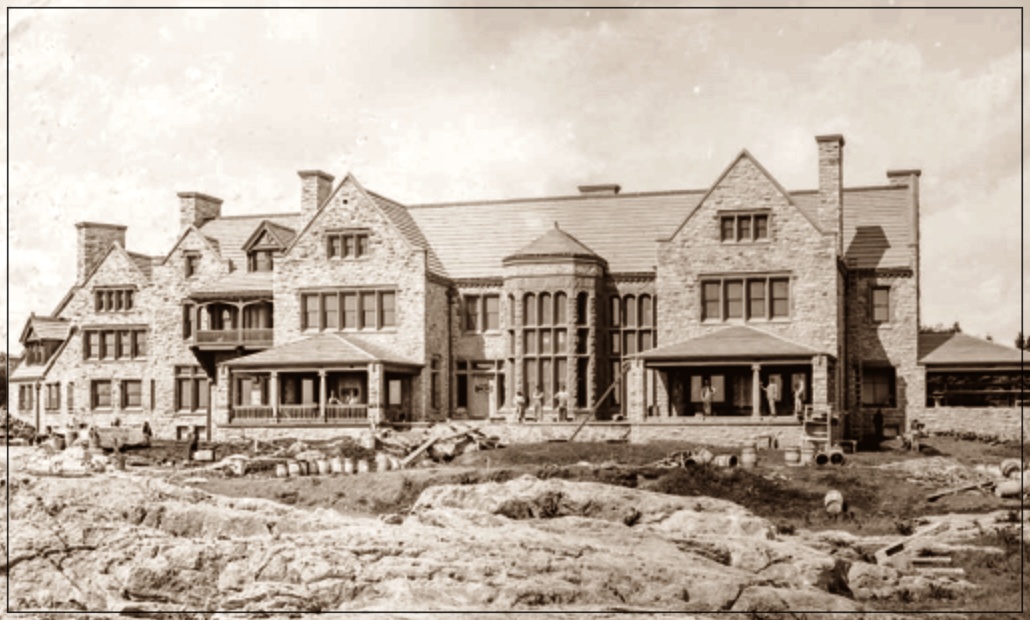
| Vintage view of Rough Point mansion (Newport Restoration Foundation) |
If you were a Vanderbilt, then money was no object and the Boston firm of Peabody & Stearns, the most popular architects of the Gilded Age designed the house. Coincidentally, this firm had designed the first Breakers mansion which burnt and was later rebuilt. The landscape firm of Frederick Olmsted designed the grounds. Today, the Olmsted firm is best known for the landscape design of NYC's Central Park and the U.S. Capitol grounds in Washington, D.C.
In 1894, the Vanderbilts began renting Rough Point to summer guests. Among these was William Bateman Leeds Sr, an owner of the American Tin Plate Company, who rented it from 1904-05 before purchasing it in 1906. After his 1922 death, his widow, Nancy, made exterior alterations to the house and remained the owner until 1922.
 |
| The Duke family, Nanaline, James and baby daughter, Doris |
That's when American tobacco and electric power industrialist James Buchanan Duke and his second wife Nanaline bought Rough Point.  |
| Rough Point Under Renovation, 1923 (The Preservation Society of Newport County) |
The Dukes hired Philadelphia architect Horace Trumbauer to renovate the house and add two new wings. Trumbauer was a prominent American architect of the Gilded Age, who designed residential manors for the wealthy. Later, he also designed hotels, office buildings, and much of the campus of Duke University.  |
| Photos of Doris Duke that were on display in Rough Point |
When Duke died in 1925, his enormous fortune, and several residences, including Rough Point, were bequeathed to his only child, 12-year-old Doris Duke. Rough Point came close to being sold twice by Duke's widow, but eventually became one of his daughter's most prized properties. Her debutante ball was held at the estate in 1929.
Doris Duke owned as many as five homes during her lifetime, including Rough Point Duke Farm in NJ, a Park Avenue penthouse, a hillside mansion in Beverly Hills, and a palace in Hawaii. She continued to spend her summers in RI. However, after the New England Hurricane of 1938 that devastated Rhode Island, and with the advent of WW II, her visits were less often.
In the early 1950s, Duke took up permanent residence in NYC and emptied Rough Point of all its furnishings. Then, in 1957, she re-established a home at the RI mansion and began refurnishing the mansion.
From 1958 to 1959, she began purchasing art and antiques for the house combining the new pieces with family treasures. The RI mansion became one of her favorite residences. She lived there from May through November and continued to decorate it with items collected during her very wide-ranging travels. Today, the mansion contains an extensive collection of fine and decorative arts, including many priceless works by Gainsborough, van Dyck, Reynolds, Bol and Renoir.
There was a distinct difference in the interiors of this mansion and most of the other Gilded Age mansions we explored on a previous Newport visit (August 2023). Rough Point maintains a mix of grandeur and homeyness missing in others. Today, it is seen mostly as it was lived in during the life of its final owner, even if her lifestyle was a bit grander than most.
The grand staircase (seen above) was imported in its entirety from an English manor house and installed at Rough Point.
The stained glass in the windows above depict the coats of arms of the signers of the Magna Carta.
The wood paneled rooms, such as the Great Hall, had the paneling imported from an English manor house which was being stripped. This room was used as an art gallery. The rather modest looking kitchen and extensive butlers pantry. The wooden doors on the left housed refrigeration units. When she was living at the house, staff at Rough Point would pick vegetables daily for use in the kitchen. In the spring, vegetables and flowers were shipped from greenhouses at Duke Farms in NJ to be planted in RI.
The house has stayed much the same as when Duke lived there. The property remained with Duke until her death in 1993.  |
| The bedroom and private bathroom of Doris Duke |
A decade after resettling in Newport, Duke founded the Newport Restoration Foundation (NRF) which has since restored more than 100 colonial buildings in RI. She gifted Rough Point to the NRF so that the public would be able to enjoy the house, estate and collections. It was opened to the public as a museum in 2000. While the house pays homage to the tastes of her parents, she made Rough Point her own and the furnishings, collections, and arrangements of the rooms reveal her personality and have become part of her lasting legacy.
 |
| Princess and Baby in trailer |
Duke was a lover of animals, in particular her numerous dogs and two pet camels, Princess and Baby. Born in 1987, they traveled in a horse trailer from her NJ mansion. The two spent summers in Newport on the back lawn of Rough Point and were known for chasing security guards around the grounds. Winter months were spent in a heated stable in NJ at Duke Farms where they retired after Duke's death.
While there are no longer live camels on the lawns at Rough Point, instead there was a herd of elephant sculptures on the day we visited.
The Great Elephant Migration is a traveling public outdoor art exhibition and global fundraising initiative presented by Elephant Family USA in collaboration with Art&Newport and various contemporary artists.  |
| The elephants were impressive on the grounds of Rough Point |
The year-long campaign will have 100 elephants migrate across the U.S. and its first stop was in Newport, RI, where the life-size elephants were located in several iconic locations. Each elephant was available for purchase through The Great Elephant Migration website. Funds raised will benefit non-governmental organizations performing conservation work around the world.
 |
| There were several family groups |
Each elephant is based on a real, wild elephant from the Nilgiri Hills. The sculptures were created by The Coexistence Collective, a community of 200 indigenous artisans in the Nilgiri Hills of South India.  |
| A closer look at the detail and craftsmanship |
These elephants are made from the Lantana camara, a toxic, invasive plant that encroaches on wildlife habitat, pushing elephants and other wildlife into closer proximity with humans with greater potential for conflict.
 |
| Us at Rough Point on a warm day |
If Doris Duke were alive, she would undoubtedly have been a staunch supporter of this initiative. In her later years Duke became a wildlife refuge supporter. The Doris Duke Charitable Trust, established after her death, continues to support animal rights and environmental conservation.
Duke Farms in NJ opened in 2012. We've visited this 1,000 acres plus environmental center a few times when we still lived in the state. Public access is free. Visitors can access 18 miles of walking trails and 12 miles of bicycle trails. There's over 247 varieties of birds, including a family of bald eagles that return annually. The Duke Farms Community Garden opened in 2011 and has over expanded to 460 plots, making it the largest allotment-style garden in the U.S.. Doris Duke may not have been a NJ native, but she certainly left a lasting connection in these two states, which coincidentally are the first and five smallest U.S. states (by land area)..