Friday, October 7, 2022

Friday Funnies

Update: Thankfully, blogger seems to have corrected the issue many fellow bloggers were having in being unable to upload images to posts. This post was created earlier today.
**********
As most regular readers of this blog know, Grenville and myself enjoy road trips within NH and other New England states and often many times a bit further.

Grenville is usually the driver, and I'm looking at everything on the roadways and elsewhere. Here's a few examples of some recent sightings.
Sometimes, messages on vehicles can be downright alarming, like the one on the truck above. But then, fair warning had been given.
In this one, notice the dual spelling. Perhaps, a smaller size could have been used on the window, but that would have been far less interesting. The license plate was from CA and this was spotted on a NH roadway. Sure, hope there wasn't a serious medical emergency.
The phone number tie-in with the business name was interesting to see and I wondered, which came first?

This vehicle brought the film, Ghostbusters to mind, especially since it's the season for many things 
πŸ‘ΉπŸ§™πŸΌπŸ‘»πŸ¦‡ that go bump in the night. (Actually, the equipment was for ham radio and weather monitoring.)

Your turn — have you also seen amusing or interesting vehicles on your travels, even ones close to home?

Enjoy Your Weekend, EveryoneπŸŽƒ
We're planning a πŸπŸ‚walk in a local park

Thursday, October 6, 2022

Deadly Sweet in Boston

History is interesting, informative and often deadly. This past weekend we learned about one of the most unusual disasters in New England history. (Spoiler alert: This is a long post.)

As most folks know, we're not native New Englanders. What we knew about molasses was that it gave brown sugar its color and sweetness and was used in baking, especially at holiday time for gingerbread treats.

But, it's not just for baking, as molasses can be fermented to produce ethanol, the active ingredient in alcoholic beverages. It was used to make munitions and other weaponry used in WW I. 

After hearing a presentation at the Nashua Public Library this past weekend, we also know that molasses can be deadly.

Stephen Puleo, author of Dark Tide, the definitive book on the subject, has spent the last nearly 20 years telling how a massive wave of sweet dark syrup redefined a neighborhood, and was more gruesome than many people know, ourselves included.

It's a fascinating read, more so because it actually happened.

What's the book about?
Puleo has chronicled the events leading up to and the aftermath of the Great Boston Molasses Flood of 1919, also known as the Boston Molasses Disaster. It happened on January 15, 1919, in the North End neighborhood of Boston, MA. 

The location was the Purity Distilling Company facility on Commercial Street along Boston's waterfront. Purity was a subsidiary bought by United States Industrial Alcohol (USIA) in 1917. A large amount of molasses had been stored there by the company, which used the harborside  tank to offload molasses from ships and store it for later transfer by pipeline to the Purity ethanol plant in Cambridge.
The molasses tank before the collapse
The tank, built in 1915, was huge. It stood 50 feet tall, 90 feet wide and held as much as 2.3 million US gallons. Molasses had been poured into the tank 29 times, only four refills to near-capacity. The fourth top-off had been two days before the disaster, after a ship had arrived from Puerto Rico with a cargo of molasses. 

Puleo details what happened on that 1919 mid-January day, after temperatures rose to above 40°F, a rapid increase from frigid temperatures of days before. The new load of molasses that week had filled the tank to near capacity. It burst open and collapsed just after noon time. 


Headlines in the Boston Post, Boston Daily Globe  & Boston Herald a day after the disaster
When the tank burst it released a 15 foot-high, 160 foot-wide wave of over 2 million gallons of molasses. It flowed through the city's north end at 35 mph destroying everything in its path. The molasses flood covered one of the densest commercial sections of Boston which included a busy port and a railway terminal.

News of the impending disaster began with a phone message—Send all available rescue vehicles and personnel immediately! There’s a wave of molasses coming down Commercial Street—to Boston Police from Patrolman Frank McManus, who witnessed the tank splitting apart. McManus later told The Boston Post he was about 100 feet away and felt a “wet, sticky substance” on his back and shoulders.

What sounds like an improbable scenario soon became a destructive and deadly disaster that caused 21 deaths and injuries to 150. Humans were not the only victims. Public Works horses in a nearby stable were killed on impact; another 10 or 11 horses were shot that night by Boston Police. They had become too stuck in molasses to extricate. Numerous dogs also perished.
The scene after the molasses tank split discharging molasses in Boston's North End
The surge picked up carts, animals, wood, houses, and debris from an overhead train trestle, according to Puleo: That’s how a lot of these injuries happened—fractured skulls, broken pelvises, broken backs. People are kind of hit by this debris as it’s being swept by the wave. It’s just a very harrowing kind of disaster.

Why was the tank so big?
Industrial alcohol, made from fermented molasses, was very profitable. The tank’s immense size reflected the demand. Built quickly, the tank has isues from the start. Instead of inspecting and filling it with water first to test it, USIA ignored all warning signs including the rumbles every time it was filled. When it leaked, the company painted it brown. Residents and children were known to fill pails with the seeping molasses.

Witnesses reported they felt the ground shake and heard a roar as the tank collapsed describing it like the passing of an elevated train. Others reported a tremendous crash, a thunderclap-like bang, and a machine gun sound as rivets blew from the tank.
Boston firehouse leveled in 1919 molasses surge
The collapse translated this energy into a wave of molasses moving at 35 mph. It destroyed several city blocks and leveled buildings, including a fire station, and damaged an elevated railway and cars.
Boston Elevated Railway collapse
The wave was so strong that steel panels from the tank burst against girders of the nearby Boston Elevated Railway structure. Puleo described how nearby buildings were swept off foundations and crushed. Several blocks were flooded to a depth of 2 to 3 feet. According to a Boston Post report which Puleo quoted in Dark Tide: 

Molasses, waist deep, covered the street and swirled and bubbled about the wreckage …. Here and there struggled a form—whether it was animal or human being was impossible to tell. Only an upheaval, a thrashing about in the sticky mass, showed where any life was …. Horses died like so many flies on sticky fly-paper. The more they struggled, the deeper in the mess they were ensnared. Human beings—men and women—suffered likewise.
Rescue efforts included police, Red Cross, Navy cadets and citizens
The Boston Police, Red Cross, Army, and Navy cadets from a docked training ship arrived. Many worked through the night. Conditions worsened when temperatures dropped and caused the liquid to harden. It reportedly was a foot deep in places. 
Section of molasses tank after collapse
Another section of tank under collapsed railway
Rescuers found it difficult to help victims maneuver the syrupy sludge. Conditions worsened when temperatures dropped and caused the liquid to harden. After four days, the search ended; many of the dead were glazed with molasses making identification difficult. Others had been swept into Boston Harbor and found three to four months later.
Searching for victims in building collapse
Firemen constantly sprayed water, but wasn't until the city ordered powerful streams of salt water using city fire boats that progress was made. Salt water cut the molasses.

The harbor was brown until summer. Cleanup in the immediate area took weeks. Rescue workers, cleanup crews, and others had tracked molasses through the streets and spread it to many places. One paper reported: Everything that a Bostonian touched was sticky.
A welder cuts parts of the molasses tank after the disaster
After 5 days, welders began cutting up the tank with torches searching for bodies. After the salt water helped cut the molasses residue, welders could see the structure of the original tank to cut it and find bodies.

What happened later?
In the wake of the disaster, 119 residents brought a class-action lawsuit against USIA in one of the first class-action suits in Massachusetts. The trial set a precedent for expert witnesses; engineers, metallurgists and architects testified. The case is considered as a milestone that paced the way for modern corporate regulation.
Boston Herald reported os USIA's claim that anarchists blew up the tank
USIA claimed the tank had been blown up by anarchists described as  evilly disposed persons as some of the alcohol produced was used for munitions production. 
Bombings were common then so police checked out this claim which was later dismissed.

The theory was an anarchist climbed a ladder and dropped a pipe bomb into a fermentation vent, and that’s what caused the tank to explode, so therefore USIA should be absolved of responsibility because it was a terrorist act,” Puleo said, adding, There was no evidence. It’s very clear that the tank was built in a very substandard way.”

In 1925, six years after the disaster and three years after testimony began, a court-appointed auditor found USIA liable. The company paid out $628,000 in damages. Judge Hugh Ogden oversaw the years-long civil suit and took responsibility for distributing damages. If the death was horrific, the surviving family received more money. 

As terrible as the disaster was, there were positive results. Sites across the U.S. adopted stricter construction codes and improved the government’s oversight of corporations acording to Puleo, All the things we now take for granted in the business, that architects need to show their work, that engineers need to sign and seal their plans, that building inspectors need to come out and look at project—all of that comes about as a result of the great Boston molasses flood case.

How could molasses have been so deadly?
Questions followed for years later and even more recently. Several factors emerged: the tank may have leaked from the first day it was filled in 1915 because of poor construction and insufficient testing. Flawed rivet design was another issue with stresses too high on rivet holes, where cracks first formed. 

A  2019 analysis listed the cause as steel too thin to withstand the pressure of 2.3 million gallons of molasses. The steel had not been mixed with enough manganese, making it brittle and more likely to crack below 59°F (air temperature on the day of the disaster was about 40°F). Ironically, the ill-fated Titanic was reported to have used the same kind of steel in its construction.
Sole marker for the molasses disaster

USIA did not rebuild the tank. 

Property formerly occupied by the molasses tank later became a yard for the Boston Elevated Railway. It's now the site of a city-owned recreational complex. 

This small sign installed by the Bostonian Society is the first-ever, and sole, marker to honor the Great Boston Molasses Flood. 

According to Puleo, It certainly doesn’t do the tragedy justice. The marker is relatively new as for about 75 years, there was nothing to mark the disaster or its location in the city.

The author's appearance was in conjunction with the library's Nashua Great Reads program. Copies of Dark Tide were made available to library users and I had borrowed one. 

Then, as unlikely as it sounds, we found a copy of this nearly 20-year old book at a NJ wildlife refuge book sale on our recent road trip. It's  50 cents price was much less than the current paperback cost. We purchased it and made a donation too for the bargain find.

At the book signing after the library talk, we shared this story with the author and asked him to sign the copy to reflect this, which explains this inscription.

If you're a fan of historical non-fiction or just like a good read, Stephen Puleo has authored seven other narrative history books, an eighth is forthcoming. A former newspaper reporter and communications professional, he currently teaches at U-Mass in Boston. 

FYI — the phrase, You’re as slow as cold molasses in January, is said to have become popular from this disaster. It was also used in the 1941 film, Gone with the Wind.

Photo Credits: Historical photos used in this post are from online sources, including the Boston Daily Globe and Boston Herald newspaper, the Boston Public Library, Library of Congress photo archives and other photographers.
*******
And, it seems that I was very fortunate in being able to complete this post (with its many images) before Blogger starting having  issues. As of today, several bloggers posted that they were unable to add images in their posts. The same happened to me when tried to insert images in a draft post.

Friday, September 30, 2022

Friday Funnies

As hard as we searched, there were no monsters for sale in this store.
Advertising isn't always accurate, but then we never really expected to find any of these. Wording on posters can be fun.

FallπŸπŸ‚ is here, finally, with much cooler temps. It's good to be back in Nashua, NH, after our road trip to visit family and friends in two states. Thanks for your comments too. It takes a few days to catch up; blog reading will be done this weekend, in between some local events.

Enjoy Your Weekend
We're going to a car show and presentation about the 1919 Molasses flood in Boston

Wednesday, September 28, 2022

We Went "Peopling"

Tis true, we've been off on a(nother) road trip the past week and a half. Unlike previous ones, this trip was to visit with people not to see places. Not just any folks, but the best type — family and long-time friends, many most of whom we hadn't seen in awhile.
Faces of family & friends visited in NJ and PA
We traveled to our home state of NJ, then to PA, and back to NJ before returning to NH.
My brother, Tony and wife, Anita, long-time friend, Margaret, and us in NJ
Our first NJ visit was to long-time friend, Margaret, a neighbor of my late parents. She celebrated her 94th birthday this past June. We spent a wonderful visit at her home before going to lunch with my brother, Anthony (Tony) and sister-in-law, Anita. We also visited Virginia, shown in the top right collage photo, an amazing 93 years young who knew my late. She and Margaret are friends who talk every evening.
Tony my "baby" brother is three years younger than myself and my only sibling.
Long time NJ friends, Jill & Art
Another NJ visit was with longtime friends Jill and Art. Jill and myself were co-workers over 25 years ago and we have maintained a now long-distance friends. 
Even longer friends, Sara & David in PA
An even longer friendship is that of Sara and David, fellow NJ natives, who now live in New Holland near Lancaster, PA. A highlight of our get togethers is to take a group shot followed by separate photo pairings. It's always fun the next time we see each another to compare pics from the previous time(s). My friendship with Sara predates her marriage; we attended high school together in NJ, many years ago.
This PA hotel is a steamboat-type accommodation on land
One of the most unique lodging experiences in Lancaster, PA, is at the Fulton Steamboat Inn, a steamboat environment on land in unique nautical or Victorian themed guest rooms. This was our accommodations thanks to a gift certificate received last holiday season from PA family members.

Why is a steamboat in the middle of Lancaster County, PA?

It's because Robert Fulton, the man credited with developing the idea of propelling boats by steam, was born in 1765 in a small farmhouse a few miles south of this location. 

In 1807, Fulton teamed with another engineer, and they designed and constructed the first successful steam powered ship, The Clermont. Fulton is credited with turning the steamboat into a commercial success and transforming transportation history.
Faces of youngest granddaughter
Our PA visit was to spend time with the youngest granddaughter. We were looking forward to seeing her play soccer on Saturday morning, but she didn't play.
We shared grandparent time 
While this was basically an indoors visit, sometimes those can be fun with game playing, coloring, story reading and naps too. 

This road trip was a busy one with many visits. As much as we enjoy seeing new places, there's nothing better than spending time with family and friends. We're sure you agree.

Friday, September 23, 2022

Friday Funnies

As a rule, this blog avoids hot topics, particularly those of a political nature. That said, the question is Why is Grenville posing with an endorsement for two political candidates?

These are not just any two candidates. 
Actually, these aren't even real candidates. 

Some of you may be wondering who are these two candidates? 
Others in our ahem age group may readily recall the names.

Here's a hint, they're were the characters in a popular American TV sit-com that ran for eight seasons from 1960-1968. It followed a small town sheriff and his well-meaning, bumbling deputy in a fictional NC town, modeled after the real hometown of the main actor. Ironically, not a single shot was filmed there; the series was all done in Hollywood, CA.

Did you figure out it was The Andy Griffith Show?

The show was televised on CBS from October 1960 to April 1968. Griffith played Andy Taylor, a widowed sheriff in the fictional town of Mayberry, NC. His deputy, Barney Fife, was played by actor Don Knotts and nip it in the bud became his signature phrase. 

Ranked by TV Guide as the 9th-best show in American TV history, the series was never lower than seventh in ratings. It ended its final season at number one. 

It's lasting popularity has generated much show-related merchandise, especially in the real town of Mount Airy, NC (which we visited on an earlier road trip). Several gift stores there specialize in everything related to Mayberry. Grenville ordered this t-shirt from one, Mayberry on Main, after he recently saw someone wearing one. 

Sheriff Andy Taylor & Deputy Barney Fife
Deputy Fife used the phrase in many episodes and 
One-Punch Opie is one in particular. This episode in the third season (December 1962) centered around Opie being bullied by a new boy who also encourages other youngsters to do misdeeds.

When Taylor and Fife find out, the deputy is outraged, telling the sheriff that something must be done: I say this calls for action, and now . . . Nip it in the bud! First sign a youngster's going wrong.

If you want to take a trip down memory lane, this YouTube link has deputy Barney Fife saying the infamous catch phrase in that episode.

FYI—this post is the first and last reference to political candidates—fictional or otherwise—that will appear on this blog.

Thanks to all who commented on the previous post about whether to repair or replace items. It seems that most folks would repair an item, if possible. But, sometimes it's not only more costly but hard to do given that some items may have be obsolete by the time a repair is needed.

Enjoy Your Weekend, Everyone
🍁Fall has (finally) πŸ‚arrived in Nashua, NH, with cooler temps
We're visiting family & friends in NJ and PA this week

Wednesday, September 21, 2022

Repair or Replace?

Do you repair or replace items (can be anything) ?

The reason for this query is that within the past two weeks, I've done both for two items that were costly when new (one more than the other), but not at all similar.
2007 Jeep Liberty

If that sounds confusing at first read, here's what happened. 

The first repair was more of a replacement, 4 tires for my vehicle, a 2007 Jeep Liberty, I'm the original owner. Yes, I know, this auto is considered old by many, but it suits me perfectly. The mileage is now nearing 111,500 miles and it runs well with regular maintenance. Compared to Grenville's 2019 Jeep Grand Cherokee which  has a complicated (to me) onboard computer, this car is easier to operate and maintain. It has the basics — auto transmission, power windows and locks, satellite radio, heater, AC and a CD player (hardly used). 

An unexpected 
flat led to the new tire purchase when a rear tire valve failed to seal after air was put in. Unaware of the air leak, we soon heard the unwelcome thump-thump of a flat — never a good sound. Luckily, we were not in a heavily trafficked area, so we pulled off the road, and called AAA. The flat tire was replaced with the spare and we continued on our road trip. Just to be safe, we took a longer route back home to avoid high-speed highway travel.

Maybe it's happened to you that  what's thought of as bad luck is a blessing. That's because when checking the service records, I saw that the tires were 7 years old with 38K miles, about time for new ones. Before arriving home, I had an appointment with a local Goodyear tire dealer who luckily had 4 of the same tires in stock. The day after our return home, the Jeep had new shoes tires. Total out the door cost with balancing, alignment, tire disposal — little over $800.

The next item was a repair that was much less costly than buying a new one.

Those of you who are iPhone users may already know that Apple unveiled its new lineup of newer and greater phones early last month. (Does anyone else enjoy watching these new product roll-our presentations? They're eye-popping to say the least.)

iPhone 10s
I confess, to have been seriously considering replacement of my older iPhone 10s which, when purchased new, was over $1,000 inc. extra AppleCare protection. After 
3+ years, it wasn't holding a charge well and battery health was at 85%. Apple recommends replacement when the battery gets to 80% and provides more details here. Mine was very close to that point, so...

After considering a couple of BIG ?s, specifically: Do I really want to spend $$$ for a new one and, more importantly, was a new one really needed? The answer was no and no, so a non-issue. 

Instead, there was an easier (and less costly) solution. I went online to the Apple store here in Nashua, NH and made a service appointment for a battery replacement. After answering a few online questions, my time slot was this past Sunday.

Two hours later, not only did my phone have a new battery, but a new speaker as well. It seems the speaker needed removal to replace the battery and would be replaced at no charge—win-win. Total cost was $69 (no sales tax in NH). The battery level is now 100% again, so it's all good !

Within a couple of weeks, I've repaired/replaced two older yet very different items. Amazingly, the total cost of 4 tires plus a new phone battery was less than just the cost of a new iPhone. And, for me, these were good $ saving decisions, especially now. At some pointing the future the car and phone may be replaced, but not in the immediate future.

Your turn—have you replaced, repaired or bought anything new? If so, please share—what and why.

Wednesday, September 14, 2022

Second Tale of 2 Yachts in ME

This is quite a lengthy post, per my usual ones which focus on historical places and things that attract me to learn more. And, since it's always nice to share knowledge, now you know too.

This post is a continuation of an earlier one about two yachts we saw in Belfast, ME, shipyards during a July visit. That earlier post focused on one of the two yachts in the photo on the right ➨.

This photo was displayed in the previous post along with a question about which one was in better shape. 

And, if you read the previous post (or not) the answer is the top yacht, Cangarda, one of three remaining steam yachts worldwide. 

Both of these vessels are historical, but for different reasons. The bottom one has the most history as it pertains to the U.S. as you will read and see in this post. And, I am not a boat person, when we found out it was in a location we were staying, I had to learn more.
The photos above are of the second yacht as it is today. It's clearly visible, that it's in very rough condition, which doesn't bode well for its former prominence. But then, Cangarda was in the same predicament before complete a restoration which took many years and many $$$. And, this one is in the same situation—time and money can work wonders.

If you haven't figured out the significance of this yacht; its nameplate gives it away, the USS Sequoia. In much better days, it was 
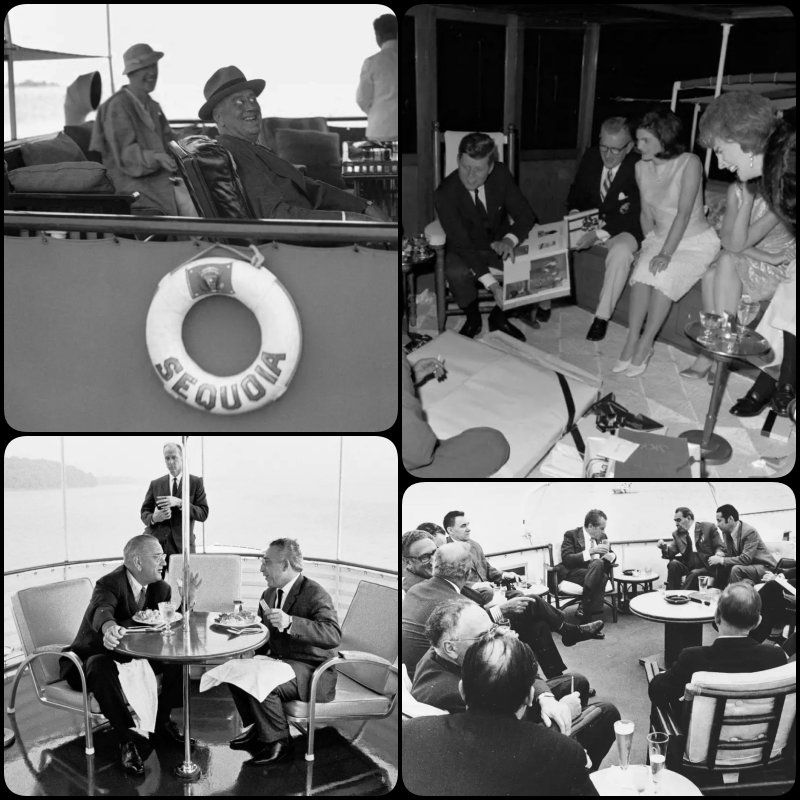
the floating White House from 1931 to 1977. Up to 10 U.S. Presidents have been on board, Herbert Hoover to Bill Clinton, (even after the yacht was sold by one of them). No, I didn't know there was a Presidential yacht, but then the yacht preceded the time before a presidential plane. 

Here's a few ways it was used by presidents: Franklin D. Roosevelt had a wheelchair lift installed. Harry Truman made the decision to drop an atomic bomb on Hiroshima while onboard. Dwight Eisenhower allowed Queen Elizabeth II to use it during a visit. In 1963, John F. Kennedy celebrated what became his last birthday onboard. Lyndon Johnson watched films considered risquΓ© if in the White House. The most time onboard was spent by Richard Nixon, who played the piano. Reportedly, it was where he decided to resign the presidency.
Sadly, the Sequoia is in such disrepair that it can no longer float on its own. The above photos show it as seen in July on boat stands at the French & Webb boatyard in Belfast, ME. This specialty boatyard has been contracted to bring back the seaworthiness and elegance of this famous vessel. From all that I have read, this will be a long process.

The USS Sequoia, is an impressive sight even in its current state. This 182,000 lb, 104-foot long wooden yacht was one of the largest personal yachts of its time.

Formally decommissioned in December 1935, by President Franklin D. Roosevelt, it continues to carry its “USS” designation and was designated a National Historic Landmark in 1987.

Surprisingly, like many things, it has a connection to our home state of New Jersey where it was built in 1925 for a woman raised in NJ who shared the same September 9 birthdate as my late mother (different birth years).
Online sources: Mathis Ship Yard, Camden, NJ, circa 1920s

Emily Roebling
Designed by famed naval architect John Trumpy, the yacht was built by the John H. Mathis & Company Shipbuilders in Camden, NJ. Trumpy, a fourth generation of boat builders was born in Norway. After naval architect training at home and in Germany, he immigrated to the U.S. in 1908 and joined Mathis as a partner in 1910. 

The yacht was designed and built for Emily Roebling Cadwalader. If that name seems familiar, it's because Ms. Roebling was the granddaughter of John Augustus Roebling, the civil engineer for the Brooklyn Bridge. Raised in Trenton, NJ, she was one of the first women to drive her own car there. She married Richard M. Cadwalader, a prominent Philadelphia banker, who shared her interest in large yachts, which luckily they could well afford too.

The Sequoia II, as it was originally named, preceded the 85-foot Sequoia I, which the couple owned before and which was also designed by Trumpy. These handmade wooden vessels, built for the rich and famous, enabled a very comfortable lifestyle. Sequoia's hull was constructed of yellow-leaf pine, the deckhouse was made of mahogany and teak. 
Online source: Vintage ad for Mathis Company lists Sequoia I and II; notice that Emily Roebling's name was not included, only her husband
Built in 1925 at a cost of about $200,000—equal to $3,223,145 now, it was the second of four successively larger yachts built between 1924 and 1931 for the couple. Years ago, luxury boats were the preferred transport for wealthy easterners who wanted to escape winter weather and escape to warmer states, like Florida. Instead of the term yacht that's now used, these luxury boats were called house boats as shown in the vintage ad above for the Mathis Company.
Online source: Sequoia II (as it was known then) in 1926
Sequoia II and its owners parted ways within three years. It was sold to William Dunning, a Houston-based oil executive, who used it for gambling trips to Cuba and business trips along the Mexican coastline. Dunning went bankrupt in the 1929 stock market crash and sold the yacht.

In 1931, the U.S. Department of Commerce bought Sequoia II from Dunning for about $40,000 justifying the cost as it was used as a decoy for rum-runners during Prohibition. Yes, I wondered about that use myself.  It would patrol the Chesapeake and Delaware Bays as a decoy vessel to attract would-be bootleggers who hoped to sell illegal liquor and would come alongside what they assumed was a wealthy owner's yacht, only to be arrested.

Presidential Herbert Hoover 
Then President Herbert Hoover, who had friends with similar yachts, and friends in high places, had the Secretary of the Navy purchase the yacht. 

In March 1933, the yacht, now known as Sequoia, became the official presidential yacht and was transferred from the Department of Commerce to the Naval Department, gaining its USS status. Hoover used it as the presidential yacht for the last two years of his presidency, including 1931-1933 voyages for business and pleasure cruises. 

Here's a fun twist, according to some sources, Sequoia was decommissioned as an official Navy vessel during WW II—alcoholic beverages were prohibited onboard commissioned naval vessels, so that world leaders, like Winston Churchill, could drink liquor onboard. The problem is that Churchill was never documented as being aboard the yacht. 
Online source: U.S. Navy classification
From 1936 to 1939, the USS Sequoia was used as the yacht of the Secretary of the Navy and from 1939 to 1977, used by the Navy, the President and executive branch officials.
Online sources: U.S. Presidents onboard USS Sequoia, FDR to Nixon
Sequoia was sold by a President
All good things come to an end. In 1977, President Jimmy Carter, decided it wasn't right to spend taxpayers dollars on such a luxury item and ordered Sequoia sold at auction to reduce Federal government spending. Sequoia was costing U.S. taxpayers an estimated $800,000 annually at the time. Later, Carter was said to have regretted his decision as a mistake. 
Online source: Presidential bedroom onboard USS Sequoia (in better days)
A RI contractor, Thomas Malloy, purchased Sequoia from the government at auction in 1977 for the highest bid of  $286,000, then spent $50,000 to turn it into a floating museum. It was anchored in RI at India Point Park. In July 1977, Malloy pulled anchor after only 500 people had visited at $2 each. In a New York Times article, he was quoted as saying that intense summer heat had deterred tourists and he hoped to find cooler air and better business in Newport, R.I. 

Those plans didn't go well. Three months later, Malloy resold the yacht to a partnership for $355,00. It was maintained in Myrtle Beach, SC, then in 1980 again resold for $750,000 to The Ocean Learning Institute of Palm Beach, FL, which used it to entertain potential donors.
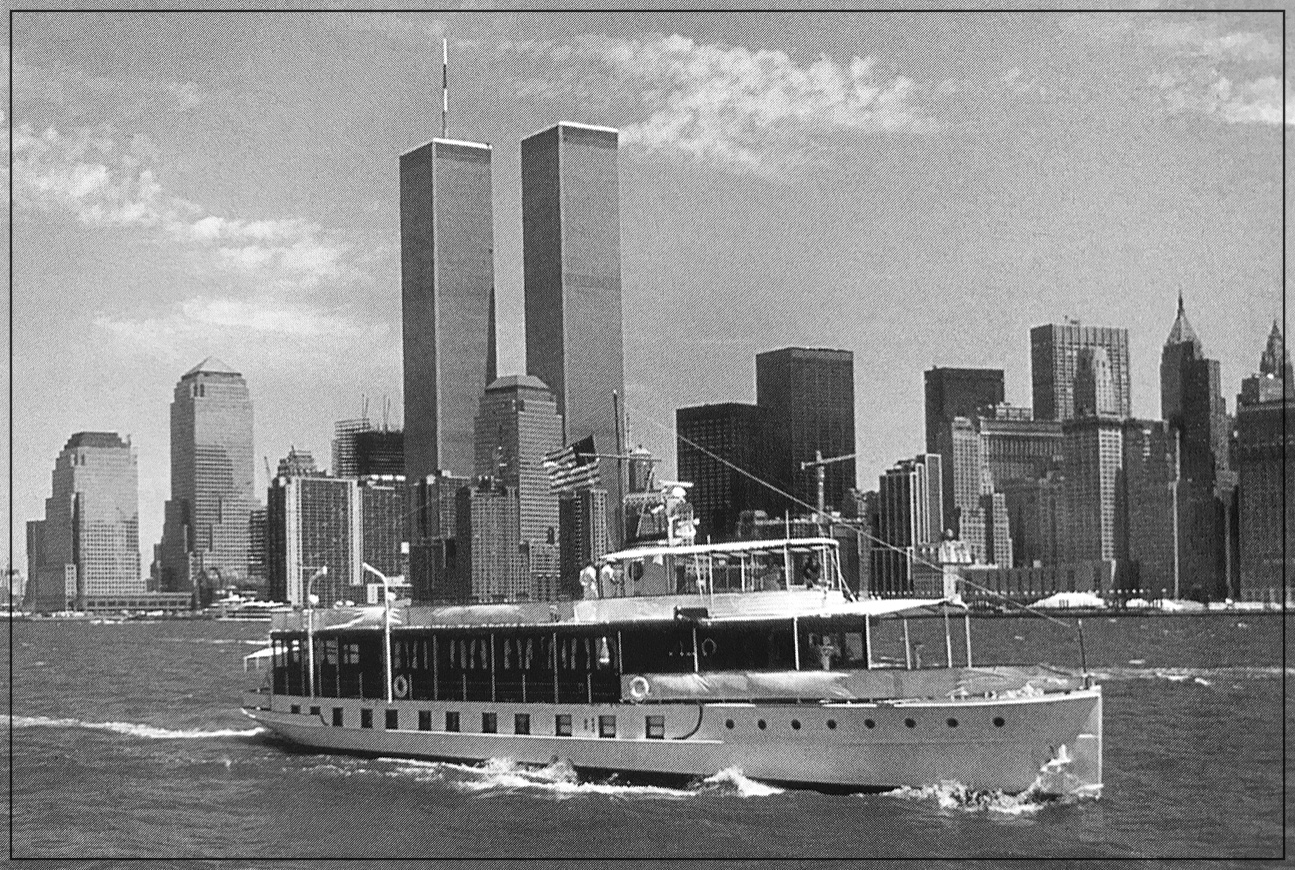
Online source: USS Sequoia on Hudson River, in NYC
The non-profit Presidential Yacht Trust acquired Sequoia from the Institute for approximately $1.1 million in 1980 and returned her to Washington, D.C. During 1984, the yacht was taken on an eight-month, 6,000-mile tour of the country. It underwent a $2 million restoration and then participated in the July 1986 centennial for the Statue of Liberty. A year later, Sequoia was designated as a National Historic Landmark.

In the intervening years there were several other owners, including a potential Japanese buyer who wanted to buy and move it yacht to Tokyo.

Years later, it was involved in a lengthy legal battle after it had been hauled to a boatyard in Virginia. According to online accounts, the vessel had been damaged when it was hauled out of the water on a marine railway in 2014. The yacht was neglected and in danger of sinking. 

The dispute was resolved after years of lengthy and complicated legal wrangling. Its current owner is the Equator Capital Group, a portfolio investment firm in Washington, D.C, which bought Sequoia in 2016 for $7.8 million. 
Online sources: USS Sequoia barging and underway
Online source: USS Sequoia on barge in Hudson River, in NYC
In September 2019, Wolfe House & Building Movers barged the yacht for transport from Deltaville, VA, to Cambridge, MD, then to Belfast, ME. You can view an online video of this amazing barging process here. (It's a condensed version of about 3 minutes.)

USS Sequoia arrived in New England in October 2019. A just over 2-minute video showing some of this amazing voyage and arrival in Belfast, ME, can also be viewed online here 

Both videos provide the best overall views of this incredible-looking wooden yacht, especially the top-down images. USS Sequoia was not wrapped until after its arrival in ME.

That's Where It Remains
Since 2019, the 104-year old yacht has remained outdoors at the French and Webb boat yard under wraps. Like with most things, the pandemic delayed the start of restoration. While it seems like no work has been done. It's all been done behind the scenes. 

According to several articles, skilled workers used laser technology to create a three-dimensional model; original design plans couldn't be found. They have also sourced rare wood and materials, including longleaf pine, from the Southeast and white oak from Denmark. No restoration costs have been disclosed.

Strict guidelines must be followed and restoration must be of museum-level archival quality. That's because the yacht is on the National Register of Historic Places. 

Sequoia will remain in Belfast for the foreseeable future. Physical restoration is slated to start in the spring of 2023 and expected to take 3-4 years. Plans call for a protective housing to be built that would protect the yacht from the elements. Reportedly, it will have a walkway for the public to view the restoration process. From what we saw, there wasn't a rush on these plans.

After its restoration, the USS Sequoia is expected to return to Washington where it will be used as a venue to support ocean conservation.

We're planning a return to Belfast, ME, within a couple of years to see how the process is going. Of course, any visit will be included in a future post, if the visual work has started by then. 

BIG THANKS to everyone for comments on my recent post with family members. As many noted, it's all good now to share special times after a stretch of not doing so.