Wednesday, March 15, 2023

Medfield Insane Asylum (MA)

This post is about a road trip to the site of a former MA insane asylum last fall. Mental illness was and continues to be a serious issue that affects many. No disrespect is intended for anyone who has suffered or knows someone dealing from any forms of this illness. In the 1950s, my maternal grandmother was hospitalized for many years in a NJ facility.

There may be no other place in the country where you can freely explore the exterior (only) of an abandoned psychiatric hospital. However, here in New England, you can walk the grounds of the shuttered former Medfield Insane Asylum, later renamed Medfield State Hospital in MA. This is a lengthy post as the history of this site was interesting and sad in so many ways.
Former Medfield Insane Asylum, 2018 aerial view (online)
The above overview shows the size of the former Medfield Insane Asylum located just outside the town of Medfield, MA. 

Medfield became a state hospital in 1914
Everyone can freely walk here, but only during daylight hours
Just don't try to enter any of the buildings. They're all boarded up and there's an onsite security patrol.

On second thought, why would you even want to try? Years of neglect and vandals have taken their toll, there's unsafe conditions. Many buildings have markings to let firefighters know the flooring is unsafe. Still, you can find many online videos of those who have trespassed.

We considered our short visit an amazing experience which led me to learn more about the long history of this now abandoned hospital.

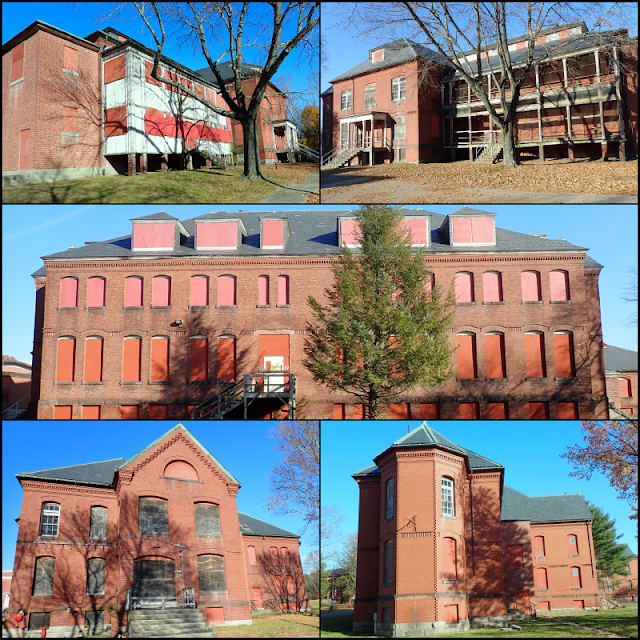
All of the buildings display signs like: Do Not Enter, Watch Out for Cancer, and Your Risk, Not Ours. During the day, you can stroll along the roadways that wind between them, walking at your leisure right past these now vacant structures. Windows are shuttered with red-painted plywood, some steps are crumbling. There's some very unique architecture to see here.
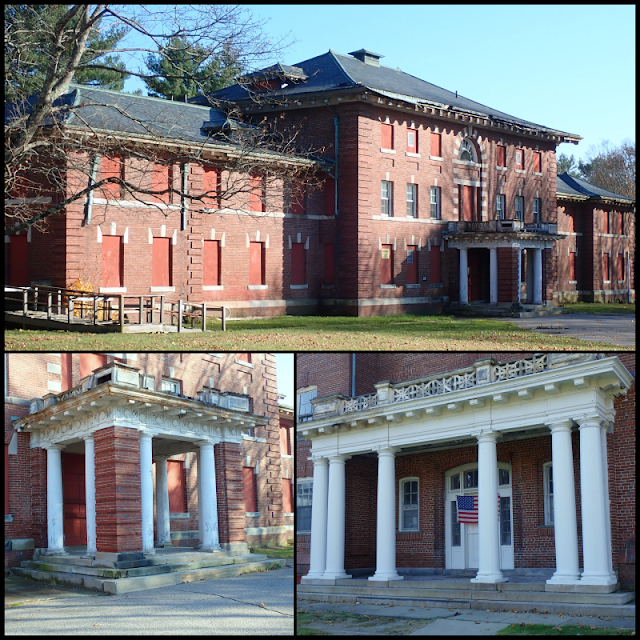
We saw fewer than a dozen other folks during our walk around the grounds, some with small children in tow, other walking dogs. The town of Medfield has opened the site as a public space. It was a short road trip, just over an hour car ride from Nashua, NH, on a beautiful late fall day.At its height, the site encompassed almost 1,000 acres. While the farm area and some buildings are gone, the campus is large with over two dozen structures remaining, all built of matching red brick, most with unique features including porches and numerous windows as shown above.
How It Started
The former Medfield Insane Asylum was a psychiatric hospital complex that opened in 1896 as the state’s first facility for dealing with chronic mental patients. The state legislature appropriated $25,000 towards the purchase of 425 acres and $500,000 for building construction. It was authorized as a 1,000-bed hospital for the care of chronic and incurable cases of the insane.
1896 illustration of Medfield Insane Asylum (online)
By May 1896, 12 buildings were completed to accommodate 600 patients. The first 60 men and 60 women were admitted later that month, by September, there were 563 patients.

It always amazes me just how much information can be found online, such as The First Annual Report of the Medfield Insane Asylum for the year ending 1896, which covered the first 5 months of operation. It is available online from the State of Massachusetts archives and reveals a lot of information, here are some excerpts taken directly from that report: 

As the year for the institutions in Massachusetts ends with September 30, this report is neces- sarily short and includes only five months, the time elapsing since it was opened. The work of cleaning, furnishing and otherwise preparing the different buildings was begun March 1, and was pushed forward as rapidly as possible.Twelve of the cottages for patients were ready to be put in order while six others designed for the filthy and more disturbed classes were in process.

The really great work of organizing and opening a large asylum has been carried on in a manner satisfactory to the trustees and creditable to the superintendent. This work was rendered more perplexing from the fact that the whole plan of administration was a new one in this State. The daily routine of the patients transferred was entirely different from that to which they had been accustomed, many of them for years, and they found it difficult easily to accommodate themselves to the change. In addition to this, building operations have been carried on through the year. This has been an important factor as a disturbing element, adding to the natural excitement of the patients incident to their removal to a new home. The friction and discomfort arising from these causes are, however, becoming less every day.

The cottage plan adopted in the construction gives a much better opportunity for the classification of all forms of insanity than is afforded by any hospital in the State.

The expenses of the institution shall not exceed $2.80 per week for each patient. This sum can be sufficient only when the asylum has become well established, with at least two-thirds of its complement of inmates . This report covers the first five months since the asylum was opened, with the number of patients varying from 120 to 596, and the expenses for this period and for the month of March, during which the buildings were made ready for occupancy, has been $3.21 per patient. Expenses during the summer are always less than during the winter, when the item of fuel adds considerably to the expenditures.

Any success which is achieved in the management of an asylum for the insane requires, on the part of those in charge, unceasing diligence, an unlimited amount of patience and never-failing kindness in manner and speech towards the unfortunate inmates.

That first annual report also listed these annual salaries: superintendent $2,500; assistant physicians $1,500 and $900, engineer $1,000, bookkeeper $600, Treasurer $500, and matron $400. No information was listed for attendants, whose salaries were undoubtedly much less.
Women patients at Medfield: Medfield Historical Society source
Six additional buildings with wards for untidy, excited, and epileptic patients were completed in early 1897, boosting patient capacity to 1,100. By year end, Medfield 
Insane Asylum had 961 patients. Many had been transferred from other institutions and classified as old, sick, feeble, filthy in their habits. (Original terms used for patient conditions.)

Life in an Asylum
Insane asylums, also called lunatic asylums/funny farms by insensitive people, were established in the U.S. in the mid-1800s often to replace poorhouses and housed many considered unfit to live with others. Here's some of the actual physical and mental admission causes listed in the Annual Report: epilepsy, fever, fall, masturbation, heredity, ill health, menopause, nervous prostration, domestic affliction, financial troubles, jealousy, religious excitement, worry, hysteria, syphilis, sunstroke, intemperance, overwork, unknown. There were also those with actual mental health issues, schizophrenia to manic-depression (known as bi-popular disorder) and some criminals. While the report contained a column for voluntary, none were listed there. 

Some patients admitted to Medfield were never diagnosed, but placed there by families who used the asylum to house unwanted relatives. Sadly, a common practice in the 1800-1900s.

According to the Annual Report cited above: There have been discharged 13 patients; 2 were improved and 11 were not improved. Eight of these were transferred to other institutions by orders from the State Board of Lunacy and Charity. There were 24 deaths. When we consider the feeble condition of many of these patients, and that in some cases death was a " foregone conclusion" when they were admitted, and the fact that the change of habits and environment of elderly demented patients often hastens a fatal termination, it is not excessive. All those that eloped have been returned except one, who was arrested as a vagrant in a neighboring town and committed to another lunatic hospital.

It was no surprise to learn that the asylum had many fatal incidents. In 1897, a patient, seriously burned after being left unattended in a tub of hot water, later died; the attendant was discharged. In December that year, a woman escaped, despite efforts to track her in the snow, her body was found in February. In 1916, a woman in the ward for violent patients was killed by another female inmate when an attendant left the room (a New York Times article reported the murder was committed with a heavy iron polisher). In 1916, three attendants were arrested and charged with a patient's murder. One was found guilty and sentenced to 3 years, the other two were dismissed. There were reported incidents of racial discrimination as well.

Internet source
Being committed to an insane asylum was akin to being imprisoned and was often a life sentence, many inmates never had visitors. If they died without a burial location, bodies were either donated to medical schools or buried in the Vine Lake Cemetery in Medfield. Those burials stopped in 1918 when the area was hit with the influenza epidemic. It spread to 308 patients and 55 died in a month and, 
with town pressure, a state hospital cemetery was built at the height of the epidemic. (The Medfield State Hospital Cemetery, which we didn't visit, contains the remains of 841 patients and is in a field about a half mile from the hospital.)
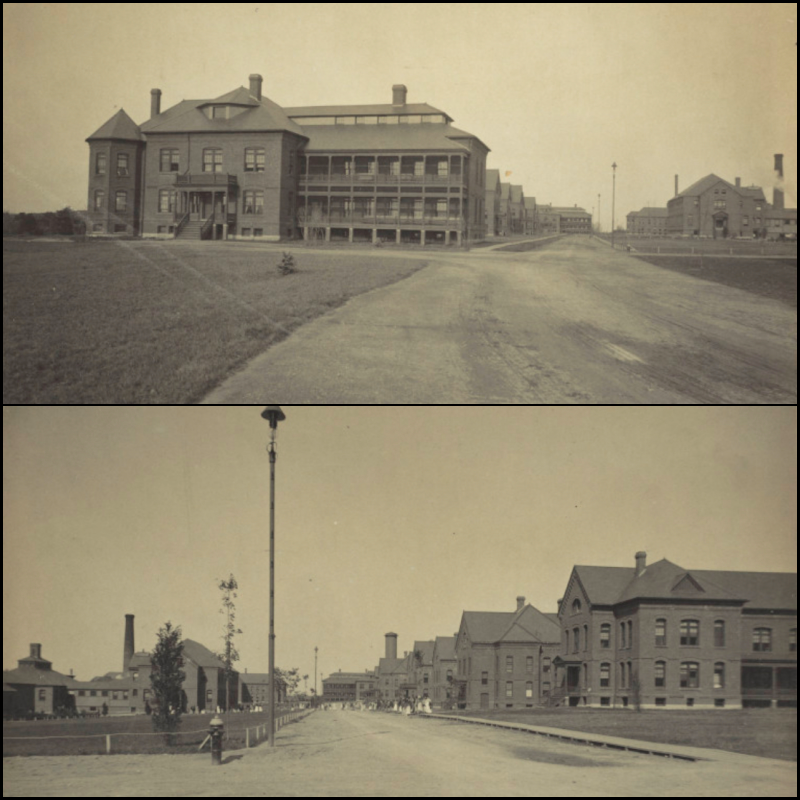
Cottages for Men (top) and Women (bottom) - Medfield Historical Society source
The college-like campus was designed by Boston architect William Pitt Wentworth, a Vermont native. Buildings were designed around a quadrangle, that resembled a New England town common and were constructed in several styles: Greek Revival, Queen Anne, and Beaux Arts. 
Wentworth was a noted progressive architect of hospitals; this was one of his last major projects before his 1896 death at age 59. (While there are many photos of the hospital buildings, there are none of its architect, Wentworth.)
Lee Chapel, patients prayed and attended mass here. Later, a morgue was added in the basement; the chapel was later reused as a gym
The Administration Building and wards for quiet patients were at the front, with wards for the untidy, excited, and epileptic patients (again, original terms) around the perimeter. The infirmary and industrial buildings were located at the corners. The chapel, powerhouse, carpenter’s shop, laundry, kitchen, and dining facilities were placed in the center; the hospital was a self-sustaining community.
Medfield was the first state mental facility in Massachusetts to be built under the cottage plan layout. Back then, this was a very unique concept because instead of placing patients in cells, they were integrated into a small community and worked a specific job within it. (Major similar institutions followed the Kirkbridge Plan created by Dr. Thomas Kirkbridge in which patients and staff were all housed in a one large building.)
Interior living quarters - Medfield Historical Society source
Living
 conditions were home-like with sleeping quarters on the second floor; sitting and work rooms on the ground floor. Staff worked on the wards 12 hours a day, six days a week and lived in the wards as well. At one point, the asylum had over 2,000 patients and 500-600 staff.

The psychiatric hospital eventually housed a population that was larger than Medfield, a small agricultural community. By 1900, the town's population was over 3,000, half of which were hospital patients. The facility provided employment for over 600 Medfield residents and others from surrounding towns.
Vintage Exterior Views - Medfield Historical Society source
The Medfield farms were worked on by patients and served much of the food needs for all the state hospitals in eastern Massachusetts. Silos stored hundreds of tons of corn. Milk from the dairy herds supplied milk for residents at Medfield and many surrounding state institutions. There were over 3,000 hens; the cattle herd numbered over 1,000.
Former Men's Infirmary
A farmhouse added near the barn in 1901 served as living quarters for the head farmer and his family plus 14 farm hands and 30 patients. The farm played an important role in the lives of the patients and the economy of the hospital until farming was stopped in the late 1960s. 

In 1902, an additional $80,000 was appropriated for a second ward for excited female patients, and $2,000 towards the purchase of 40 acres for the construction of additional buildings for 600 patients. A nurses residence for 75 nurses, a male attendants’ home, a hospital for tubercular patients, a ward for 100 excited male patients, and a new powerhouse were also added.
Former employe cottages

Several wood-framed cottages were built in 1906 for employees. By year end, there were 1,500 patients.

The hospital was renamed Medfield State Asylum in 1909 to reflect changes in the treatment of the mentally ill. Five years later (1914) it was changed to the current Medfield State Hospital name which allowed it to care for patients with all types of mental illness, not just chronic mental illness. It was believed the word hospital conveyed a more hopeful outcome than the word asylum

At its height, the complex numbered 58 buildings on 425 acres, with a capacity for 2,200 patients. It raised its own livestock and produce, and generated its own heat, light and power. 

During the 1930s-1940s the hospital continued to be overcrowded with the population climbing to over 2,300 patients. In 1938, electro-shock treatment began to be used for the first time at the hospital.The outbreak of WW II and men enlisting, left a significant staff shortage. Higher-functioning patients performed laundry, housekeeping, food service, grounds care, farming, and other duties. A nurses training school was discontinued in 1943. By 1945, facilities at Medfield were failing and a state report noted many improvements were needed.

How It Ended
By the 1950s, new medications changed the care of the mentally ill, allowing the discharge of more patients. Replacing long-term psychiatric hospitals with community mental health services expanded in the 1960s after Congress passed a law requiring that mental health patients in the U.S. be housed or hospitalized in the least restrictive environment. By the mid-1970s, most of Medfield's patients were moved to community-based halfway houses. 

By 2001, Medfield had just 150 inpatients, with 29 out of 54 buildings still in use. With an annual maintenance budget of under $1 million, buildings were failing, earlier some were condemned. In 2002, faced with mounting expenses and an underused campus, the state of Massachusetts announced the closing of Medfield State Hospital and shuttered all buildings.

The Aftermath
The Medfield State Hospital campus was listed on the National Register of Historic Places and the State Register for local and national historical significance in architecture, health and medicine and social history in 1993. 
Architectural rendering of Lee Chapel as Medfield Arts Center (online)
In 2014, the town of Medfield purchased Medfield State Hospital from the state for more than $3 million with a goal to repurpose it for community use, a plan still in the works. 

Another online report is the 2018 Medfield State Hospital (MSH) Strategic Reuse Master Plan which includes historic rehabilitation/reuse of 28 buildings for housing, commercial space, and recreation, including the conversion of Lee Chapel to an arts center. New construction would include housing and an inn with meeting and gathering spaces.
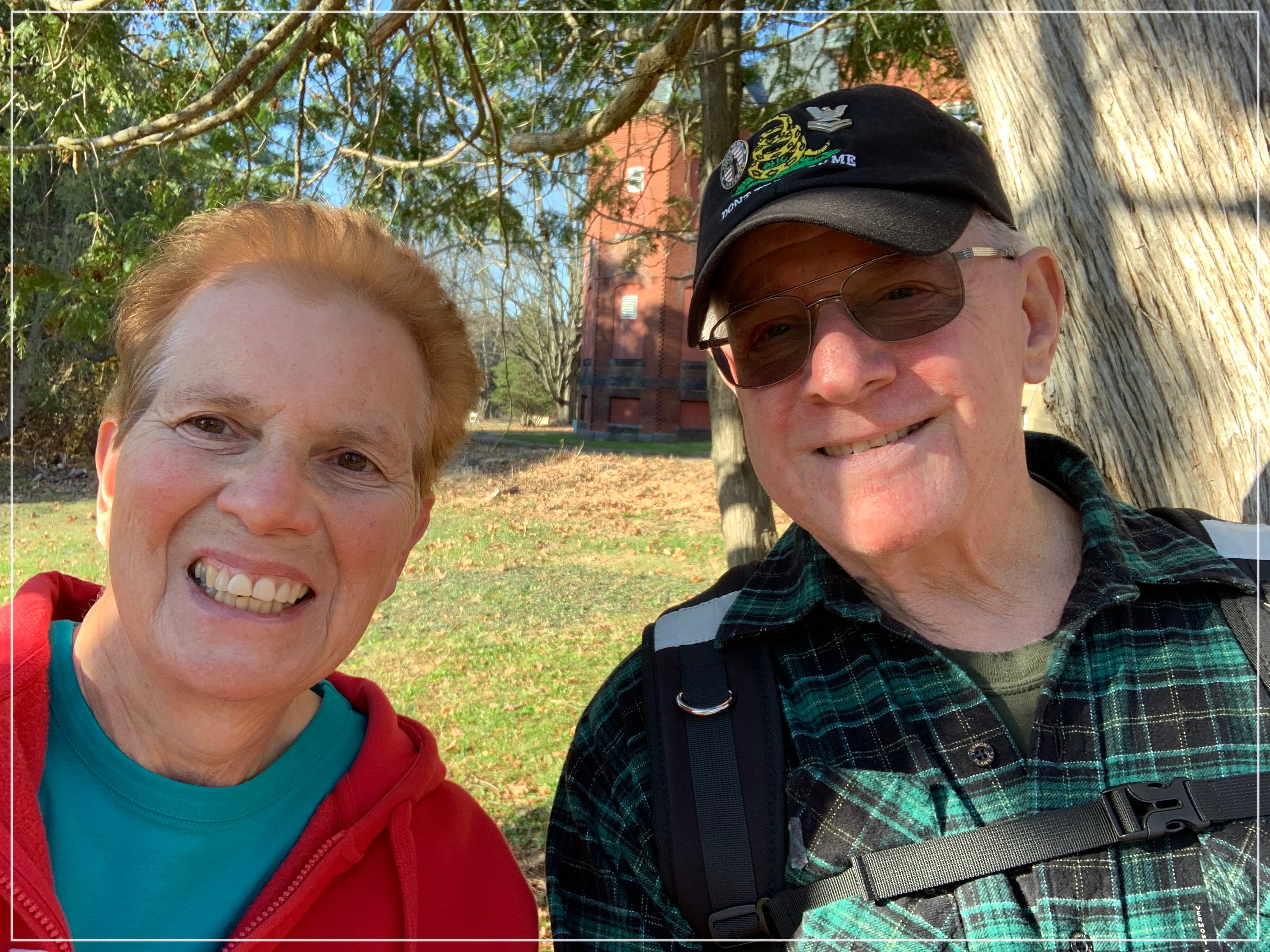
We didn't see any evidence of work in process during our visit. Instead, it felt like walking the back lot of a film studio. It's a perfect location for any production that requires an aging complex. 

In fact, it has been used as filming locations for at least two motion pictures, notably Shutter Island and The Box, neither of which we have seenReportedly, the 2019 film, Knives Out  too. But, we recently rewatched the film and didn't recognize any of the facility in it.

In summary, our walk around the grounds of this defunct hospital campus lead me to learn about and share its very unique and unsettling history. It's unlikely that we will ever revisit the site. How much longer free public access will remain is uncertain. If you ever plan to visit, here's the address: 

Medfield State Hospital, 45 Hospital Rd, Medfield, MA
grounds open 6 am to 6 pm, public access, buildings boarded up, entry prohibited

Monday, March 13, 2023

Home Bookcases

It's always interesting to read about and see what other bloggers have in their homes. In the interest of sharing too, this post presents an overview of our living room (LR) bookcases.

Our LR bookcases don't hold novels even though we both enjoy reading. The two small bedroom bookcases hold some fiction and nonfiction reads. There's a lot of sale books there, some read and others waiting to be enjoyed.

However, the LR bookcases do have books and other things, which hold meaning. There are five bookcases, four of which have traveled from our NJ and VA homes to our current NH apartment. The fifth one was a giveaway from a fellow resident that perfectly matched our existing ones, a wonderful surprise! 

Regular blog readers may know that Grenville and myself enjoy cooking at home. One bookcase holds our too many cookbooks on three shelves. (The top shelf has framed photos.)
Recently, some of these cookbooks were purged and are no longer in our collection. They went to friends and a local thrift store. But, in recent weeks, a new one, Simple One-Pan Wonders (Jamie Oliver) was added as Grenville's ♥️ day gift from me, so more recipes to try.
The bottom bookshelf holds several holiday cookbooks plus cookbooks from both our late mothers. It's also storage for several of The South Beach Diet books, which we sometimes use.
Regular readers of this blog know of our fondness for travel, especially road trips, which is why travel books fill up a couple of bookshelves. Those shown on the top shelf focus on New England states we've visited or revisited. The basket is full of more travel brochures and maps.
As someone who prefers photos to digital images, another bookcase is dedicated to family/travel photo albums. None of these are labelled on the spine, but there is a system, also there are a number of blank albums bought for possible future use.

The three taller albums in the photo above (left) have grandchildren photos from infancy to present day. Other albums hold photos of various family members, another has photos of our former homes, a few more contain our travel and friends photos.

I've often ordered too many photo reprints and have cut down, but still order prints after holidays/special occasions/travels to send copies to family members.

Just wondering—does anyone else keep photo albums too? 
Framed family photos and collages are on the shelves of two other bookcases. These photos celebrate weddings, birthdays, holidays and other events. 

Other folks we know don't exhibit as many family photos, however, we enjoy keeping the memory of family and friends close by and looking at these photos makes us happy.
The shelf in the top photo is the top one of the cookbooks bookcase and shows photos of our much-younger selves. We're also featured in the photos on the wall. That wall hanging is a favorite expression that's so true and seemed to fit here perfectly.
Vintage photos of our parents and other family members are framed on another bookshelf. The top four-image frame shows our parents, his (left) and mine (right)
This framed collage was made by daughter years ago and received as a holiday gift. It's one of our favorites and captures special family moments, like graduations and weddings.
This photo on canvas was a birthday gift to Grenville several years ago on his July birthday. It was taken when the three grands celebrated July 4th together in PA.
This bookshelf has our collection of Christmas books, plus some fun books, just in case one  this teddy bear fancies a read.
This group of penguins and snowmen have taken up permanent residence on the top shelf of our games bookcase and seem to be living life joyfully.
The bottom shelves contain assorted games. The wooden box, a handmade holiday gift is perfect for holding several smaller card games. 

We hope that you've enjoyed this look at some of our treasures. 
How about you — do you have bookcases? If so, are they used for 📚 or other purposes?

Friday, March 10, 2023

Friday Funnies

This post will be going to the mats, but not in the terms of a wrestling match.

As most regular readers of this blog know, Grenville and I live in a repurposed mill building in downtown Nashua, NH, called Clocktower Place (it has two clock towers and a bell tower). By the 1990s, six mill buildings of the former Nashua Manufacturing Company mill yard were converted into apartment residences; 326 apartments of varying sizes on five floors.

While there is wall-to-wall indoor carpeting on all five floors, many residents place floor mats outside their apt entry. Some are quite entertaining. Here's a few seen on indoor walks.
Residents are allowed to have pet felines for an additional monthly fee. The only allowance for dogs is that they be classified as service animals.
Some doormats have explicit messages.  
While other mats can be somewhat vague.
Throughout the hallway floors, variations can be found on the ever-popular theme of home.
A welcome mat can be colorful as well as seasonal.
Sometimes, residents express their preferences by way of their entry mats.
Others have mats with messages that are direct and leave nothing to the imagination.
That said, this one wins in the most direct category. It's eerily ironic since visitors parked in the mill apts outdoor parking lot need to either leave or move vehicles by 9 pm. That's when towing will start for all cars without a resident hangtag. (There's a $150 fee to remove a car boot.)
While not door mats and despite the fact that these figures are in seasonal attire, they are both outside a resident's apartment to welcome visitors, year round.

Enjoy Your Weekend, Everyone
Daylight savings time starts this weekend

Wednesday, March 8, 2023

Safety for All

This topic is popular because, let's face it, the world has become a rather unsafe place.

But this post is not about safety in ways you might be thinking (there's plenty of articles on that topic). While it differs from all of those, it's still, in a way, about personal safety.

And, there's a historical background. I enjoy learning about many things and, of course, sharing on this blog. It's not the first time — and far from the last.
Some of the safety pins in our home
Behold the safety pin. It comes in various sizes and shapes and at some point (or more) in our lives we've used it. I always have several in my luggage and purse. How about you?

Curious to know more, I found out that this invention was created by a prolific American inventor named Walter Hunt. Yes, that name was new to me as well.

1854 Walter Hunt's patent
model of sewing machine
Yet, from 1829 to 1853, Hunt's inventions and patents included not only the safety pin but also a knife sharpener, a rope making machine, a heating stove, a wood saw, a flexible spring, several machines for making nails, a fountain pen, a streetcar alarm bell and — the sewing machine.

By now, you're correctly thinking that Elias Howe is credited with that last invention for which he received a U.S. patent (no. 4,750) in 1846. 

But, in 1833, years earlier, Hunt invented a sewing machine which he never patented. Why? He reportedly felt his invention might cause massive unemployment among seamstresses, as the U.S. was in a recession.  Not only did Hunt failed to patent his design, but was reluctant to take the financial risk to manufacture it (double mistakes).

Because, in 1854, when Hunt did submit a patent application for his sewing machine design, which preceded Howe’s design, the U.S. Patent Office recognized Hunt’s precedence. But, did not grant him a patent because he was too late and he had not applied first. Hunt received public credit for his invention, but Howe’s patent became valid. 

Now, back to the safety pin. Years after the sewing machine debacle, Hunt who owed a $15 debt was thinking of a new invention that would earn money to repay it.

And, that invention became the safety pin .

Hunt took an 8-inch piece of brass wire and made a coil in the center so it would open up when released. The pin design included a clasp that covered the point to keep from opening, and a circular twist at the bend to act as a spring and hold it in place. It was the first pin to have a clasp and spring action to keep fingers safe from injury. 
Safety Pin 1849 patent filing by Walter Hunt 
This time, he patented the design. 
According to Hunt's patent application: This design could be used without danger of the device becoming bent or wounding the fingersIn his patent filing application, Hunt described his invention as a new and useful improvement in the Make or Form of Dress-Pins.

Did he repay the debt? Yes, and made a profit too, but short-sightedness cost Hunt in the long run. In April 1849, after being issued U.S. patent 6,281, Hunt sold the patent to W.R. Grace and Company for $400 (about $14,000 in today's money). He repaid the debt and pocketed $385. In years to follow, W.R. Grace profited millions of dollars in profits from this invention.

Fibulae (Internet source)
Actually, Hunt’s invention wasn't original or new, but improved on an ancient fastener, the fibulae (Latin for brooch). Coiled bronze pins embellished in gold have been found in Egyptian tombs. Romans used fibulae to hold togas in place. Etruscans used them to fasten dresses and cloaks. Made from expensive materials like bronze, silver, and gold, the design of fibulae became more detailed and elaborate. They emphasized class differences as only the wealthy could afford such costly ornaments.

Another version of the safety pin is credited to Thomas Woodward in 1842 for a Victorian shielded shawl and diaper pin, while similar it lacked the spring mechanism of Hunt's design.  Woodward's invention was a safety pin for baby diapers which fastened according to the bulk of the material which often caused the pin to bend or break.

Walter Hunt, American inventor
Walter Hunt (1796-1859) was born in upstate New York in a rural community of Lewis County, NY, the eldest of 14 children in a farming family. Educated in a one-room schoolhouse, he became a stone-cuter (mason), married and settled on a farm near a textile mill. A skilled mechanic, he often helped local textile mill owners with equipment repairs.

When a mill owner lowered employee wages due to a drop in market prices, Hunt suggested the problem was due to the inefficiency of the machines, not the workers. He suggested building a better machine. Within months, he designed a new system and in 1826 patented it. Hunt left for New York City with a plan to raise money needed to manufacture more of the milling machines. That the plan collapsed within a year. It seems that he was a better inventor than businessman. In what was becoming a pattern, Hunt later sold the patent outright.

While in New York, Hunt witnessed an accident in which a carriage ran over and injured a girl. Carriage drivers had horns to warn pedestrians, but rarely used them wanting to keep both hands on the horse reins in tight traffic. Hunt devised a metal gong with hammer that could be operated by foot. After he patented it, he again sold the idea outright, yet again.

If his business skills matched his inventions, he would be more well known. Hunt was a prolific inventor, but toiled in obscurity, selling many of his designs before they became mainstream items. Unlike other inventors, who built industries and profited from inventions.

In all fairness, Hunt may never have fully capitalized on his inventions due to circumstances. Married with a family of four children, he was often financially strapped. He sold his patents to solve immediate cash problems rather than waiting for a potentially larger gain.

Paper shirt collars
He continued working on inventions in his workshop and died in 1859 from pneumonia at age 63. Before dying, he had the personal satisfaction, but not the financial gain, of finally profiting from his sewing machine invention. In 1858, Isaac Singer agreed to pay Hunt $50,000 for his original design to end a patent controversy; Hunt died before Singer paid up. 

Later, his family was able to capitalize on another invention, the paper shirt collar. In 1875, his son, George, reached a settlement with the Union Paper Collar Company for $5,000 plus expenses in cash, $50,000 in company stock, and 10 percent of all royalties for the use of Walter Hunt's invention which he had patented in 1854.

While Hunt didn't die wealthy, he was well-respected. In its 1859 obituary, the New York Tribune wrote: For more than 40 years, he has been known as an experimenter in the arts. Whether in mechanical movements, chemistry, electricity or metallic compositions, he was always at home, and, probably in all, he has tried more experiments than any other inventor.

Some Safety Pin Trivia
The term pin money originally referred to a custom wherein the head of the house presented the lady of the house with a sum of money at the start of January which she would use to purchase pins for the year as they were costly. When pins became cheap and common, ladies spent their allowances on other fancies, but the term pin money remained popular. The mechanization of production in the 1800s changed the cost and status of safety pins. Now, over 3 million can be made by a factory in a single day.

While more modern fasteners, like velcro, have been introduced over the years, the safety pin remains an everyday necessity worldwide. Its simplicity and household presence have made it not only a useful item, but one of culture and tradition. 

In India, for example, safety pins and sewing needles are kept for generations and passed down to daughters. In the Ukraine, pins are a way to ward off evil spirits when attached to the inside of  children's clothing. In other countries, a safety pin is a form of good luck.

And now you also know — the rest of the story

Thanks for all your comments on a previous post (Cathedral of the Pines). As many of you noted, this site is very special. We plan to visit later this year.

Friday, March 3, 2023

Friday Funnies

It's here, the first Friday Funny to start a new month.

To me, this looked like the perfect chill-out couch . . .
This was spotted on roadside near Nashua, NH, after a recent snowfall. A line of traffic behind our car didn't allow time to pull over for a photo of the full couch. It was still in the same spot we had seen it a couple of weeks earlier, when it wasn't filled with snow. (Yes, it's unfortunate that a better use couldn't be found for it then as a roadside discard.)

Enjoy Your Weekend, Everyone
We're heading home after a short NH getaway (details later)