

Perhaps, you're wondering why all this mention of time.
That's because it's time to go back in time to post about a visit to a PA museum in 2021. OK, pun time is almost never over.
For one reason of another, mostly forgetfulness, this last September road trip was waylaid on my computer. This museum was one of the most interesting locations with lots of time (sorry) to explore. That's because on the day of our visit there were less than five others in the museum.

The National Watch and Clock Museum (NWCM) in Columbia, PA ↑, specializes in horology, which is the study and measurement of time with devices including clocks, watches, sundials, hourglasses, timers, time recorders, marine chronometers, and atomic clocks. Those who study time are horologists.
Described as the widest specialist horology museum in the country, the museum houses an extensive collection of historical clocks and watches from grandfather clocks to vintage clocks, mass-produced wristwatches and an atomic clock.
Founded in 1977 by the U.S. based National Association of Watch and Clock Collectors (NAWCC), the museum’s collection includes over 12,000 timepieces from around the world of which 3,000 are on display.

This Seth Thomas 4-dial street clock, circa 1920, (shown above) was originally erected in Greenville, SC. It was purchased by James Bell in 1967 and relocated to the Bell Photography Studio in Seneca, SC. In 1992, it was donated to the NAWCC Museum by the Bell family.
Unfortunately, the 10-minute introductory film which formerly welcomed visitors to the museum was no longer being shown as social distancing wasn't possible in the smallish room. Although our tour was self-guided, navigating through the museum was relatively easy. It's all on one floor with various rooms dedicated to specific timekeeping and timepieces.

The lobby display featured American-made tall case clocks, also known as grandfather clocks, longcase clocks or floor clocks. These freestanding clocks are 6 to 8 feet tall with an enclosed pendulum and weights suspended by cables or chains which need occasional calibration to keep the proper time.

One of the museum’s most popular collections is the large group of 18th and 19th century tall case clocks. Cases can feature elaborately carved ornamentation on the hood (bonnet), which surrounds and frames the clock face. Until the early 20th century, pendulum clocks provided the most accurate timekeeping. Tall case clocks were found in households and businesses. Today, they’re retained for decorative and antique value, replaced by analog and digital timekeeping.


One very prominent tower clock maker was the E. Howard & Co. of Boston, MA, founded in 1857, which become a leading manufacture of weight driven clocks, including residential, commercial clocks and tower clocks. The company never made an inexpensive clock and everything made was of excellent quality. Today, Howard clocks are very collectible. The company name was used until 1861 when it became the Howard Clock & Watch Company which continued in business and produced about 854,000 watches through 1903.
 |
| Tower clock made by E. Howard & Co. is in Clocktower Place, Nashua, NH |
 |
| Interior and exterior views of tower clock at Clocktower Place, Nashua, NH |
The highlight of our visit was an introduction to the monumental clock. The term monumental clock applies to very large clocks placed on the face of a building or tower as focal points that can be seen from afar. These clocks are most often found on stadiums, waterfront properties, transit centers, and/or skyscrapers.
That said, a monumental clock can also be an oversized freestanding, complicated, handcrafted clocks. Some two dozen of these were taken on tours around the U.S. and worldwide between 1875 and 1900. The clocks had animated panels, automated and mechanical music and often astronomical indicators. Monumental clocks of 19th-century America had classical and Christian symbolism with uniquely American characters and motifs. The clocks were popular not for time telling but entertainment.
 |
| Engle Monumental Clock |
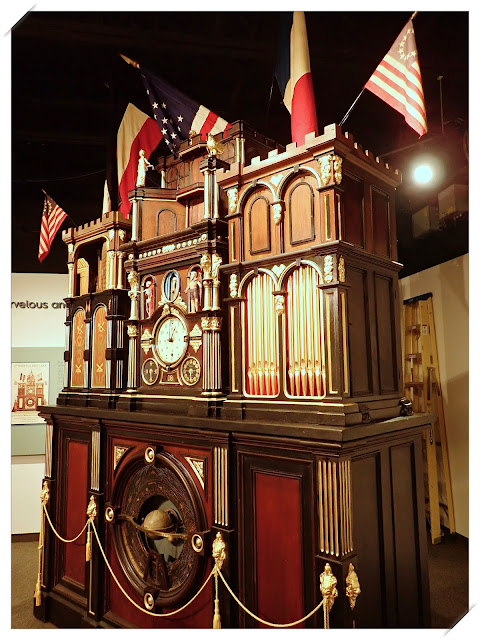
The museum’s most impressive display is the first known American made monumental clock. Built by clock designer Stephen Decatur Engle of Hazleton, PA, the Engle Clock is monumental in size with dimensions of 11 feet high, 8 feet wide, 3 feet deep and weighing 1,049 pounds. Engle completed the clock in 1877 after 20 years of workmanship. It features time-telling, music, and moving carved figures. But timing is everything and unfortunately this creation was finished several months too late for the 1876 Philadelphia Exposition.

The Engle clock indicates the day of the week, current month, and phase of the moon. It has three towers, two organ movements and 48 moving figures that include a unique cast of characters: Jesus Christ, the three Marys from the New Testament, the 12 apostles, Satan, Father Time, Death and a group of Continental soldiers who march past Molly Pitcher on their way to the Battle of Monmouth adds a distinctly American dimension.
This monumental clock toured the Eastern U.S. continuously for 70 years then disappeared after a 1951 showing at the Ohio State Fair. Museum members spent years searching before it was found in 1988 a barn in New York State. The clock's purchase and restoration by NAWCC members and volunteers was funded by donations from member chapters.
The museum includes demonstrations of the clock's mechanisms at two daily showings with a staff member advancing the time settings so visitors are not watching for a full hour. It's nothing short of amazing to see. To see the clock in action, you can check online as museum visitors have included videos on YouTube. The NWCM has one on Vimeo as well.
Here's a rundown of the action: On the hour, the skeletal figure of Death strikes a bone against a skull attached to the column of the clock. At 15, 30, and 45 minutes past the hour, Father Time strikes a bell with a scythe and turns his sandglass as the central figures of Youth, Middle Age, and Old Age revolve in the arch above the clock dial. At 40 minutes past the hour, a parade of Revolutionary soldiers and Molly Pitcher appear in the left tower and a barrel organ plays patriotic tunes. At 55 minutes past the hour, the three Marys come out of the center tower as a procession of apostles takes place accompanied by hymns from the barrel organ in the right tower. The soldier at the top of the central tower maintains a vigil while the clock is running.

Engle, who was more interested in invention than showmanship, turned over management of the clock to Philadelphia entrepreneur Captain Jacob Reid who promoted it as The Eighth Wonder of the World. Reid exhibited the clock throughout the Eastern U.S. charging 25 and 15 cents for adults and children.

The above image shows an advertising clock popular in the 19th century. These were made primarily of wood with spring-wound movements. Product or manufacturer information was painted directly on the dial, case or anywhere it could fit and be seen. The clocks featured three drums covered with advertisements connected to them, which would rotate every 5 minutes when the clock was running showing a total of 9 ads every 15 minutes.  Other companies advertised their products on the front of clocks.


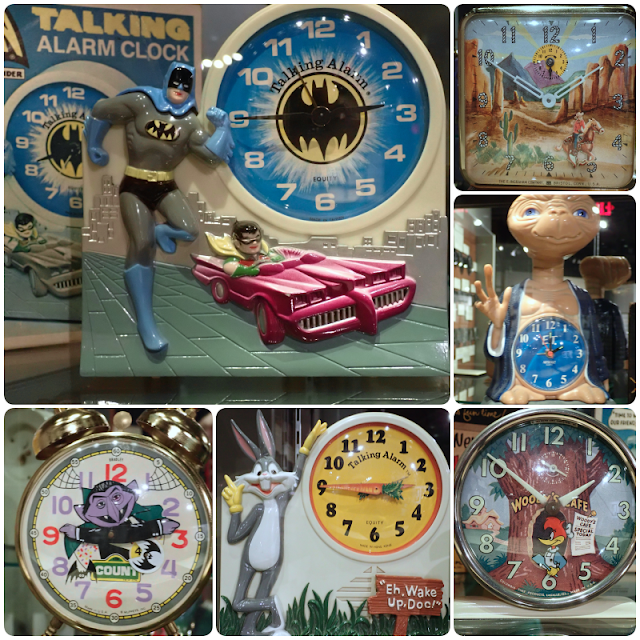

There's a prominent local connection to watchmaking in this part of the state. The museum includes an extensive collection of models, drawings, and time pieces from the Hamilton Watch Company formerly based in Lancaster, PA, and now a part of Swatch.

Hamilton was established in 1892 and many of its timepieces gained fame as The Watch of Railroad Accuracy. While many industries required careful time-keeping, railroad accuracy could be a matter of life and death. In the early days of American railroads, there wasn't a common method of timing so accidents were frequent. As railroads became more popular, tracks became crowded and trains started crashing into one another. If one train was running early and another running late, they could be running on the same track at the same time in opposite directions. The precision of Hamilton pocket watches was reported to have helped this issue. Hamilton's first railroad watch was the model 940, with 21 jewels and about 200,000 were made.

In 1918, as aviation developed, Hamilton watches were used to keep the new coast to coast U.S. Airmail service on time and became synonymous with the world of aviation. In the 1930s, Hamilton was the official watch of the four major American commercial airlines.
In WWI, as an official supplier to the U.S. Armed Forces, Hamilton equipped soldiers with timepieces prompting a shift in production from pocket watches to wristwatches. In 1942, Hamilton halted consumer watch production during WWII. The company produced over a million timepieces from wristwatches to marine chronometers and earned an Army-Navy E award for excellence in manufacturing.

In 1957, Hamilton revolutionized the watch industry with Ventura, the world's first electrical battery operated watch. In 1972, Hamilton Watch marketed the Pulsar Time Computer, marketed as the world’s first digital watch, which was marketing promo as it only told time. It produced only 400 pieces with an 18-carat gold case at a cost $2,100, more than a new Ford Pinto sold for then.
Hamilton was known as the Movie Brand for almost 90 years. Its watches have appeared in over 500 major feature films since 1932. The Hamilton Watch Company ceased operations in 1980.
Another U.S. watch manufacturer predominantly featured in the museum is the Waltham Watch Company, which was based in Waltham, MA, and pioneered the mass production of watches with interchangeable parts.


We learned that there are other horology museums within road trip distances: The American Clock and Watch Museum in Bristol, CT, and the Willard House and Clock Museum in Grafton, MA. Unlike the PA one these are focused solely on American-made timekeepers.
And now this post is definitely almost out of time.
But it's not quite over.

Just wondering about your preference in personal timepieces if you wear a watch. We both wear Timex battery-powered analog watches. This Timex (left) is my daily wear watch. A few pluses: the dial is easily read, there's a built-in light and, after nearly two years, is still powered by the original battery with no charging needed. I was surprised to learn that its current cost is nearly double that of my original purchase price (under $30 to slightly over $50).
The 1950s tag line in Timex commercials was this: "It takes a licking and keeps on ticking" delivered by pioneering TV journalist John Cameron Swayze. The tagline has been replaced in recent years by: "Timex. Life is ticking."


