Showing posts with label estate. Show all posts

Thursday, May 6, 2021

Haunted in Portsmouth

Hotel Portsmouth, NH
They say that what you don't know won't harm scare you. What we didn't know when we stayed in a Portsmouth, NH, lodging recently was that it has been named as one of the state's haunted locations.

This was another in-state New England getaway. As we've (temporarily) run out of area castles to visit, we've downsized architectural styles to former grand homes, many of which offer lodgings. A previous estate stay was Stonehurst Manor, North Conway, NH. As far as we know, it has not been reported to be haunted. 

But this latest stay was a different story. This hotel is in the Lark Hotels chain that's concentrated in New England (ME, NH, VT, MA, RI) with a single location in Carmel, CA. According to the company website: Lark Hotels are intimate getaways. They reveal a sense of place and nostalgia with imagination and a touch of mischief. 

That elevator sign in last week's Friday Funnies was taken during our stay at this former estate, now the Hotel Portsmouth. We thought the sign was humorous, as did others, but it seems the sign may have ghostly undertones not disclosed during our stay. Also, the elevator amenity was unusual as most multi-floor B&Bs and small hotels rarely have one which usually discourages us from staying on upper floors.

Portsmouth, NH, settled in 1623, is just over an hour's drive from Nashua. It's one of the state’s oldest towns and also home to some of its most historic buildings, such as Strawberry Banke, The Rockingham, and The Portsmouth Athenaeum. Quite often, spooky stories become very much associated with places that have been around for hundreds of years. 
Hotel Portsmouth, Court Street, Portsmouth, NH
The 138-year old Hotel Portsmouth is no exception. Built in 1881 by John E. Sise, a wealthy Portsmouth ship merchant and businessman, the estate is a classic example of Victorian architecture in the Queen Anne style.
Woodwork on hallway staircases, Hotel Portsmouth
Chandeliers on ground floor, Hotel Portsmouth
Before 1881, a three-story Federal mansion stood in this location on the south side of Court Street. It was built in 1798 for Charles Treadwell, the last owner was the family of L.E. Marsh. 
John Sise married Lucy Maria Marsh in 1857. They purchased the Marsh family mansion in 1879, which they demolished and replaced it with an elaborate estate. The Sise family included four children. The eldest daughter, Mabel, later owned the house and expanded it after her marriage to the Rev. Alfred Gooding.
John E. Sise residence, circa 1902 (Internet source) looks similar to current hotel
It remained a private residence until the mid-1930s, when the mansion began to be used for business and professional services that included a doctor’s suite of offices, a beauty parlor, a fashion shop, and apartments. In the 1950s, it was used as a half-way house for those afflicted with mental illnesses. 
Side view to show building Hotel Portsmouth expansion over the years
In 1986, it was expanded and, with a nod to its former owners, opened as the Sise Inn with 34 four guest rooms. After nearly 30 years, it was sold in 2013 and, after a six-month renovation with attention to historic details, it reopened as the Hotel Portsmouth with 32 guest rooms. The renovation didn't seem to have eliminated the spirits that frequent its walls according to sources.
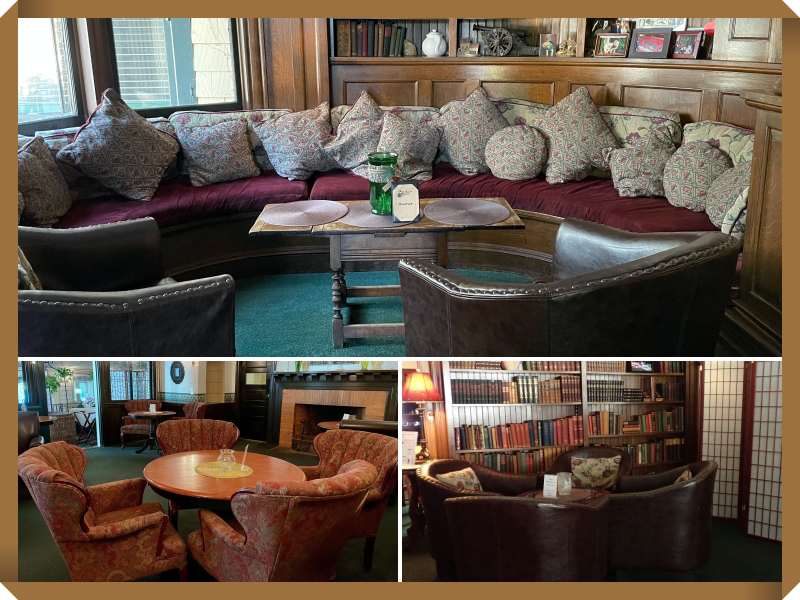
Hotel Portsmouth lounges (we enjoyed pizza & wine by gaslit fireplace on lower left) 
Suite 204 is considered a particular hotspot. Rumor goes that a butler of the home's original owner fell in love with a maid who he killed and then hung himself in the room. There's no factual evidence this ever happened.
Hotel Portsmouth, Room 104
Our 2-night stay didn't result in any unusual occurrences or sightings even when we used the elevator. Our room (104) was on the first floor, and the rear hotel entry is on the ground floor.

We'd read about things that had reportedly happened like items being thrown or moved, elevator doors opening and closing, a rocking chair moving on its own. Some guests were locked out of their room and others said they felt like someone had climbed into bed with them.

Numerous online sites and printed publications, have included the Hotel Portsmouth as one of the states notable haunted places. It should be noted that many reported that any hovering spirits were considered to be more annoying than harmful. Perhaps, we'll meet on a future visit.
Stairway woodwork viewed in hall mirror
This post was not meant to discourage stays at the Hotel Portsmouth, which we enjoyed and would re-book again. The hotel was centrally located within walking distance from downtown Portsmouth, provided free on-site parking (a nice perk as many larger area hotels have a parking fee), and last (but not least), the staff were helpful and friendly. We enjoyed a take-out pizza and wine seated in front of a gas lit fireplace in one of the lounges on the rainy evening of our last night stay. No, we didn't share with any errant spirits. 

In a couple of weeks, we'll stay at another Lark hotel to celebrate a special anniversary. As far as we know, there's been no unusual sightings there. But, who knows what can happen on a getaway adventure?

Monday, March 29, 2021

Time Spent in a Manor

We're fast running out of New England castles to visit. Of course, there are several we hope to visit, including some normally open to the public. But these are not currently open because of you know what precautions. So, it may be a while until we have another castle adventure.

That's why we've switched architectural styles even downsized a bit to visit once grand estates. Some of these have been converted into lodgings, which means an overnight road trip as well.
Our most recent excursion was to North Conway, NH, and a repeat stay at Stonehurst Manor, once the summer estate of carpet magnate Erastus Bigelow. He's the New Englander native credited with the invention of the 
power loom for carpet manufacture (as in Bigelow Carpets). The larger portion of more than 50 patents that Bigelow took out were directly or indirectly connected with textile arts. Today, Erastus Bigelow is widely credited with developing the textile arts and has been dubbed the father of the modern carpet industry.
Erastus Bigelow

Bigelow was born in West Boylston, MA, in 1814. His father was a cotton weaver. His parents wanted him to study medicine, when his father’s business struggled, he discontinued his studies to help in his father’s cotton mill. 

At 14, he invented machinery to manufacture piping cord. Then, at 25, in 1839, Bigelow invented a power-loom capable of weaving two-ply ingrain carpets. These had previously had been woven by a handloom, which only produced eight yards a day. With this first carpet loom he succeeded in obtaining 10 to 12 yards daily, and increased that number by improvements until a product of 25 yards was regularly obtained.

This was significant and changed the way Americans furnished their homes. A carpet weaver could produce 2 yards a day of 2-ply ingrain carpet. Such skilled laborers commanded high wages which meant that woven pile carpets were beyond the reach of most 18th and early 19th-century families before the carpet power loom was invented. Later, as quantity increased, prices lowered, and no longer could only wealthy families afford a parlor carpet.
Illustration of  Bigelow Carpet Company, Clinton, MA
The power loom that Bigelow developed was used to manufacture Brussels and Wilton carpets. Erastus and his brother, Horatio, formed a firm near Lancaster, MA, and founded the Bigelow carpet mills to manufacture the looms and produce Brussels and Wilton carpets. 

These terms were unfamiliar to me and here's what I learned online: Brussels carpet is a type of machine-made floor covering with the loops of the pile uncut. This process is believed to have originated in or near Brussels and became fashionable in the first half of the 19th century. All colors run with the warp, concealed, and are brought above the foundation in loops, as needed, to produce the pattern. Wilton carpets follow a similar process, but are often cut or loop products and different yarn types can be used to produce different surface textures.
Illustration of a carpet power loon: online source
In 1859, the Bigelow's factory village near Lancaster was officially incorporated as a separate town and named Clinton after the DeWitt Clinton Hotel, a favorite NYC hotel of the Bigelow brothers. A year later, U.S. carpet production doubled. The Bigelow Carpet Company became a leading manufacturer of carpeting in the late 19th century. The company made carpets for use in the White House, the U.S. Senate and House, Massachusetts State House, and the Waldorf-Astoria Hotel and St. Patrick's Cathedral in NYC.

Carpets ads appeared in widely available and highly popular consumer magazines. Later, TV commercials touted Bigelow Carpets, like this one from the 1950s. (The laugh track wasn't in the original, but the dated ad seems funny today). The ads below appeared in 1930s and 1940s magazines such as the Saturday Evening Post and the Ladies Home Journal. 

Bigelow carpet ads from the 1930s and 1940s appeared in consumer magazines
The mill complex includes six brick buildings ranging in height from two to five stories.  Shut down in the 1930s, the buildings were either left vacant or used for storage, then in the 1970s,  began to see increased industrial use again. In 1983, the mill was listed on the National Register of Historic Places. In June 2020, a suspicious fire caused damage to the first floor and basement of the large factory. 

Bigelow's NH summer mansion, Stonehurst, was started in 1871 and completed in May 1872. The property included a gatekeeper's cottage, stables, and servants house.Three years later, the original house burned, and was rebuilt in 1877 following the same design. Unfortunately, Bigelow didn't enjoy the residence for many years as he died in 1879, 2 years later.

A manor is defined as an estate belonging to someone from the upper classes or nobility, (think duke or lord) with a large amount of land. The estate house is the manor home. Bigelow wasn't upper class or royalty, so his summer home was more of an estate with a very large mansion.
Vintage Stonehurst Manor photo and swimming pool, snow covered during our visit 
Since 1946, Stonehurst has been an upscale country inn which includes the manor house, a connected motel, privately owned condominiums, and recreational facilities set on 33 acres of secluded pine forest in the White Mountains of NH. 
Main stairway leading to the second and third floors
Drinks are served in the cocktail lounge which has varied seating
The grand manor house has retained much of its historical character largely intact. It includes 19th-century touches like intricate English oak woodwork and traditional light fixtures. Its 26 guest rooms are furnished in period decor as well.
Stonehurst Manor features an eclectic collection of lighting
Fireplace in the lounge area which was our favorite afternoon sitting spot
All rooms have dark wood furnishings and red carpets or hardwood floors, but exact color schemes and fabrics vary by room style. Some rooms have a fireplace, others a jacuzzi, which ours did and Grenville enjoyed during our stay.
Our second floor bedroom had a jacuzzi and small balcony
Admittedly, Stonehurst Manor can be considered dated with its dark brown wood furniture and floral prints. Overall it has a cozy bed-and-breakfast feel. For us, it's a unique and reasonably priced not-to-far getaway and offers full service breakfast and dinner included in the room rates.
There are several dining rooms in the Irish Rose restaurant
Meals are served in the Wild Rose restaurant which is also open to non-hotel guests. Our dinner options included among other choices, freshly made pasta, lobster ravioli, roast duck, seared salmon, trout,  scallops, and prime rib, and included a soup or salad; desserts are extra.
Despite physical alterations over the years, the historic hotel conveys an elegant impression as it did a century ago. It provides a glimpse of upper-class summer architecture and life in late-Victorian America. This was a time when families would travel either to their summer estates or to a grand hotel for the entire season
A snow-covered Mount Washington was visible from the hotel parking lot, it's the highest peak in the Northeastern U.S. As noted earlier, this was a repeat visit for us and this time we stayed on the second vs. the third floor. Befitting its time period, there's no elevator; assistance is provided if needed.