Thursday, April 22, 2021

Once Upon a Bell

City Bell at new City Hall
Once upon a time, the City of Nashua had a bell that sat in the cupola atop City Hall to announce fires, holidays and deaths. (That's the old City Hall as the one to the right is the current or new City Hall, circa 1939.)

But, it's been decades since the bell, aka the City Bell, has been in service to the community. Now, that once prominent bell is relegated to a corner of the current City Hall municipal plaza.

It's a sight I pass constantly when walking on Main Street, and curious about its history, Because it's interesting to learn more about the city we now live in, I decided to learn more (a lot) about it and, of course, to share (because that's what I do).

The City Bell has quite a history dating to the mid-1800s when it was cast by a British foundry. The bell is inscribed as follows: Naylor, Vickers & Co. 1860, Sheffield, No. 1665, E.Riepe’s Pat.
Foundry and patent markings on City Bell, Nashua, NH
The Sheffield, England, steel company of Naylor, Vickers & Co. commonly referred to as Naylor Vickers Co., was known worldwide for cutlery and other steel products. And, it has long been acknowledged for the cast steel bells it produced in the mid to late 19th century.
Naylor Vickers Co advertisement (Internet source)
Brothers-in-law, George Porter Naylor and Edward Vickers formed a partnership in 1853 in Sheffield as steel manufacturers. In 1855, they started producing cast steel bells. The British patent under which the steel bells were produced was taken out by a German contact, Ewald Riepe who found a way of casting steel and excluding air from the melt to avoid loss of carbon. 
Naylor Vickers Sheffield, England steel bell production (Internet source)
An 1860 advertisement for Naylor Vickers Co. described the bells as “having a very pure, melodious sound, peculiar to cast steel; and as the elasticity of this material seems to produce more powerful vibrations, their sound penetrates to a greater distance.” While that may true, many English church goers, used to hearing the sound of bronze or copper bells, did not appreciate the sound and said it sounded like “rusty, tin cans.”
Naylor Vickers Co. catalog (Internet source)

Steel bells had their place. The benefits of steel over bronze was its relative cheapness and comparative lightweight. A 48-inch diameter bronze bell weighed 2,200 pounds compared to a steel bell of the same proportions which would weigh 1,500 pounds and be much less costly.

For more then 40 years, Naylor Vickers Co. produced steel bells weighing between 35 pounds to 7 tons and shipped them to Africa, America, Asia, Australia, and Europe, among other places. Only 204, about 25 percent of the known production, were sent to the U.S. 

Today, many of these bells are located in churches and public places throughout New England, including Holy Cross Catholic Cathedral, Boston, MA (1859) and Faneuil Hall, Boston MA, 72 inch diameter (1866). And, the one in downtown Nashua, NH, weighing 2,414 pounds and 55 inches in diameter.

The exporting of bells began soon after the company started producing the bells helped largely because the company had established a sales office in Boston, MA, before bells were being cast. There were also offices in New York City and Philadelphia, PA. At the time, these were the largest, most important cities in the country. In city directories of 1865 to 1875, the business was described as "iron, steel, and bells."  The bells were exported to North America more as a sideline, and the term "bells" was dropped between 1875 and 1885, possibly because production was declining. 
Old City Hall, Nashua, NH
(Nashua Experience book)

The City of Nashua purchased its bell in 1863 for $827.35 after Issac Eaton, a former chief of the city’s fire company, wrote in a 1861 report that the city needed a bell so firefighters could have a clear signal to alert them of fires. The bell was hung atop old City Hall in late September 1863, three years after being cast. It rang not only to warn of fires, but also commemorated holidays, other events, and the deaths of presidents and prominent locals.

The last time the City Bell was rung at old City Hall was after the announcement of President William McKinley’s assassination in September 1901.

In 1936, after decades of service, it was taken down when the tower housing it was deemed unstable to support its weight. It was thought that removing the bell would extend the building’s life span. That expectation was short-lived. 

By 1939, the city had completed a new City Hall at another Main Street address. The old City Hall was demolished in 1939 along with an adjoining Municipal Records building. The gold eagle atop the original building was relocated to the new building, but the bell was not as fortunate.

When it was taken down, the bell was transported to a gravel pit until citizens complained about the location. It was moved to the city barn on E. Hollis Street. When it was learned that the city had received an offer from a concern that wanted to break it up to sell as old metal, another public outcry ensued and the bell remained in the barn.

In 1939, a new City Hall was built; the old one was demolished in 1940. While the gold eagle atop the original building was relocated to the new building, the City Bell was left behind. It was gifted to the Greek community for use in a local church. The only stipulation was that the church bear the expense of removal and set up at. It hung in the Church of the Annunciation on Ash Street for nearly 30 years until the mid-1970s, when the church merged with another Greek church and moved out. The bell once again was left behind; however, the Fellowship Baptist Church moved into the building, and it was once again used.
City Hall bell relocated to 109 Main Street near site of old City Hall (Internet source)
This bell didn't linger and in 2003 it was on the move again, this time to Court Street, near the present Nashua Public Library. It was outside on display until 2008 when it was transported to Nashua Foundries for restoration thanks to the efforts of a city intern and a hefty $40,000 contribution from a local philanthropist for its restoration.

After restoration, the bell was relocated (again). In 2008, it came full circle and was placed on Main Street at the site of the original City Hall (photo above).
City Hall Plaza, 229 Main Street, Nashua, NH
In 2015, the bell moved to its current location on the current (new) City Hall plaza. Based on its history, it won't come as a surprise to me, if the bell moves again at some future date.
City Bell, Nashua, NH
Plaque at base of City Bell details its history and movement in Nashua, NH
After exposure to New England weather in the 13 years since its restoration, it's badly rusting. Perhaps another local philanthropist will step up with restoration $ sometime in the future.

Friday, April 16, 2021

Friday Funnies

In terms of convenience, this one is most definitely a very BIG inconvenience.
Hopefully, no one was inside using this facility when it toppled over.

UPDATE: Speaking of an inconvenience, the weather is certainly that today—these views were taken at 10 a.m. from the 5th floor of our Nashua, NH apt — springtime in New England.
Mother Nature was a bit late with an April Fools' day surprise, especially for motorists.
 
Glad that so many folks enjoyed the egg yolk funnies last week. I also chuckled at some of the ones added in the comments, thanks everyone for the additional laughs.

Enjoy Your Weekend, Everyone
We're going to a free indoor concert

Thursday, April 15, 2021

Something's Fishy Here

When you say or hear that something's fishy, it can mean that it's something is suspect or shady. And, if you're sitting next to someone eating fish, it could refer to a particular odor.

But . . .
Here, in Nashua, NH, it means something entirely different and instead refers to the Nashua National Fish Hatchery, which we visited on a recent local outing. 
Hatchery Manager Keith

Although it's usually open for tours, this is the time of Covid, and like so many other places, there's no scheduled open hours now. Since I had called ahead, Hatchery Manager Keith (that's his title) who happened to be on-site was able to give us a guided tour. We were all careful to mask-up during the tour. After all, you never know where those fish have been.

In many ways, a hatchery is like a nursery. It's a place to spawn, hatch, and rear fish under controlled supervision to maximize the number and survival rate of offspring. With declining fish populations becoming more prevalent countryside, fish hatchery operations have become more crucial. As human population increases, so do instances of overfishing, poor water quality, waterway blockage, and other obstacles which negatively impact many species. The U.S. Fish and Wildlife Service works to increase endangered fish populations and provide healthier aquatic ecosystems throughout the U.S. by education and increased conservation efforts.

Fish & Wildlife logo
A very brief history, President Ulysses S. Grant is credited with taking government action to conserve the nation's fishery resources. He established the U.S. Fish Commission in 1871, the predecessor of the U.S. Fish and Wildlife Service. 
In 1872, the first Federal fish hatchery, known as the Baird Hatchery, was established in CA (it's no longer in operation). The oldest operating Federal hatchery is the Neosho (MO) National Fish Hatchery (NFH) established in 1888. Today, NFHs located in 35 U.S. states, produce more than 60 different species of fish. Leave those poles home, there's no fishing allowed at any facility.

The Nashua National Fish Hatchery (Nashua NFH) was established in 1898 after land was purchased for this purpose. It's a working part of the Eastern New England Fisheries Resource Complex, one of 11 national fish hatcheries in the Northeast Region, and one of 70 in the National Fish Hatchery System (NFHS) which works to conserve rare imperiled species and common game fish to strengthen ecosystems and economies. It consists of a network of field stations located throughout the U.S. that work with tribal, local and state governments, federal agencies, and even foreign nations to conserve fisheries. 

Salmon incubator
The 
Nashua NFH is a broodstock hatchery. In case you don't know (I didn't either) broodstock are sexually mature adult fish used for breeding or spawning. A broodstock hatchery specializes in raising fish to adulthood, then strips eggs from the females and fertilizes them with sperm (milt) from the males. 

Fertilized eggs are then incubated and monitored throughout early stages where mortality is highest. After the eggs have developed enough for transport, they are either grown out within the Nashua NFH to different stages for stocking or shipped to other hatcheries. Think of it as raising young-uns until they can be on their own, only much sooner, and they're sent away.

For 80 years, the station produced rainbow, brook, and brown trout for stocking state and federally managed waters within New England and trout and salmon eggs for distribution throughout the U.S. In 1978, production shifted to Atlantic salmon for use in the Merrimack River Restoration Program. For many years, the Nashua NFH was a domestic and sea run salmon broodstock facility producing 4 million eggs each year for restoration programs in the Merrimack River Basin in NH and MA, the Pawtucket and Wood Rivers in RI, and NH Coastal Rivers.

Work at the Nashua hatchery supports Atlantic salmon, American shad and other aquatic species as well as restoration efforts in the Merrimack River and several New England rivers. The station provides Atlantic salmon eggs for fry release programs and retired broodstock for Atlantic salmon recreational fisheries.
Atlantic salmon rearing tank at Nashua National Fish Hatchery
Atlantic salmon is a well-known species in New England rivers. The fish are anadromous, which means they spend most of their life span in the Atlantic Ocean, but migrate to freshwater rivers to reproduce. Facilities at the Nashua NFH for raising Atlantic salmon include 20 raceways for fish aged 1 - 4 years, 20 rearing tanks, 13 egg stacks, and an additional egg-incubation room for grow out of the eggs.
Salmon raceways - exterior views
Salmon raceways - interior views
American shad is the largest herring found in North America, growing up to 2 feet long and up to 6 pounds in weight. These fish can be found along the Atlantic coast from Florida all the way to Canada. Like the Atlantic salmon, this fish is also anadromous and migrate from salt water to fresh water to spawn.
American shad indoor tank, Nashua National Fish Hatchery
Shad eggs are obtained from adult shad returning to the Merrimack River, then incubated at the Nashua hatchery. Once they hatch, the juveniles are released into sections of the Merrimack River and other New England rivers. E
quipment for American shad production includes 4 large tanks for adults, 11 circular fry tanks, and 2 large water troughs holding up to 30 egg jars each. The shad buildings run on a recirculating water system with a bio-filter and ultraviolet unit to maintain water quality.
Filtering equipment in rear of buildings, Nashua National Fish Hatchery
Once fish are ready to leave the hatchery, how do they get to where they will be released — after all, they can't just swim away. 
Years ago, fish were transported in milk cans carried by pack horses or in horse-drawn wagons. To ensure their survival, most fish transported this way were stocked in waters close to the hatchery.
Fish do not pose well for a photo opp
By the 1870s, specially designed railroad cars, fish cars (no kidding), transported fish in specialized containers filled with fresh water that had to be changed often, when available. Each fish car carried a crew charged with keeping the fish alive. Fish cars enabled shipping live fish  cross country. Fish were transported from Midwest hatcheries to locations along the Pacific coast. 
Early fish car interior

The first trip was in 1874 when Dr. Livingston Stone of the U.S. Fish Commission (forerunner of the U.S. Fish and Wildlife Service), tended 35,000 shad fish fry. His task was to get them safely to California for deposit in the Sacramento River and other Pacific coastal streams. 

Fish were carried in open milk cans and Stone changed water every 2 hours, when possible. After days of round-the-clock care, most shad fry arrived safely. As a result, a new species was established on the West Coast for sportfishing and commercial fishermen.

Today, modern and sophisticated equipment makes transporting fish much easier. Modern tank trucks transport over 200 million fish (some 48 species) annually from over 90 Fish and Wildlife Service hatcheries to stock many rivers, lakes, and coastal waters nationwide. They are transported in carried in cooled, oxygen-aerated, constantly circulated and cleansed water. The science of fish transportation is so highly developed that most fish arrive safely.
Partial view of fish transport truck at Nashua National Fish Hatchery
At the Nashua NFH, trucks equipped with water tanks and aeration systems are used for fish transport. After arrival at their destination, fish are removed by opening a valve and draining them via a flexible hose from tanks into the water. 

It doesn't happen here, but in remote parts of the U.S., helicopters and planes are used to stock fish. And, the USPS or private carriers have been used to ship fish in specialized boxes. Other times, it's done the old-fashioned way with horses transporting fish to remote lakes and streams.

Overall, this was a fascinating visit to a much under-visited facility, according to Hatchery Manager Keith. There were no other curious folks pulling into the parking area the day of our visit. But, since many other public places (City Hall, bank lobbies) remain closed to visitors, folks may naturally (and correctly) figure the same is true here. Hopefully, that will change as this was a very interesting and Free local excursion. It was a great good learning experience for myself. Grenville has a degree in marine biology and may pursue volunteering when the you-know-what allows such opportunities to resume. 
Fish young-uns at the Nashua fish hatchery

Friday, April 9, 2021

Friday Funnies

As you may know from previous blog posts, we're fond of egg coloring fun at Easter time. 
Last weekend's holiday was no exception. Here's some colorful results.

While wondering if colored eggs could express themselves, this ↓ happened. 
Here's some eggs-ample puns that might crack you up:

Why was the egg upset at school?
It failed an eggs-am

What's a chicken's favorite drink?
An eggs-presso

How did the hen get to work fast?
She took the eggs-press lane

What did the hen say to her chick?
Don't egg-nore me

Why did the egg fail a driving test?
It egg-celerated too much

What do you call an egg on safari?
An eggs-plorer

What does Mr. Egg say every day?
Have an eggs-tra special day

How do chickens stay fit?
By eggs-ercising

How did the chicken feel after a long walk?
Eggs-hausted

How does a hen leave the coop?
Through the eggs-it

Enjoy Your weekend, Everyone.
Be careful around egg whites — they can't take a yolk

Wednesday, April 7, 2021

Giggles Galore

That's the best way to describe how things went this past Easter weekend for a first (and long-awaited) family get together with the grandchildren and their mom. We'd been vaccinated over 2 weeks prior to our weekend reunion.
As expected and long-anticipated by us, there was the usual holiday event of egg coloring. While it had been a couple of years since we had last done this activity with both grands, they willingly obliged and joined in again. By way of a video visit, youngest granddaughter joined in as she and her mom colored eggs in PA.
Both grandkids have really grown since we last saw them in 2019, which seems such a long time ago, 16 months to be exact. Both have been distance learning at home for nearly a year and expect to return to classroom learning by this fall — he in 9th grade and she in 5th.
Because the outside weather, while sunny, was unseasonable chilly (this is New England), there were several hours spent playing indoor board games, including the above chess game between grandson and grandpa, which grandson won.
A photo request resulted in a series of very happy faces and showed how glad everyone was to see one another again.
Although we were not able to visit with other family members, these photos were sent. The top photos show youngest granddaughter. Not one, but two Easter bunnies visited my brother's NJ home to the delight of his granddaughter our great niece. Wearing her holiday finery, she posed with her grandparents. My brother also celebrated an Easter birthday.

We hope that your holidays had happy family moments. Hopefully, this was the just the first of more travels this year as it becomes easier and, of course, safer.

Sunday, April 4, 2021

Happy Spring Holidays to All

 Happy Easter or Happy Pesach to all who celebrate either holiday.
Our Best Wishes to ALL for a Happy 2021 Springtime
Happy Birthday today to my "baby" brother, Anthony, on his 69th 🎂
It's been over a year and half since we've visited our home state of NJ, where my brother lives. We hope to go there this spring for a face-to-face belated reunion. Enjoy your celebrations. (comments off today).
Beatrice & Grenville

Saturday, April 3, 2021

We Are Eggs-ilarated

Because today we're on our way for a weekend visit with the grands and their mom for the first family visit in a while. We're fully vaccinated and so ready for a face-to-face visit — an event long overdue for many.

Naturally, there will be sweet treats like chocolate rabbits, jellybeans, and marshmallow chicks. But, a long-time favorite holiday activity this Saturday afternoon will be coloring eggs.
Egg coloring is a long-standing holiday tradition in this family, maybe it's the same in yours as well. Grandson, now 14, was a toddler when he started with mom and grandpa.
Grandpa is a big fan of egg coloring, but more so he enjoys the results afterwards. He was very keen to show how to peel an egg and then cover it with mayonnaise.
When she was about the same age the tradition continued with his sister. Again, grandpa was there to help out. As you can see, she enjoyed some holiday chocolate.
In years past, we all donned bunny ears because grandchildren can't have all the fun.
However, wherever, and with whomever everyone is be spending this holiday weekend, we hope it's joyful in as many ways as possible. We all need more happiness; this will be ours.

Thursday, April 1, 2021

Ziplines Go Way Back

Today is April 1, traditionally a day wherein jokesters have a field day playing pranks on many unsuspecting others. However, this post doesn't fit that category. It's no joke, but a factual and tale that's part of history in Nashua, NH.

If you think ziplines are relatively new, you'd be mistaken. The fact is that they have been around for hundreds of years. In mountainous or jungle areas they were used as a way of transport and of sending supplies from place to place. Those in remote areas liked them as they were easier to build and quicker to use then bridges.

We can remember Johnny Weissmuller swinging through jungle treetops in a dozen Tarzan films from the 1930s and 1940s. How about you? 

Despite their long history, modern zipline courses only started in the 1970s. Seventeen years ago, the U.S. had about 10 commercial zipline compared to over 400 now and today, 72 countries boast commercial zipline courses.

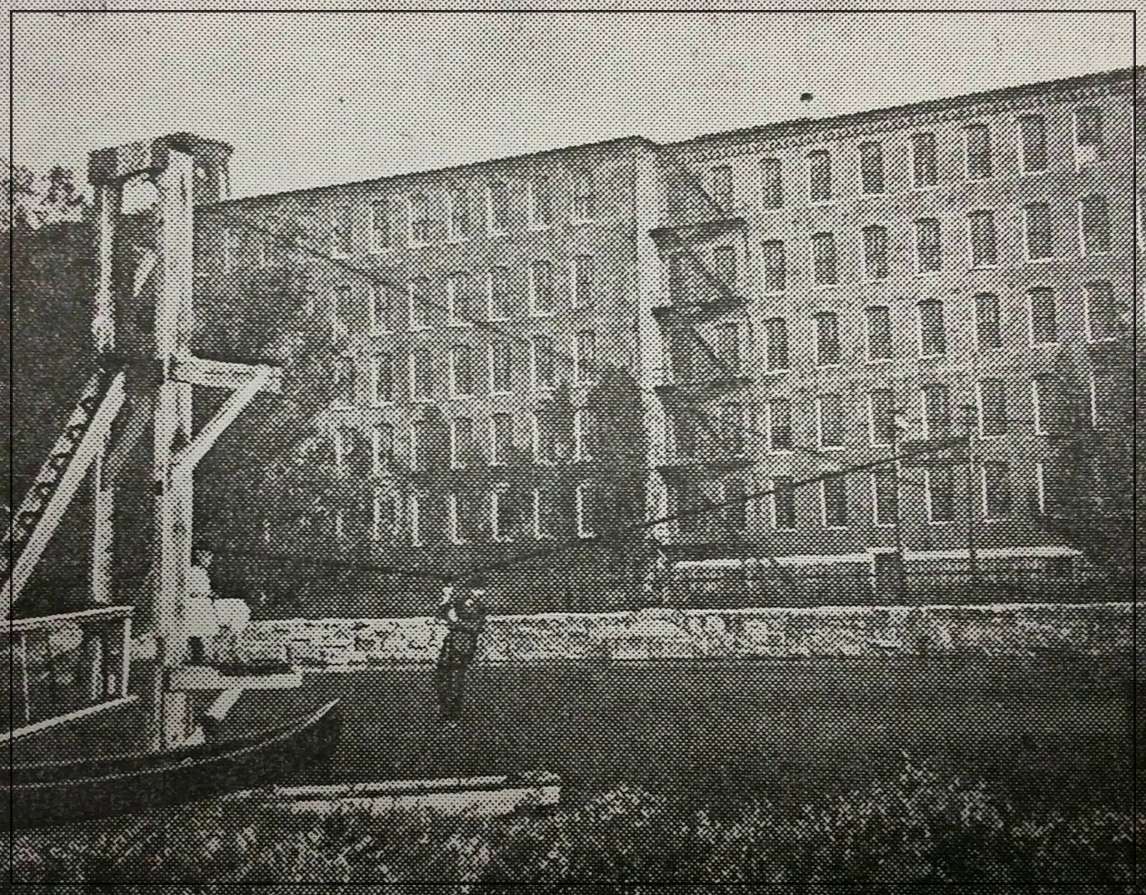
Here in Nashua, NH, as far back as 1888 some folks were actually ziplining  on what was called an aerial trolley. 

There was only one in the city and it operated for 20 years from 1888 to 1908 within the mill yard area of the Nashua Manufacturing Company (NMC). It was privately owned and used for transport to and from work at the mill, which is now the Clocktower Apartments, where we live. 

My interest began a couple of weeks ago after seeing this vintage photo of that aerial trolley in The Downtowner, a local online publication. The information that was included with the photo is shown below but did not provide much information.
As recently as 1908, folks used an aerial trolley, basically the precursor to a zipline, to cross the Nashua River at the Cotton Mill. They built the existing Cotton Mill Transfer Bridge on this site in 1910. Can you imagine doing this back in the day – in turn of the century attire.
The photo shows someone going from a point of origin (most likely on Front St) to the large brick NMC mill building. So many questions went unanswered, including who built the trolley, who used it, how long was it used, and finally what happened to it? 

Despite countless online searches, a call to the local historical society, and a library visit, there was no info to be found on this device. However, its owners could be traced, which is how I learned about the ownership of this one-of-a-kind transport, as well as its demise. My source documents were online copies of information from two local papers, Nashua Daily Telegraph (1869-1904), Nashua Telegraph (1901-1952), also statewide NH newspapers, Ancestry (library edition) and census records. All of these could be accessed on the Nashua Public Library website and were available to any library user. 

Here is the rest of the story — as much as I could learn. 
The Nashua aerial trolley had 4 owners in its 20-year history (all males) who lived in the same general neighborhood. Three of these men, under the age of 30, worked at the NMC textile mill and used the trolley to cross the Nashua River from Front St to their mill jobs; one may have rented out its use to mill workers. 
Photo from Nashua Public Library shows NMC and homes along Front St.
Years ago, Front St. which is directly across the river from the former NMC was a residential neighborhood. Many of the residences, as partially shown in this undated photo, were either owned or rented by NMC mill workers.
Parking lot industrial buildings along Front St today
Today, all that residential area is long gone and the land is taken up by buildings, parking lots, and apt buildings as shown in this recent photo. Only the Nashua River remains unchanged.

Who started the aerial trolley?
In 1888, George Wells, 28, and Woodman F. Davenport, 30,  wanted to shorten their work route to the mill and avoid a longer and roundabout way across the old Main St bridge. According to the 1900 census, Wells and Davenport were both machinists. Wells lived at 30 Front St and Davenport lived a block over on Franklin St. and they got permission to build the aerial trolley. It consisted of a two-line system going from a Front St location to the mill and vice versa. There was no information on who granted permission, who built it, or how it was built.

Trolley ownership transfers twice
It's unclear how long Wells and Davenport owned the trolley before selling it to the Rev. Issac D. Colburn who lived at 12 Front St. He didn't work at the mills and it's probable that he rented the trolley for use by mill workers. Again, no specifics or dates could be located.

Then, in 1898, Jewell Wallace, 29, who lived at 40 Front St ,and a neighbor of Wells, Davenport and Colburn purchased the rights to the trolley. In the 1900 census, his occupation was listed as a machinist in the mill cloth room. Wallace was to be the final owner as both he and the trolley would met their demise. 

Here's where the story ends . . .
Wallace had advanced to become head man in the sample cloth department by 1908. On the weekend of Aug 8, he was working late to prepare for a major sample auction set for Aug 10-12 in NYC. According to a Nashua Telegraph account, 1907 and into 1908 found numerous NH textile plants in Lowell, Lawrence, Manchester and Nashua either shut down or on short time schedules due to lack of orders. Mill warehouses were full of material. Workers at those mills, like Wallace, were preparing sample cards to show buyers the quality of cloth goods produced at the mill in anticipation of sales. 

On Saturday, Aug 8, 1908, Wallace again rode the trolley across the river to work after telling his wife, Minnie, that he expected to work late. When he failed to return home for dinner, Minnie, who could hear the mill machinery running until late at night, didn't worry about his no-show. But early Sunday morning when her husband still wasn't home, she became alarmed, went to the home of neighbors (George Peno and William Senecal) and asked them to look for her husband. 

After checking, they found that the cable was broken and the trolley seat and its passenger were missing. (According to another article, it was Mrs. Wallace who went to the river bank and found the broken cable.) Finding the broken cable led to the prevailing theory that the 30 lb. trolley had struck Wallace in the head causing him to fall into the river. 

Police were notified and the river was dragged with grappling irons for hours with no results. Then, a party of canoeists found Wallace's cap caught in a bush. Shortly afterwards, a fellow mill worker hoisted the trolley up on a grappling hook. Shortly afterwards, Wallace's body was found in 8 feet of water, some 20 feet from the shore and about 10 feet down river from where the trolley had been located.
Headline in Nashua Telegraph on Monday, August 10, 1908
The medical examiner, who stated that Wallace's death was due to a blow to the head, later listed drowning as the cause of death on his death certificate. He was 39 years old.

Gravesite of Jewell Wallace & Family
The NYC sample sale auction was held as scheduled. It was declared to be a huge success and was said to have made the name Nashua synonymous with household blankets. Some 700 buyers purchased the entire accumulation of blankets and flannels at prices better than the NMC had expected. 

Unfortunately, Wallace never knew about this success which was due, in large part, to the efforts of he and his fellow mill workers. He and members of his family are buried in Woodlawn Cemetery in Nashua, NH. As the headstone reveals, the family suffered earlier tragedies with 3 children dying very young, a common occurrence in that century.

After his death, the trolley was never replaced. Instead, the Cotton transfer Bridge was built in 1910 as a safer travel alternative. It is one of the oldest riveted single span high Pratt truss bridges remaining in NH. (Designed by Thomas and Caleb Pratt, a Pratt truss includes vertical members and diagonals that slope down towards the center of the bridge.) It was used to transfer 500 lb cotton bales and also served as a foot bridge.
Cotton Transfer Bridge across Nashua River, NH
This view shows the bridge today as it straddles the Nashua River between Clocktower Apts (formerly the NMC) and Cotton Mill Apts.
The bridge is no longer covered or used for materials transport. It's primarily a foot bridge accessed from stairs on both sides and offers an alternative to way to cross the Nashua River instead of using the Main St bridge.
Main St bridge across Nashua River
I found this story a fascinating part of Nashua's history despite its tragic ending. In the end, there were many more questions than answers found. For now, the local history room of the Nashua Public Library remains closed. However, when it reopens, I will check its resources to see if more information can be found. If so, an update will be the topic of a future blog post.

That said, there's still a wealth of information available online through the library's resources. And, despite not finding much on this topic, looking at newspapers from the previous century was quite fascinating. Future posts may include some local topics or advertisements in local newspapers from the 1800 and 1900s.