Last weekend was perfect weather for a road trip, so we took a 90-minute drive from Nashua to Wolfeboro, NH, known as The Oldest Summer Resort in America.
Incorporated in 1770, Wolfeboro stakes this claim based on an early mansion (Kingswood) built by Governor John Wentworth on what eventually became Lake Wentworth, just east of Lake Winnipesaukee. Kingswood was the first summer country estate in northern New England. Later, the town became a popular summer destination for families from Boston and southern NH. In recent years, the rich and famous including Prince Rainier and the late Princess Grace of Monaco, Kurt Vonnegut, Drew Barrymore, Mitt Romney, Jay Leno and Jimmy Fallon have vacationed or lived in Wolfeboro.
Wolfeboro is situated on the shores of Lake Winnipesaukee (beautiful water in a high place) the largest lake in NH and the third largest in New England, trailing Lake Champlain and Moosehead Lake, and covering over 71 square miles with 260 islands.
Main Street is a cross between a beach town and an arts colony with a myriad of galleries, clothing stores, gift shops and (best of all) several ice-cream stores (after all, it's a resort town). The town hall shown above is quite impressive. We rode Molly, the downtown trolley and enjoyed pumpkin and apple crisp ice cream. (Yes, it was good.)
Besides having several good ice cream places, Wolfeboro's greater claim to fame is being home to three NH museums: The Wright Museum of World War II, the New Hampshire Boat Museum, and the Libby Museum — We went to all three during our visit.
The Wright World War II Museum in Wolfeboro, NH, is named after its founder, David Wright. The son of a World War II veteran, Wright experienced WWII on the home front growing up near Worcester, MA, and later served as a U.S. Marine during the Korean War.
For many years, Wright was an avid collector of WWII vintage vehicles. He owned and restored over 50 fully operational vehicles. In 1983, he established the E. Stanley Wright Museum Foundation, Inc. in Shrewsbury, MA. Originally, this museum was a mobile exhibition that Wright made available to communities around the Northeast for parades and military functions.
While his vehicle collection was impressive, Wright believed it was important to tell the story of how World War II-era Americans contributed to the war effort. He wanted to create a public awareness and appreciation of contributions on the home front and the battle fields. Their commitment played a crucial role in the Allied victory.
In 1992, Wright purchased an 8-acre former sawmill site, adjacent to Wolfeboro’s Smith River and began construction. The museum opened to visitors in mid-July 1994. Some 300,000 people have visited the museum since then. Many, like ourselves, were drawn by seeing the M3A1 Stuart tank that protrudes from the building’s facade. (We knew about the tank beforehand, but it's still quite striking.)
Grenville and I are part of the Baby Boomers Generation. However, our late parents were included in the Greatest Generation who experienced the war years firsthand. I don't recall my parents talking about those years. For me, the museum's exhibits and artifacts provided some insights on what life was like during those years.
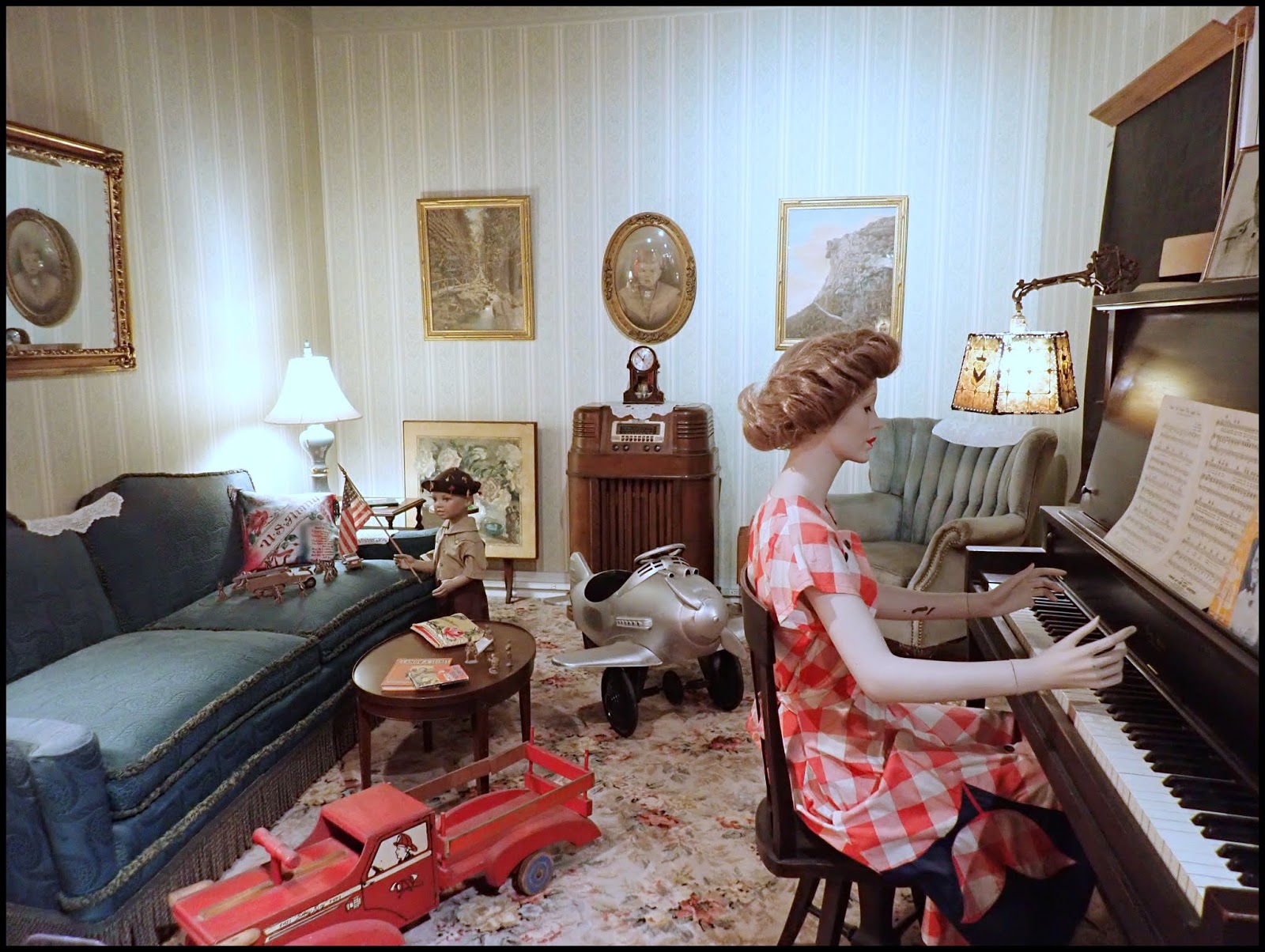
I found the museum’s main room to be the most interesting. Here several tableaus were set up with models to represent scenes of American life during the WWII years.
Museum exhibits in the designated “Time Tunnel” cover the war years of 1939-1945 in a series of connected rooms, labeled by years. Artifacts in these rooms include items relevant to that year, including what was popular in movies and music, the cost of household items, and popular posters and ads of that year.
This display of vintage cameras interested me. I inherited the Kodak Tourist model camera from my late parents and can remember using it on a 6th grade class field trip. It's here in NH and includes the original leather case. It takes 120 roll film, so it's no longer used.
During World War II, Victory Gardens, also called "war gardens" or "food gardens for defense," were planted both at private residences and on public land to help prevent a food shortage and to reduce demands on the public food supply due to the war effort.
There’s a separate display area dedicated to many of the WWII vehicles in Wright's collection, including tanks, Jeeps, motorcycles and engines.
Through its extensive collections, the Wright Museum has built a reputation as a national repository for historically significant WWII items with over 14,000 items in the collection.
In addition, the 20,000 square foot museum offers many educational programs, conducts school tours, and hosts special traveling exhibits relating to the war years. It does all of this things during its seasonal operating season from May 1 to October 31. Admission fees range from free (children 4 and under) to $10 for adults and $8 for seniors and military. If you're in the Wolfeboro, NH, area don’t pass up the chance to visit this museum.
 The New Hampshire Boat Museum was founded in 1992 by a group of antique and classic boating enthusiasts. The purpose was to celebrate and preserve the history of wooden boats and boating heritage on the waterways of NH.
Originally called “The New Hampshire Antique and Classic Boat Museum” the museum changed names to reflect its mission. After moving to different locations around Lake Winnipesaukee, it found a permanent home in Wolfeboro in 2000. Today, it’s housed in what was formerly the Allen “A” Resort theater and dance hall, a large, barrel-round, Quonset hut style building built in the late 1940s.
All the displays are exhibited on a single floor. As a non-boater, what impressed me about these boats was the workmanship and beauty of all the woodwork. Many boats looked more like fine furniture than something that went in the water.
Several boats had quite unusual designs as shown in these examples.
And where there are boats, there's also motors and many vintage ones were on display, including ones by Evinrude and Johnson.
For those interested in fast boats, there's a couple of hydroplanes. A hydroplane, also called a thunderboat, is a super fast motorboat. The hull design is such that at fast speeds, the weight of the boat is supported by planing forces, rather than buoyancy.
The boat below is a 1929 Chris-Craft Closed-Cabin Limousine Sedan, one of only a few still around. Its original $5,850 cost would equal almost $82,000 today. Purchased in 1984, it was restored by a NH resident who used it as an island commuter at a Lake Sunapee summer home.
The Old Boat Shop exhibit displayed materials and equipment related to the boat repair, building, and maintenance.
Several display cases housed models of boats that operated on Lake Winnipesaukee. The Lady of the Lake was severely damaged in a fire in November 1867 while berthed in Wolfeboro. The fire caused severe damage and burned the vessel down to the waterline, it was completely rebuilt in 1872 and retired in 1893.

The original Mount Washington paddle steamer dates to 1877. It was the largest steamer operating on the lake and was built by the Boston and Maine Railroad Company to transport cargo and passengers around the lake, By the late 19th century, it transported over 60,000 passengers a season. In the 1920s, it operated as a tourist attraction, and burned in 1939 after a fire started at a nearby railway station and spread to the dock.
The museum is open seasonally from May to Columbus Day weekend in October. Admission is free for children 13 and under to $9 for adults, $7 for seniors and older students.
 The Libby Museum, the oldest natural history museum in NH, was built by NH resident Dr. Henry Forrest Libby to reflect his love of the natural world.
Dr. Libby was an inventor, dentist, sculptor, author, historian, naturalist, scientist, and a NH State Representative.
The museum’s display cases are modeled after 16th century German Wunderkammer (curiosity cabinets). A unique exhibit feature is the descriptive plaques of white gypsum, hand-penciled by Dr. and Mrs. Libby. Dr. Libby created this material after seeing a need for natural history mountings that would not shrink, crack or discolor.
Henry F. Libby was born in 1850 in Tuftonborough, NH. His early years consisted of hunting, fishing, and collecting local flora and fauna. He attended local public schools and at age 19, went to Boston, MA, to apprentice as a dentist. In 1875, he married Hattie Horne, a Latin teacher. They lived in Boston for 20 years where Dr. Libby practiced dentistry and earned an honorary degree from Harvard University.
In 1897, Dr. Libby returned to the Lakes Region to pursue his interests in the natural world. He started turning his collected specimens into exhibits and, in 1908, started building a museum to house his collections and those of others. Exhibits are from surrounding local areas and from other countries, including Africa and Asia.
Dr. and Mrs. Libby placed a twin flower symbol (linnaea borealis) on all their exhibits and this symbol can be seen on many of the display cases. This label designated items from their personal collection and their commitment to each another.
The Libby Museum opened to the public in the summer of 1912. Dr. Libby retired to a home near from the museum and died in 1933. The museum and surrounding lands were bequeathed to his family with the stipulation that the museum be opened to visitors each summer. In the 1950s, when the family could no longer manage it, the museum was given to the Town of Wolfeboro which still oversees its operation.
Despite living in NH for nearly 4 years, this is the closest we've come to seeing a full-size moose and we're OK with that. The Libby Museum is opened seasonally from June through Columbus Day, closed Mondays and is one of the best values we found; free to all aged 16 and under and veterans; all others pay a $5 admission, donations gratefully accepted.