Last fall we were part of a group that traveled abroad on a Shades of Ireland tour, focused on that country. However, extras included a 3-day pre-extension to London and/or a 3-day post-extension to Edinburgh. We booked London, Ireland, and Edinburgh and saw as much as possible. This post focuses on one of the most visited sights in London.
As anyone who has visited London knows, 3-days here is not enough. We were a small group (7) and attempted to see a few highlights, including the formidable Tower of London, a royal fortress and London landmark, that's an imposing structure even when seen from a distance. This complex of several buildings is set within two concentric rings of defensive walls and a former moat. It's situated on the North bank of the River Thames on the border with the central City of London. Touring the Tower of London was included as a self-guided tour on our London pre-extension option. Upon submitting our entry voucher, we received the above map. This large complex of buildings is spread over 18 acres. We explored as much as possible on a rain-free morning learning that the buildings and grounds historically served as a royal palace, political prison, place of execution, arsenal, royal mint, exotic animal menagerie and a public records office.
 |
William the Conqueror
National Portrait Gallery |
Following his 1066 coronation as the first Norman king of England, William the Conqueror, Duke of Normandy, built the White Tower as a demonstration of power after invading England and defeating Harold, the last Saxon king of England, at the Battle of Hastings.
The tower was sited strategically on the River Thames as a fortress and gateway to the capital. It was quite unlike anything before in England. It was built to awe, subdue and terrify Londoners and to deter foreign invaders. Over 1,000 years later, the Tower still amazes those who visit, including ourselves. (Entry to the tower is by a steep set of steps along an outer wall. We did not go in; it was late in the day, we were tired from walking the grounds.)
The central keep, better known as the White Tower was begun around 1078 and built of white limestone from Caen, France, from which it derives its name, and a local building material, Kentish ragstone.
A keep was built by European nobility within castles as a fortified tower during the Middle Ages. It was used as a refuge or last resort if the castle was overtaken.
 |
| The White Tower is the most famous castle keep in the world |
It was designed by Gundulf of Rochester, a Norman bishop. Masons from Normandy brought stone, most of the actual labor was done by local Englishmen. It took 20 years to build. William I didn't live to see it completed; it was first used by his son, William II.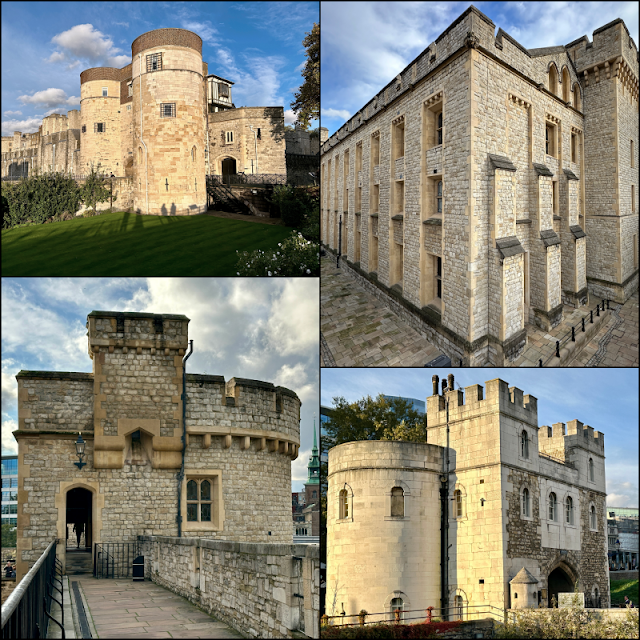 |
| Structures within the Tower of London complex |
The Tower of London encompasses more than the White Tower, which is the core of this fortress. The walls of the White Tower are up to 14-feet thick in places. It has three floors, each connected by a spiral staircase located in one of the four corner turrets. During the 12th and 13th centuries, when fortifications were extended beyond the city wall, the White Tower became the core of a series of concentric defenses enclosing an inner and an outer curtain. The inner curtain at the Tower of London has 13 towers surrounding the White Tower. Best known are Bloody Tower, Beauchamp Tower and Wakefield Tower. The outer curtain was surrounded by a moat, originally fed by the River Thames but drained since 1843. The wall outside the moat has openings for cannons; next to them, modern artillery pieces are fired ceremonially on state occasions.
The curtain, a feature common to most medieval castles, was a set of walls that surrounded and protected the interior. Walls were often connected by a series of towers adding strength and providing better defense of the ground outside the castle.
As the most secure castle in England, the Tower guarded royal possessions and even the royal family in times of war and rebellion. For 500 years, monarchs used the Tower as a luxurious palace. Kings and queens imprisoned rivals and enemies within its walls. Stories of prisoners are still said to haunt the Tower.  |
| Entry to Traitors gate from River Thames |
The whole complex of buildings covers 18 acres. The only entrance from the land is at the Southwest corner, from the City. When the River Thames was still a major highway of London, a 13th-century watergate, Traitors’ Gate was in use. Prisoners were brought through it to the Tower, which was used as a state prison. A political prisoner conveyed through the gate awaited either a long period of incarceration or a usually public spectacle of execution.
The site became notorious as a site of torture, but records show that few people were tortured there; executions, however, were different and more common at the Tower of London. Prisoners were executed on Tower Green or, outside the castle, in public on Tower Hill, by means of beheading, firing squad or hanging. Initially not intended as a prison, the Tower of London housed those accused of treason or religious infractions. It witnessed 22 executions, the last in 1941.
 |
Princes Edward & Richard by John Everett Millais, 1878 |
In 1483, Princes Edward and Richard, 12 and 10, sons of the late Edward IV, were last seen in the tower before their disappearance and suspected murder by their uncle, Richard III, who claimed the throne. In 1674, two skeletons were unearthed. The bones were re-examined in 1933 and proved to be those of boys the same ages as the princes when they disappeared.
 |
| Thomas More, Guy Fawkes, Catherine Howard, Ann Bolyen were all executed |
In 1535, writer and statesman Sir Thomas More was beheaded after refusing to recognize King Henry VIII as the head of the Church of England. A year later, Henry VIII ordered the beheading of his wife, Anne Boleyn and in 1542, he had his fifth wife, Catherine Howard, executed at the Tower of London. In 1554, Lady Jane Grey and her husband, Lord Guildford Dudley were beheaded on Tower Hill. Political prisoner Guy Fawkes was executed in 1606 after found guilty of guarding explosives and gunpowder in a 1605 plot to blow up Parliament,
German spies (11) were executed at the Tower of London during WW I when London underwent numerous attacks, only one bomb was dropped on the Tower and landed in the moat. The facility didn't fare as well during WW II suffering significant damage during multiple bombings, including the destruction of several buildings. It was later restored for public access.
 |
| Yeoman Warder who provided us with much historical background |
Since 1485, security at the Tower of London complex has been maintained by a special order of guards called Yeomen Warders, originally part of Yeomen of the Guard, the monarch’s personal bodyguard. They are informally known as Beefeaters, a name allegedly based after a 17th century Italian nobleman commented they were given a large daily ration of beef. Recognized worldwide as symbols of the Tower of London, the Yeoman Warders were originally part of the Yeomen of the Guard, the monarch’s personal bodyguards who travelled with him. Henry VIII (1507-47) decreed that some would stay and guard the Tower permanently. Today, the group of over 30 men and women are all drawn from the British military and each must have at least 22 years of active service.
Yeomen Warders provide free guided tours within the Tower of London and carry out ceremonial duties, which include the oldest military ritual, Ceremony of the Keys, the nightly gate locking at the Tower for over 700 years. Red state dress uniforms are worn for special occasions and special events, such as Gun Salutes and the firing of the huge cannon on the Wharf.
 |
| Fusiliers Museum was originally used to house officers |
The armories that now occupy the White Tower, as well as a later 17th-century brick building alongside, house arms and armor from the early Middle Ages to modern times. Arms and armor were made, tested and stored here until the 1800s. The Fusiliers Museum is housed in a building originally built as officers' quarters. The building still houses the Royal Regiment of Fusiliers' Regimental Headquarters and the Officers' Mess, used for formal dinners and ceremonial occasions.
The Tower once controlled the supply of the nation’s money and produced England's coins for five centuries. All coins of the realm were made at the Tower Mint from the reign of Edward I until 1810. Initially handcrafted, the mint introduced modern coin-making techniques and eventually relocated to a purpose-built facility in the 1800s.
 |
Top: Imperial State Crown (1937, Sovereign's Sceptre with Cross (1661), Bottom: St Edward's Crown (1661) Queen Elizabeth's Crown & Koh-i-Noor diamond (1937) |
Kings and queens used the Tower to safeguard themselves, their valuables and their jewels. Today, the crown jewels comprising more than 100 objects and over 23,000 gemstones worth over $30 billion are among the most popular attractions.
 |
| Line-up of people waiting to see the Crown Jewels |
Housed in the Waterloo Barracks they include the platinum crown of the late Queen Mother (Elizabeth) set with the 106-carat Koh-i-Noor diamond in 1937, and the Imperial State Crown, worn by the monarch at the State Opening of Parliament. These jewels are kept under armed guard; no photographs are permitted. (The photos above are from the Historic Royal Palaces website.)A flock of ravens are permanent Tower residents and are cared for by the Yeoman Warder or Ravenmaster. The highly intelligent birds have a flight feather trimmed to deter them from flying off. Free to roam within during daytime hours (as shown in the photo) and are caged overnight.
According to legend, the tower and the monarchy will fall if ravens ever leave the fortress. The raven-keeping tradition dates to King Charles II (1660-1685), the first monarch to insist that the birds be protected. When the royal astronomer complained that ravens were leaving droppings on his telescope, King Charles moved the Royal Observatory to Greenwich.
 |
| Statues of animals once in the Tower of London complex and remains of the moat |
For over 600 years, the Tower of London was home to an exotic collection of wild animals that had been received as royal gifts. In 1230, King Henry III had lions, elephants and a polar bear in his collection. In the mid-1830’s, the animals were relocated to a new home, now known as London Zoo, by the Duke of Wellington.
As protector of the Crown Jewels, home of the Yeomen Warders and its legendary guardians, the ravens, the Tower of London attracts over 3 million visitors annually. Designated as a UNESCO World Heritage Site in 1988, it is an exceptional example of a medieval structure, remarkably intact that retains its historical significance. When gates are locked and visitors have left, it embraces a thriving community within as home to the Yeomen Warders and their families, the Resident Governor and a garrison of soldiers. There is also a doctor, chaplain and, of course, a pub (after all this is the UK).
The Tower of London is owned by The Crown Estate, which belongs to His Majesty The King in ‘the right of the Crown’ by virtue of being the reigning monarch. It is not the private property of the crown, and therefore cannot be sold.
This is not a final post about our UK travels from late 2023. We experienced so many new-to-us adventures. I hope you will travel along as more highlights are shared in future posts.


